Showing posts with label superheroes. Show all posts

Friday, October 30, 2015

The Pilot Episode of Supergirl: A Review

I hadn't originally intended on watching the pilot episode of Supergirl starring Melissa Benoist in the title role, but it was online, it was free, so I figured, what the heck. I didn't expect to like it all that much, but I was curious how CBS was going to adapt decades of Superman and Supergirl canon. My reaction is mixed.

I've read a few of the other reviews of the pilot, both before and after I saw the episode, and they range from "good but not perfect" to "triumph for everyone wanting a strong female hero for a change". You can see examples at Yahoo News, IGN, The Mary Sue, and The Los Angeles Times.

The episode started out with a summary of how Kara Zor-El came to Earth. Launched from a doomed Krypton just minutes after her infant cousin Kal-El, 12-year old Kara was charged by her parents with taking care of the baby after they both arrived on Earth. Granted, no one would have had a clue where Kal-El was going to land on the alien planet and under what conditions, but sending a mere 12-year-old on such a mission was a long shot at best. Still, the writers had to inject her into the canonical story of how Superman got to our planet somehow.

Then, her space pod is caught in the shock wave caused the Krypton's explosion and is sent hurdling off course and into the Phantom Zone where time doesn't pass.

Some years later (at least as time passes outside the Zone), her ship is mysteriously freed and somehow finds its way to its original destination...Earth. When it lands, the pod opens and Kara is greeted by her cousin, grown to an adult, and already sporting the blue and red.

(At this point, I figured out that this show isn't leveraging the film Man of Steel (2013) starring Henry Cavill and instead represents a separate canon)

You only see Superman in silhouette and he's never called "Superman," but it would be impossible to tell key portions of Kara's story without acknowledgement to her more famous cousin.

Kal-El places the orphaned Kara (really, the kid must be freaking out -- her entire race and home world are long gone, her parents dead, her only relative (an infant cousin who is now 12 years older than she is) and fellow Kryptonian is the most powerful hero on her new alien home planet, and he places her with Jeremiah (Dean Cain) and Eliza (Helen Slater) Danvers (I liked the nice, continuity piece of choosing these two actors, both with ties to the television and film appearances of Superman and Supergirl respectively).

I wonder how Kal-El managed the legal niceties of getting Kara adopted or was able to explain to the authorities (since adoption requires the involvement of the civil court system) who Kara is, where she came from, how her parents died, and why she doesn't have any relatives or home community to take her in...a person with absolutely no recorded history before age 12?

This was glossed over (ignored) and we next meet Kara Danvers (no need to adopt the name from the comic books of Linda Lee Danvers apparently) working as a 24-year-old "gofer" uh, assistant, to Cat Grant, owner of her own media company Cat Co.

In spite of the fact that she has decided to play a low profile in terms of her powers (the world doesn't need another superhero) and to "fit in," she's wearing glasses, which she doesn't need, as if she's maintaining a secret identity. It's true that when she finally decides to adopt the Supergirl persona (although the "girl" part was first coined by Grant), she'd need to separate Kara from the young woman in the red cape, why did she decide to wear glasses in the first place?

Benoist imbues Kara with a wholesome, naive charm and she's instantly likable. Although she's attractive, I kept relating to her more like my best friend's sister than as any sort of "hottie". I was almost taken off guard when she went out on a blind date (with someone who quickly gave her the brush off). I was also slightly surprised when she reacted to Jimmy, uh...James (Mehcad Brooks) Olsen (who admittedly is a solid hunk) with attraction (although she clearly wasn't sure what to do about it). Benoist convincingly portrays Kara as "the girl next door," the friendly, kind, helpful girl, the one you'd never think to ask out.

Kara grew up with an older (adoptive) sister Alex who has a big secret. She's an agent for a government agency created after the first appearance of the alien Superman in orter to investigate other alien appearances on our planet.

Kara doesn't know this, of course...well, not at first. She doesn't even want to be super. Not until she has to rescue her sister's overseas flight from crashing, which she barely manages (hey, even if you're super, you still have to deal with things like mass, momentum, and inertia).

It was cute when her date asked Kara where she's from originally. It was cute when we saw Kara with wide eyed wonder, shoveling down pizza while watching herself on the news rescuing the airliner. In fact, I was beginning to be overwhelmed with cute. Is this show only written for young teens?

With the help of her friend Winn (Jeremy Jordan) Schott (isn't that the last name of the Toyman?), the IT guru where she works, Kara slowly transforms into Supergirl. Kara took a big chance telling (and showing) Winn who she really is. She couldn't have predicted how he'd react. Their boss would no doubt pay a lot of money to anyone who could deliver the exclusive story of who Supergirl is and where she could be found (right under your nose, Cat).

But Winn plays the loyal if nerdy friend and helps design her costume. Well, the first one was without a midriff and our modest Kara wouldn't wear it to the beach, let alone to rescue people.

That's actually one of the things I like about the way the show characterizes Supergirl. It's not about an overwhelmingly sexy, or even cute nymphet Supergirl doing daring do. Kara, if anything, is a bit conservative, both in how she dresses and how she acts and reacts. She's like a lot of people her age, still trying to figure herself out and walking into walls (not literally) half the time. Now she's got to figure out how to be both Kara and Supergirl.

But things get muddy fast. Turns out on one of her first missions, she's all too easily captured by Alex and her boss Hank (David Harewood) Henshaw, the director of the Department of Extranormal Operations (DEO) using Kryptonite darts and holding her in Kryptonite bindings. Henshaw doesn't like aliens (even though the DEO has her spaceship) and demands that Kara stop being Supergirl. Alex backs Henshaw up, at least this time, but circumstances pull the "Maid of Steel" back into the fight.

When Kara's ship left the Phantom Zone, it didn't leave alone. Somehow (a lot of somehows), it brought along Fort Rozz, formerly Krypton's high security prison facility, crammed full of the biggest, baddest, aliens (apparently not all are Kryptonian) in the galaxy...and now they're on Earth conspiring to do what...take over the planet?

That part is left vague, but they're also plotting to bring someone called "the General" to our world, and they sabotaged Alex's flight in an attempt to kill her.

An alien prisoner named Vartox (Owain Yeoman) who wields a mean, super-heated ax, calls Kara on a special high frequency only she can hear (I think I saw this done in one of the old Christopher Reeve Superman movies) to come out and fight. Turns out these aliens not only know Kara but her Kryptonian mother, who was a judge back in the day, and had sentenced all of these interstellar tough guys to Fort Rozz. Now they want revenge against the daughter of their jailer (also a theme from the second Chris Reeve Superman movie).
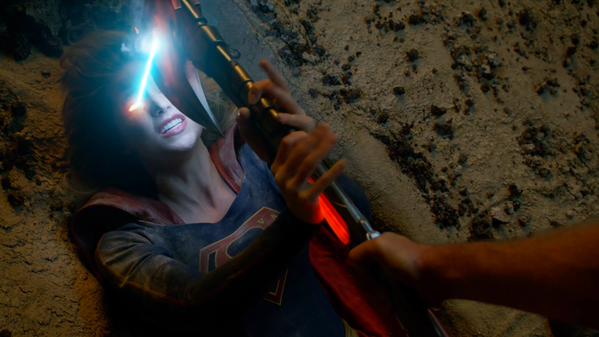
Long story short, Supergirl almost gets her head handed to her (literally) but her sister arrives just in time with some serious artillery to save her. Although Henshaw again warns Kara to hang up her cape, this time Alex encourages her to be the hero she's destined to be.

In the final battle between Supergirl and Vartox, with the DEO having her back, as Kara is about to lose, Alex delivers a stirring "I believe in you" speech which turns the battle around and Supergirl saves the day (it was pretty cliche and internally, I gagged a little).

Vartox commits suicide rather than be captured, but issues the dire announcement that he's only the beginning, forecasting that future episodes will feature the alien baddie of the week with the mystery of who the General is and what she...that's right, she, wants.

As if I didn't dump enough spoilers on you already, the General is none other than Kara's aunt, leader of the band of miscreants, who would like nothing better than to see her niece dead.

So like Team Arrow and Team Flash, Supergirl now has a team, or more accurately, she's now a covert super agent for the United States Government. That's truly terrifying.

It's also concerning that Henshaw, in the 1990s comic books, became the villainous Cyborg Superman. Shades of a future story arc?

Impressions: The show tries to be a little too cute (didn't I say that enough?). I get that we're supposed to like and even feel protective of Kara, but it's hard to imagine this sweet little millennial getting the chops to play in her cousin's league. I know a hero like Wonder Woman would probably embody more of the feminist ideal, an already strong, developed, self-assured figure, so it's difficult to understand why Supergirl would be appealing as the leading female-driven superhero show on television. I suppose emerging power laced with vulnerability makes her more relatable to young girls and women than a commanding personality like Diana Prince.

From the look and feel of the show, it's seems the main demographic must be between the ages of 12 and 20. Sorry, but a lot of what I watched seemed very juvenile. Maybe I'm jaded by the darkness of most of the other superhero TV shows and films. But the Flash is light hearted and "young," and yet you get the impression that adults are also supposed to relate to the main characters. By comparison, the pilot episode of Supergirl seemed a little more "cartoonish".

I didn't outright dislike the show, but I wasn't immediately hooked either, the way I was by Arrow and The Flash. Also, the show promises to be "formulaistic" as I already mentioned, with a built-in conspiracy delivering the super villain of the week for Kara to sharpen her teeth on (not literally, of course..if you want teeth, watch The Vampire Diaries).

I do believe that the world needs more female oriented superhero shows and films, but I can also acknowledge that all of the source material for each and every one of them today is at least fifty years old. Half a century ago, comic books were overwhelmingly male driven, with just a few token females on various teams (Wonder Woman being one of the notable exceptions) to break up all that "maleness". If entertainment producers want female characters more easily adapted to modern audiences, they need to read more recently created comic books. The 1960s weren't particularly progressive compared to 2015.

All that said, I wish the show success and hope the writers manage to develop the character and her supporting cast and environment into something slightly more mature people can connect with. The show isn't bad, and I know most pilots have a lot of rough edges, but the Supergirl television show has left itself a great deal of room in which it needs to grow.

Friday, July 5, 2013

Review: Iron Man 3

It wasn't as bad as Iron Man 2 (2010) but not quite up to the original Iron Man (2008) film. Of course, it's trying to tell a more complicated story than the original film and it's trying to show us the humanity of Tony Stark. So who is Iron Man: man or machine...or both?

That's really the main question this film is asking and trying to answer, which is why we don't see Tony Stark (Robert Downey Jr.) in his armor for most of the film. However, when this movie finally gets rolling, we have armor up the wazoo!

But first things first.

The movie starts in the dark with Stark's narration, "A wise man once said: we make our own demons." This is important but you don't realize it right away. I'll get to that.

Stark decides to start his story on New Year's Eve 1999 in Bern, Switzerland. He's trying to get a brilliant research scientist named Maya Hansen (Rebecca Hall) into bed for a one-night stand and all she wants to do is talk about her latest experiment in reprogramming the human brain to amplify a person's ability to self-repair dramatically. Tony seems too drunk to notice or care, but he's brilliant enough to not let that stop him, either in his quest to get her into the sack (which he does) or to help her with her technical problem (which he also does, but we don't find out until later).

OK, she's interested in bedding Tony too, after they get rid of the overly attentive Happy Hogan (Jon Favreau). Tony's also promised to meet with the newly minted inventor of AIM (that's right, Advanced Idea Mechanics...the bad guys) Aldrich Killian (Guy Pearce with a really bad haircut and a hopelessly fan boy attitude in the 1999 sequence) on the roof of the hotel, but that was a total lie. Booze and sex drive Tony Stark at this point in his life.

All this is to set the stage for the present where we pick up the loose threads left dangling on the morning of January 1st, 2000.

As a nice homage to the first film, we get to see the brief appearance of a very beloved character (at least to me) in the opening few minutes of the 1999 sequence. Watch for him.

Shift to the present or close to it: the Christmas season 2012 (presumably). Happy has been upgraded to Chief of Security at Stark International, Pepper is handling the day to day running of the empire, and Tony...Tony's a mess.

He has been ever since the end of The Avengers (2012), but then again, escorting a live nuke into another dimension and almost getting stranded there, and then, having gotten back out, almost falling to his death, all have a way of negatively impacting a person. In Tony's case, he's prone to panic attacks (they don't last long enough to qualify as anxiety attacks).

Pepper's moved into the Malibu mansion with him, but that only helps a little. Night after night he can hardly sleep and he spends most of his time building a wide variety of super-powered armor prototypes. The latest is Mark 42, which on command, will leap into the air in pieces and slap themselves onto Tony's body (it's not a perfect process).

But then he finds something to focus on besides the past, his anxiety, and his uncertainty. The Mandarin (Ben Kingsley). The Mandarin seems to have it in for America in general and the American President in particular. So much so that he needs to blow up lots of American stuff, including the TCL Chinese Theatre in Hollywood.

Long story short, the formerly dweeby Aldrich (with a much better haircut and tons more confidence) visits Pepper at SI to pitch "his" technology for hacking into the human brain to enhance healing and performance (sound familiar). Pepper turns it down since it can all too easily be weaponized (something SI doesn't do anymore). Security Chief Hogan gets suspicious of Aldrich and his henchman Savin (James Badge Dale) and follows them to the aforementioned Chinese Theatre...

...where he discovers how the Mandarin blows up things...not with bombs but with genetically altered people...

...and ends up in a coma (don't worry, he gets better by the end of the movie).

This is where it becomes personal for Tony and he challenges the Mandarin on TV to a duel, giving out his home address (as if the entire world could miss that giant half factory/half work of art in Malibu hanging over the Pacific).

Big mistake. The long missing Maya Hansen shows up "coincidentally" to warn Tony about her boss as Pepper is trying to convince Tony to get out of the mansion...just minutes before three of the Mandarin's helicopters blows the whole thing into the ocean.  Tony "armorizes" Pepper just long enough for her to get Maya and herself out of harm's way, then pulls the armor onto himself just in time to go into the water with his house.

So begins Tony Stark's armorless journey to discover who the Mandarin is and the secret behind exploding people.

Cute relationship between Tony (AKA "the Mechanic") and eight-year old Harley Keener (Ty Simpkins). Nice and heartwarming, even though Tony is still a dick at heart. The relationship does buy Tony time to start unraveling the mystery and he makes a number of surprising discoveries.

Most aren't all that surprising to the audience but one came at me out of left field. I loved what Kingsley did with Trevor. I had no idea it would turn out this way but in retrospect, it was brilliant. It goes completely off canon which is probably good, since you can't do The Mandarin the way he originally appeared in the 1960s Marvel comic books. The Mandarin in the comics was actually a throwback to the 1930s pulp fiction stories and comic strips and in no way could that "Fu Manchu" character type ever play in the 21st century. Nice twist and kudos to the writers.

I was disappointed that the armored suits, including James Rhodes's (Don Cheadle) seemed to be taken out so easily by the "Lava people." Even though Rhodes inside Iron Patriot (the War Machine armor with a Captain America paint job) was taken by surprise, once Rhodes regained consciousness, none of the armor's toys were put into play to get him out of his mess. The best he could do was eject himself out of the armor and run like hell.

In fact, Rhodes was a far more effective fighter without the suit than he was in it. He could totally kick ass with nothing besides a sidearm and lots of athletic skill, which is how he manages to rescue the President.

Tony manages to do derring do, including saving about a dozen people in free fall who were forcibly blown out of a crippled Air Force One, but finally it's Rhodes who saves the Pres and it's Pepper who defeats the real bad guy and saves Tony's ass (never mind that she came just that close to buying the farm herself).

Good Stuff

What they did with the Mandarin. Ben Kingsley puts in a surprising performance once Tony comes face to face with who he thinks is the mastermind behind the international terrorist organization AIM.

The finale where thirty or forty remotely controlled suits of armor are all flying around fighting the bad guys. JARVIS is the main hero here, although Tony shows masterful coordination at getting into and out of different suits of armor literally on the fly. Pretty good for a guy who has panic attacks with very little provocation.
For once, the female lead saves the day. She kind of blows it by immediately being shocked at how violent she could be (having just blown the bad guy into millions of superheated pieces).

Tony finally gets rid of all of the shrapnel around his heart, eliminating the need for an electromagnet in his chest powered by a mini-arc reactor.

He blows up his armored suits. All of them. It's a way for Tony to grow up and realize that he is he hero behind Iron Man, not a bunch of technology.

Bad Stuff

For a guy who has panic attacks when you just mention "New York," he can do lots and lots of really risky, heroic stuff that should either have put him in a fetal position or sent him to an emergency room. Even without his armor, he's leaping  thirty feet to come down on precarious perches, dodging flying debris, explosions and one really super-heated and pissed off bad guy. If he was that prone to debilitating anxiety, she should have ended up dead.

The film seemed uneven. Yes, I know the point was to show Tony outside his armor and what he could and needed to do without depending on "the suit," but the name of the movie is "Iron Man," not "The Adventures of Tony Stark."

The armor was shockingly ineffective against a crew of super villains whose only real power was getting hot enough to melt metal and exploding. I can see where that could catch you by surprise the first time, but once you expect it, the armor and all its gadgets should just kick ass. I think the film makers tried too hard to make their "man over machine" point.

The worst disappointment though has to go to the after ending credits scene. Normally these scenes are meant to show secrets into the next Marvel films, little surprises, teasing easter eggs. This time it was a cheesy joke between Stark and Bruce Banner (Mark Ruffalo). Totally not worth wasting seven minutes of my life sitting through the end of film credits. This is where we see that Tony's narration is part of a dialogue with Banner.

The movie is watchable. It leaves us with the feeling that Tony has outgrown Iron Man and is leaving the armor behind along with his blown up and sunken Malibu mansion (guess he's moving to New York). If I didn't know Downey had signed on to do two more Marvel films, I would have interpreted this movie's ending the way The Dark Knight Rises (2012) ended. Batman dies so Bruce Wayne can live.

I had thought that the after end credits "teaser" might have been used to introduce Ant Man (2015) or at least his alter ego Henry Pym. No such luck (unless he was in the scene but too small to see).

Yeah, I'll watch this movie again, but not until it's out on DVD. It was a nice ride, but not a fully satisfying one. The Avengers is still top of the heap of super hero movies...at least until I see Man of Steel (2013) next Sunday and then review it.

Wednesday, August 1, 2012

Save Me, Supergirl!


Please, please, please save me!!!

Sorry. Just saw the image and had to say that. Thanks.

Friday, October 29, 2010

Halloween Fantasies: The Women

Yesterday I asked if I should include a blog post for women in Halloween costumes. After a resounding silence, I figured, "what the heck". Keep in mind that, unlike the previous blog post that depicted my fantasies about costumes I'd like to wear (if I was built for it), this blog contains my fantasies for costumes I'd like to see women wear (if they have the bodies for it). Consider this blog post definitely not "PC".

Harley Quinn

Harley is my favorite bad girl. I know, Catwoman has a lot more class, but Harley just seems really fun...when she's not trying to kill you. This is a fantasy and, in real life, I'd drop Harley like an angry rattlesnake and start running, but in the safety of my imagination, I think she's really HAWT. Found a pic of a model in costume that I think shows how the Harley costume would appear in real life.

I found something else at the Fan Art Exhibit blog. Apparently, there was an online April Fool's gag that depicted actress Kristen Bell made up as Harley for a supposed appearence in The Dark Knight (2008) . I don't think Bell's Harley looks as fun as the one from the Batman animated series, though. She seems kind of sad. Makes you want to take her under your (Bat) wing, doesn't it?

Supergirl

What can I say? Supergirl is one of the ultimate sex fantasies for Superhero fan boys. Smallville fans have come to think of actress Laura Vandervoort as the Supergirl, but she has many incarnations. The one thing I don't understand is how you're expected to read the "S" on her chest with all of the "distortion"?

Power Girl

Even more than Supergirl, to pull off this costume takes quite a set of "attributes" not possessed by most women. After all, how can a woman be so big on top and so thin elsewhere? It's like expecting a real life woman to have the proportions of a Barbie doll or Jessica Rabbit. It just can't be done. At least Supergirl has a more or less realistic frame that could be attained by a human being (with a lot of exercise and dieting). Nevertheless, she remains a popular male fantasy.

Batgirl

There are so many versions of Batgirl, I don't know where to begin, but I decided on the version that has the most mystery while still retaining the male fantasy factor. As you can see, this Batgirl has had an encounter with the Huntress (supposedly the daughter of Batman and Catwoman) and guess who didn't win the battle?

I couldn't find a pic of a Batgirl costume on a live model I felt gave a satisfying appearance and that was also printable on my blog (no pr0n, please), so you'll have to be satisfied with the graphic.

I know, I know. So many other fantasy super women to choose from. Catwoman and Wonder Woman are obvious favorites, which is probably why I decided not to include them (except for the brief homage to Selena below). Frankly, just about every woman in costume these days sports at least C-cup sized breasts which is amazing considering how they don't seem to get in the way during a fight. They also have waists that are supernaturally thin, so it's hard to believe these women even eat (though, by definition, they do burn a lot of calories during their various battles and jumping around buildings and such). Another woman who could have appeared here was the slave girl Leia from Return of the Jedi (1983), but based on Carrie Fisher's admission of using cocaine on the set of The Empire Strikes Back (1980), one wonders if the body of the bikini clad Leia was crafted less by workouts with a trainer and more by "nose candy".

That's it for now. Choose your favorite costume and go for it this Sunday. Happy. Have fun.

Monday, August 23, 2010

Superhero Role Models, Part I

Today's media superheroes -- including Batman in The Dark Knight and the Hulk in Planet Hulk -- as well as the ''slacker'' characters often portrayed in TV shows and movies offer boys poor role models, says a University of Massachusetts professor who polled hundreds of boys up to age 18 to find out their favorites.

The poll results suggest boys hear two ways to be masculine, says researcher Sharon Lamb, EdD, distinguished professor of mental health at the University of Massachusetts-Boston, who presented the findings Sunday at the American Psychological Association's annual meeting in San Diego.

"One was the superhero image, created as someone who shows their masculinity through power over other people, through exploiting women, showing their wealth, and through sarcasm and superiority," she says.


Superheroes: Bad Role Models for Boys?

Superheroes, in the modern sense, have been around for over 70 years (Superman made his debut in Action Comics in June 1938). Every once in awhile, some expert or authority decides to criticize comic book and movie heroes as bad "role models" for the youth of our country/the world. On the other hand, if they were always good role models, they'd probably be pretty boring and nobody would read their comics or want to make movies about them (the Amazing, Spectacular Dali Lama!).

I thought I'd perform my own analysis because I grew up on comic books and have a love for their classic incarnations. It would be too difficult and time consuming (and my time is precious) to go through all the different permutations the various heroes have endured over the decades, so I'll try to stick as close to their original personas as I can. Remember, nothing's perfect, including heroes and this review.

Superman. I figured I'd start with the superhero. As far as role models go, you'd think he'd be the best. He's basically a boy scout in a cape, paying equal attention to saving the President's plane from crashing and saving a cat stuck up in a tree (citing the 1978 Superman film). He was originally an American role model (..."truth, justice, and the American way"), at least in the 1950s, but political correctness has resulted in expanding his role to be more "universal".

The dark side of this role model is that he isn't that universal. He was created in 1938 to appeal to the likely readership of the day, which were 12 year old white boys. Forget it if you were a girl or a person of color. Even his Jewish origins (Jerome Siegel and Joseph Shuster were both Jewish and modeled Superman on the concept of the Golem, a large, anthropomorphic being who overwhelmed problems with shear might and had the word "truth", in Hebrew, on his forehead) were obliterated to make him attractive to the majority of American kids in the depression era.

Superman does teach that you can have great power and manage it responsibly, never using it for your own gratification (like most of us would do in real life) by peaking through Lana Lang's bra when she's 15 year old (and what high school guy hasn't thought of the advantages of X-ray vision?) or conquering the world just for giggles.

He loves his mother, married his girlfriend, holds down a steady job and regardless of whether he's Superman or Clark, is always someone you can depend upon. On the role model scale, Superman gets an A+.

Iron Man. Originally, in the early 1960s, Tony Stark was a rich, handsome, millionaire playboy who just happened to make weapons for the military. One day, while strolling through Vietnam, he's injured mortally, captured by the bad guys, and in order to escape, has to invent Iron Man, to free himself and save his life...literally. The film version starring Robert Downey Jr, is pretty close to the original as far as origin stories go, except they make Tony much less clean cut, and more of a spoiled brat. The process of becoming Iron Man tempers him and redeems him from his "lost" image, though he doesn't exactly get a personality transplant.

Tony does learn that, dying with the most toys doesn't mean you win and what life really means is saving those people who you hurt, even if you didn't mean to. He's beat (or is in the continual process of beating) alcoholism and repeatedly puts his life on the line, risking a fatal heart attack every time he puts on the Iron Man armor, in order to help others. Joining the Avengers means he's learned to be a team player. Yeah, he's a thrill seeker and it's an emotional power surge just to be Iron Man, but he's a better person than he was before. No, not perfect by a long shot, but with just enough flaws to keep him interesting.

Iron Man comes in on the role model scale as a C+.

Spider-Man. Originally a shy and very smart teenager who could never make it with the cool kids and was always picked on. He got to live out every kid nerd dream by becoming physically powerful enough to pound the bullies, which is more or less what Peter Parker did back in the early 1960s. No, he didn't beat Flash Thompson to a pulp, but he did tell everyone to go take a flying leap into the toilet and, instead of immediately using his powers to become a hero, became a TV star. He probably would have gone on in that direction, having loyalty only to his aunt and uncle, except that his arrogance cost his uncle his life. That's what turned Peter around, but his life is hardly enviable.

Spider-Man is sort of the comic book world's version of a dog's chew toy. He always has one problem or another to overcome, but his shining virtue is, no matter how much he wants to give up on everyone and everything, he hangs in there, probably more for guilt's sake than anything else, but out of great suffering comes great perseverance, to twist a classic phrase.

As a role model, he gets his revenge on being bullied by beating up the bad guys and sending them to jail. OK, ok, he really does love his aunt, has girlfriends, but they either die or divorce him, gets mad at the world half the time, but manages to recover to do the right thing in the end. In some ways, he's the most "human" guy in this review so far. Stan Lee created a number of superheroes back in the day to break the mold of the "perfect person" hero, and it worked. Spider-Man was the poster child of this new hero...the guy the rest of us could relate to. Role model? Maybe not a perfect one, but Peter is a role model we can understand.

Spider-Man gets a B+ on the role model scale.

Last but not least (for this entry) Green Lantern. Hal Jordan was originally one of the most perfect of the perfect heroes. In fact, to get the power ring, you had to be. The qualifications were to be completely honest and completely fearless. That lets him out of being a politician right from the start. If Superman was the boy scout of heroes, Green Lantern was the police officer, but in the best possible sense. As he develops into the 1970s, we discover that Hal's "cop on the beat" take on life also makes him perfectly inflexible and his sense of "right and wrong" is absolute. Oliver Queen (Green Arrow) buddies up with him for awhile to teach him that life has infinite shades of gray.

Actually, you can't blame Hal too much. His bosses, the Guardians of the Galaxy (Universe...whatever) are just as inflexible and Hal has to teach them a few lessons, too.

Reinvented, Hal was a cocky, self-assured test pilot with a chip on his shoulder, put there by his old man who was even more "perfect". In the reinvented version, Hal gets the power ring but also a DUI and has to work off both, one in jail and the other taking humility lessons from master Green Lantern Sinestro, ultimately having to overcome his obsession over himself in order to take on the corrupt "perfect" Sinestro and take his place (eventually) as the galaxy's greatest ring bearer (OK, this side of Frodo).

As far as "super cop" goes, he makes a great role model, but like Superman, his clean cut white guy image made him pretty dated and unrelatable beyond a certain demographic.

These days, he isn't infinitely honest or fearless, but to use the ring, he does have to become the type of hero the ring demands. He's had his dark moments...like becoming Parallax and destroying everything to try and recreate the perfect world (that seems to be a reoccurring theme in his life), but goes through a series of salvational experiences and eventually is the Green Lantern again.

Green Lantern gets a B- on the role model scale, and given the fact that he's killed a lot of people (like the universe), that's generous.

I could go on and on, but this is an analysis that could be taken through a series of blog posts. My ratings are pretty arbitrary, but are superheroes really meant to be role models or are they strictly entertainment? Do kids really try to become like the people they read about in comic books or maybe the comic book heroes are becoming more like us?

Thursday, June 24, 2010

SandwichJohnFilms

John (yeah, that's his real name) invited me to write some guest articles for his blog. Being asked to write on someone else's blog is an honor. Most bloggers guard their commentaries and venues like a guy guarding his jugular at a Twilight convention. So far, I've written two articles for SandwichJohnFilms, the most recent being Tomorrow, Our Heroes Will Be Digital. Besides the fact that I'm obviously doing some shameless self-promoting, John works hard to post the latest buzz on upcoming and just released films in a variety of genres including the superhero/fantasy realm. It's worth the read. Check it out.

Tuesday, June 8, 2010

Super Cowards

This isn't to put superheroes down, but don't you find it interesting that everyone who just happens to get superpowers turns out to be a hero or a villain? Good guys and bad guys...or gals. What if the person who got powers wasn't particularly courageous. Does getting powers automatically mean you have to do something either good or bad with them? What if you got superpowers?

I know what you're thinking. You're thinking, "If I got superpowers, I'd become a great superhero." Sure you would. I suppose if you became Superman or Superwoman or something, and your powers meant that nothing could hurt you short of kryptonite (and assuming you were the only superpowered being in the world, which means no serious challengers), it would be easy to have "courage".

You could dive into a burning building, rescue a bunch of people, and not risk getting burned or choking on the smoke. You could stop a bank robbery cold and if someone shot at you, the bullets would just bounce off your chest (sorry about the innocent bystanders who got hit by the ricochets). But what about other, less "perfect" powers?

Say, if you were bitten by a radioactive spider. Sure, Peter (in the origin story) went into entertainment and didn't think a thing about helping other people, until a bad guy he could have stopped but didn't ended up killing his Uncle Ben. If you suddenly had the proportional strength, speed, and climbing ability of a spider, what would you do with it? No, seriously. Not what would you fantasize doing with such powers, but what would you really do?

Would you make a costume and patrol the city by night? Chances are, you don't have the science and engineering skill to make web shooters, so unless you came by web spinning "naturally", as part of the process (like the Spider-Man films), you'd be out of luck there. Would you really dive into a burning building to save some kid, risking burns, smoke inhalation, and even death? Maybe you would. Most people wouldn't.

What if you were hiking alone on some nature trail and you happened to see an alien spaceship crash nearby. If you found a dying alien inside the ship and he gave you a green ring and a lantern to charge it with, then explained what they were and how to use them, would you really become Green Lantern and fight evil and injustice and dance on the ends of the Guardians' strings? Maybe so, maybe not. After all, you didn't ask for the responsibility. You didn't want the job. Why should you risk your neck?

Let's take a look at power rings for a second. You can't just activate one with a casual thought. It takes will power and lots of it. The original Hal Jordan GL had loads of will power but not a lot of imagination. He'd hit bad guys with giant boxing glove, made of green energy. He could fly. He could do anything...as long as he focused all of his will and told the ring what to do. It must have taken a lot of practice.

When Kyle Rayner took up the ring, the rules were different. No more 24 hour time limit on a charge. No more vulnerability to yellow. No requirement to be really honest or brave, which is why Kyle was chosen in the first place, but he grew into being a hero (and good thing he had a lot of imagination). Would that always happen with everyone, or would you toss the ring and the battery in the back of your closet the first time you got your butt kicked? Would you even try to go up against a bad guy or rescue people from a burning building in the first place?

Most people are OK to fly in an airplane, but if you really had the power to fly all by your little lonesome, would it freak you out? If you had spider powers, would jumping off a 50 story high building be even a little scary (this isn't the Matrix jump program...if you splat on the street, you really splat)?

Comic books are unrealistic because people can do impossible things in the comics. We overlook that because it's fun and it's entertaining. However, another piece of the unrealistic we never even think about is that, whenever anyone gets superpowers, no matter who they are or where they're from, they always make the decision, at least eventually, to become a hero or a villain. There's no in between. There's no one who decides it would be too dangerous. There's no one who even considers not making a costume, which always looks OK in comic books but almost always looks ridiculous in real life (put one on, go out in public, and see how people react, if you don't believe me).

One of the reasons superheroes don't exist in the real world is that various natural laws prevent people from getting a spider's natural abilities by being bitten by a radioactive arachnid. As far as we know, no aliens have visited our planet, especially ones with magic green rings to give away to the casual passerby. As far as we know, no alien from another planet has grown up on Earth and gets incredible superpowers just by working on his tan.

Another reason why there are no superheroes is, even if we severely bend the laws of physical reality, no one, or almost no one, who got superpowers would really do what we see people in comic books do...decide they have a moral responsibility to the rest of humanity to use those powers to help. I guess we'll never know if I'm right or not but consider one more point.

We do have heroes. A hero is someone without special powers who dives into a freezing river to help a Dad pull a kid out of a car that drove off the side of the road a minute ago. A hero is a firefighter who runs into a burning building, risking getting burned, choking on smoke, and even killed, to pull out someone who would otherwise die. A hero is someone who joins a group of passengers on a hijacked aircraft to stop the hijackers from crashing the plane into a populated area, dying in the attempt. These heroes are ordinary people. These heroes are your neighbors, co-workers, family, and friends. One of these heroes could even be you. What made them heroes wasn't any special power. What made them heroes was that, when the circumstances called for it, they put whatever fears they may have had aside and made a decision to make a difference.

I could be wrong. Maybe getting superpowers would be like one of those circumstances, but the situation wouldn't be comic book nice and neat. Your life and the people whose lives are in danger aren't just two-dimensional characters on the printed page. They're real. You're real. Powers or not, you may face a situation where you have to decide if you can make a difference. Your name won't be Clark Kent or Diana Prince. They're just examples of what the best of us could be. We're the real life expressions of who we are and the hero we could possibly become.

What if you got superpowers? You probably never will. But that doesn't mean you won't ever have a chance to be a hero. When your chance comes, what will you do?

Thursday, June 3, 2010

Wearing the Reboots: Reinventing Superhero Movies

Ever since (at least in my case) the J.J. Abrams Star Trek reboot, all I seem to be hearing is how a bunch of "reboot" films are coming down the pike. I don't mean new films that haven't been done before such as Iron Man or the upcoming Thor and Captain America films. I'm talking about superhero/fantasy films that have already been done and either flopped or have gotten too old and need to be updated (speaking of Star Trek).

Superman seems to fall into both categories. The original film starring Christopher Reeve was made in 1978, which in terms of the superhero/fantasy genre is eons ago. While the first film was revolutionary for its time and reasonably watchable (minus the "Can you read my mind" sequence), each successive film became more campy and, dare I say it, dull (and I know I'm going to get hate comments for that). Warner Bros didn't exactly try for a reboot with Superman Returns (2008), but rather described events that should fit between Superman II and Superman III. The general consensus is that the Brandon Routh rendition of Superman was ghastly. I haven't been able to force myself to watch it after my first viewing.

The Smallville TV series by comparision, has been wildly successful. It departs significantly from the established Superman canon, but has managed to incorporate significant elements from the Reeve film series lore and the extremely large body of comic book content (JLA, JSA, the Martian Manhunter, the Phantom Zone, and on and on and...). All and all, Smallville is extremely entertaining and Tom Welling is a delight to watch as Clark Kent pre-Superman. The problem is, I can never figure out how Welling's Clark will ever pull off the transition to the costumed Superman. Lex Luthor knows his face so well (being such good buds for years before having their falling out), that a little thing like wearing glasses won't prevent him from figuring out that Clark is the guy wearing the big red cape. For that reason, Smallville has to die so Superman can be born, or reborn.

Enter the numerous rumors and half stories about a Superman reboot film with Christopher Nolan at least offering some creative assistance. Unless you've been hiding under a rock for the past five years, you've most likely seen Nolan's landmark Batman Begins (2005) and The Dark Knight (2008) films. While Batman Begins was incredibly good, The Dark Knight virtually blew my socks off, it was that much better (and a sequel as well). If Nolan can do for the Superman film franchise what he did for Batman (and the prior Batman series launched by Michael Keaton as the Caped Crusader just didn't "do it" for me), then the Superman reboot is in very good hands. I feel secure.

Daredevil (2003). What can I say. It's watchable and I've seen it more than once (better than Superman Returns, apparently). Ben Afflick is hardly my favorite actor, but the film was more or less true to canon and the "radar sense" effects were awesome. However, there's a reason why no one has made "Daredevil II, III, and so on". It wasn't particularly good. Better casting would have helped. In addition to Afflick not being a good model for Matt Murdock/Daredevil, who in their right mind would consider Jennifer Garner as a woman born and raised in Greece and a master assassin? Not me. Why anyone bothered to do an Elektra (2005) spin off is beyond me. Total waste of money. Rumor has it that a Daredevil Reboot is on the way, but nothing is confirmed.

Actually, I should probably mention that Ang Lee's rather lackluster Hulk (2003) film (and 2003 doesn't seem to be a good year for superhero films) was already rebooted as The Incredible Hulk, a much better film thanks to the stellar acting and multiple uncredited re-writes of the exceedingly talented Edward Norton. It was still not well received, but I think it did well enough to warrant a sequel and even if that doesn't happen, the Hulk should make an appearence in the upcoming Avengers (2012) film. After all, the reason the Avengers became a team in the first place was to stop the Hulk (though it was really a ruse by Thor's half brother Loki to "get" Thor).

X-Men First Class isn't exactly a reboot but more of a prequel. The original X-Men film trilogy was made between 2000 and 2006 and showed the original team as rather long in the tooth to be students. Hank McCoy (the Beast) had already left the "nest" and both Scott (Cyclops) and Jean (Marvel Girl/Phoenix) were teachers. The prequel gives us an opportunity to see what the team was like when Professor X first formed them. Of course, the timeline departs significantly from the comic book canon since Warren (Angel) first meets the X-Men in The Last Stand film in 2006 and Bobby (Iceman) only finally figures how to "ice up" in that same film. Nevertheless, exploring the early days of Xavier's school promises to be a treat.

The Fantastic Four (2005) is in desperate need of a reboot. Although someone thought the storyline and cast deserved a sequel, both films quite frankly sucked. Someone should tell the film makers that, just because modern special effects including CGI make it possible to create realistic stretching, flaming, and rock-skinned Thing images, it doesn't mean the film will automatically be good. Also, as much as I admire Jessica Alba's body, the comic book version of Sue Richards never depicted her as an air-headed blonde (Alba's chronic role, whether she means it to be or not) with almost no clothes on.

A Fantastic Four reboot is also confirmed but no timeline has been set. I hope Marvel/Disney doesn't screw this one up. The FF was one of my favorite comics as a kid and there's a vast wealth of sagas that could be adapted to make excellent films. Now all someone has to do is create the right team to build on what's already there and make a movie to be proud of.

While the Spider-Man (2002) films starring Toby Maguire were generally good, it was decided to "take it back to formula" by doing a complete reboot of the film franchise. What was handled well before can only (hopefully) be handled well again...and perhaps improved upon. Word on the street has it that the reboot will be based more on the Ultimate Spider-Man incarnation rather than the original canon, but I'd like to see a more Steve Ditko look, which tended to be darker and more mysterious than later versions of ol' webhead.

What else? Should I mention the horrible Supergirl (1984) film? What about Swamp Thing (1982) or (yuk) Catwoman (2004)? Not that Halle Berry isn't both beautiful and talented, but this was not the film for her.

DC Comics has largely had its successes on the silver screen thanks to Superman and Batman. Other DC character films were of lesser value or no value at all. I doubt anyone is dying to see either of the aforementioned movies rebooted in any sense. If we see Catwoman again, let her be within the context of a Batman film.

Marvel has only come to the silver screen in the last decade or so. That's not absolutely true, but you have to go back a ways (like 1944) to see the original Captain America movie serial. Hardly modern film quality in any sense, but fun if you like the history of film. Wikipedia has a list (not complete) of superhero films if you're interested.

Departing from reboots, and besides the new Marvel Avengers-related films, DC is going to be coming out with a series of new movies including Green Lantern and The Flash, so can Aquaman, Hawkman, the Atom, and Wonder Woman be far behind (and I still think, at least physically, Megan Fox would make a great Wonder Woman)? Actually, we've seen at least some of these characters in the Smallville TV series, and it was really fun to have them included in the mix. I should also mention The Flash TV series (1990) which starred John Wesley Shipp as Barry Allen. I thought it was done well, with just a bit of an art deco feel. Mark Hamill even got in on the fun playing one of the classic Flash arch-foes, The Trickster.

What superhero films would I like to see made? Ones based on the characters I just mentioned in the previous paragraph would be great, but of course, they have to be handled well. A lousy film is worse than no film at all (and I could have lived without seeing the Fantastic Four dragged through the mud by the last two filmed versions).

I often wonder how Prince Namor, the Sub-Mariner would look like on the big screen (now in 3D). He was originally created in the late 1930s and reintroduced as one of the early anti-heroes/villains battling the Fantastic Four. He also fought the Nazis and Japanese during World War II (he's rather long lived), so there's a Captain America tie in.

If you're into the mystical, Doctor Strange would be an interesting choice. Film makers could explore darker and more occult themes than would be possible for most other comic book characters but would need to avoid the temptation to turn the movie into a horror film.

If I missed any candidates for superhero reboots or "wish list" films, let me know. I can always include your ideas into a "part 2" blog.

Addendum: The latest quote from Chris Nolan about the Superman reboot.

Wednesday, June 2, 2010

Playing

Trying out Xara Xtreme on Linux, which is a powerful vector graphics tool that can do just about anything. I'm still at the novice stage, but having fun. In this case, I decided to show Ant-Man shrinking (couldn't find a decent image of The Atom online. I'll let you know how things progress as I learn more.

Heroes like Gods

I recently wrote a blog called Myths comparing our modern comic book superheroes to the mythic heroes and gods of various ancient cultures going back to the Greeks and Romans. I was wondering this morning why we have heroes at all, particularly "super" ones? What do we get from heroes that we don't get from the regular people in our lives?

The immediate answer is that people are flawed. I don't know anyone (me included) who isn't screwed up or bent out of shape in one way or another. We all have our biases, perspectives, issues, and angst. We used to look up to celebrities such as actors and politicians, but history tells us that those people, in real life, were just as human as anyone else and had just as many problems as the rest of us...maybe more. It can be a real let down to admire old time heroes of the movies and TV like Roy Rogers or the Lone Ranger, only to find out that these heroes are no different than you and me. Acting is a job, not a calling and Clayton Moore was an actor who played a hero, not the hero himself (and I should mention that both Rogers and Moore were very fine men who I admire greatly...I'm not criticizing them at all).

Admiring politicians is even a worse option. I can't think of any political figure who, admired during their time in office, wasn't subsequently found to have engaged in very human behaviors that at least potentially could have tarnished their reputation. Up until Richard Nixon, the Office of the President of the United States was well respected and the infrastructure around the President works to make sure that any of the more "common" activities of the President never reached the public. Watergate changed all that.

During our last Presidential election, Barack Obama was so admired, his public image verged on Sainthood and Messianic. Even though he remains fabulously popular among his hard-core "fans", the past 16 months of his time in office have shown that, "audacity of hope" or not, he's still just a man.

The answer to why we have fictional heroes then, is that real life people can be a bit of a disappointment. Any time you fix your eyes on a person and decide to use them as a role model, they'll say or do something to knock themselves off the pedestal you've placed them on. Real life heroes may start out well, but like Icarus, they eventually fly too close to the sun, get burned, fall from grace and back to earth. The irony of the Greek and Roman gods (since I'm on the subject more or less) is that they tended to act just as human as anyone else, and even worse than most (and Zeus was a very bad boy...uh, "swan" in his "encounter with the mortal woman Leda).

In the modern age, we have heroes like Superman, a "strange visitor from another planet, who came to Earth with powers and abilities far beyond those of mortal men!" Of course, in his first appearence in Action Comics #1, he acted more like Batman in some ways. In order to get a corrupt politician to confess to his misdeeds, Superman hung him from the top of a lamp post (I'm writing this part from memory, so if you have a more accurate version of the end of Superman's first adventure, let me know) to "loosen his tongue", so to speak.

In 1938, the "tough guy" good guy was very popular, but eventually, Superman shifted into the classic "nice guy" good guy, almost all-powerful, but equally incorruptable. This version was best portrayed on the silver screen by Christopher Reeve who developed both Clark Kent and Superman as two separate identities. Both were still very good and admirable men (though Clark by necessity, had to be a bit of a coward). The George Reeves Superman of 1950s TV by comparison, though played lightly through most of the series, had his darker moments, such as the time when he dodged a crook coming at him with a knife (this is Superman, remember) so that the crook would trip and fall over a cliff to his death.

The Silver Age Superman was clean cut, pure of heart, and a really nice guy. Just what a bunch of boys around the age of 10 or 12 would want and need for a role model. Be strong, be good, help people, and don't smooch too much with your good looking reporter girlfriend.

It seems we may have come full circle though. Our comic book heroes have become more tarnished of late. Actually, since about the early 1970s. I've mentioned before about the iconic two-part Green Lantern/Green Arrow tale from 1971 titled Snowbirds Don't Fly where it's shown that Green Arrow's former "trusty sidekick" Speedy (Roy Harper) has become a heroin addict. Hardly the role model for impressionable pre-teens.

As I said in my article Reflections, comic books, like any other entertainment medium, are a reflection of the desires and morals of the age that produced them. It's not that people were really "goody-goody" in the 1950s and 60s, but, as a society, we needed our heroes to be that way. Even the "Dark Knight" was so clean cut and sappy that modern audiences would probably puke if they read some of the Batman comics from that time (or watched the 1960s Batman TV series that starred Adam West and Burt Ward).

While "nice guy" heroes are an inspiration, we always fail them because, as real human beings, we can never be perfect. In a sense, both the ancient and modern heroes are easier for real people to relate to because they more or less act like we do, only with super powers. If that's the case though, isn't it a bad thing to have a flawed, corruptable human being be so powerful that bullets bounce off their chest and they can incinerate an entire city with heat vision?

It's not that bad. Our superheroes are heroes because they face their "demons", the dark side of their personalities and struggle to do the right thing. The "Dark Knight" Batman walks the edge of the abyss each night, in danger of becoming that which he fights against, but never actually falls in...at least not for very long. Our heroes are heroes because they are like us, but they struggle and overcome their problems. They're super, because the amplification of abilities makes the struggle larger than life, drawing our attention into that world so that our existence can too seem more nobel and less mundane.

Like the gods of old, our heroes act like we do, but unlike the ancient gods, Superman, Batman, and a score of other superpowered beings do not give in to tempation to become as totally corrupt and self-indulgent as their powers would allow them to be (imagine a completely narcisstic Superman, for instance).

While we, in real life, can never be super, we can use our heroes as an example of what it's like to fight against the odds and win. Like our heroes, we can have set backs and reverses, but we're shown that we don't have to just give up. Like our heroes, there's always another issue and another chapter in which, even after the bitterest defeat, we can rise again, Phoenix-like from the ashes of our failures, and fight another day.

Our spirits, like Superman, can even fly.

Sunday, May 30, 2010

Myths

I've been part of a small conversation on twitter about DC vs Marvel superheroes. I guess some folks can feel really impassioned and loyal to one group over the other. I've never seen it that way. I've enjoyed the stories of Superman, Batman, the Fantastic Four, and Spider-Man equally well. They all have something to say in their own particular ways and I think they're room in the universe for each one of them.

Another way to look at the superhero comic genre is as our modern mythic heroes. All you have to do is travel back in time a few decades to encounter another set of modern myths: The Lord of the Rings. Although based on much older mythic race types (elves, dwarves, dragons), JRR Tolkien tells a unique saga of heroism and the struggle against an ultimate evil, mirroring the post-World War II period in which he wrote his stories.

Go back much further, and you'll encounter heroes you truly recognize as classic myths, from the King Arthur legend all the way back to Greek and Roman heroes such as Heracles. Admittedly, I'm skipping over a large body of other, similar legendary characters, but this is a blog, not a dissertation.

Do Superman and the Hulk represent mythic heroes in the way Arthur and Heracles do? Probably only time will tell, since a legend or a classic is measured only by the test of time. True, Superman has been around since 1938 and Spider-Man, the Fantastic Four, and the Hulk since the early 1960s (when Marvel shifted from producing horror and science fiction anthologies to serial superhero stories), but the legends I'm talking about have been around for hundreds or even thousands of years.

Is one pantheon of "gods" better than another? I suppose if you were a pagan worshiper of one sort or another, you would answer "yes", however we don't (I hope) actually worship comic book superheroes. With that in mind, is one comic book publisher's heroes better than another's? Do we favor DC over Marvel or Marvel over DC for any true qualitative reasons?

It seems to come down to a matter of opinion. There are people who dynamically support one over the other and will fight (argue) to the end their viewpoint or position. That makes me the odd man out (my usual role), since I've found enjoyment in many different characters created by different publishers. I even enjoy some that many DC and Marvel fans have never heard of and would probably consider irrelevant (and such heroes will probably never have movies made about them).

If we don't "worship" these heroes, what do they do for us? On the most obvious level, they entertain us. They take us into a world that can't possibly exist (you have to suspend certain facts about reality to believe a man can fly) so that, for awhile, we can forget about the world that does exist. That's what fantasy entertainment is all about.

Then too, there's the telling of a story that touches us in some sensitive part of our humanity. The Dark Knight (2008) tells a story that is tragic and heroic, of a man, driven to be a hero by night, longing for release from his self-imposed purgatory. A white knight enters the arena and we all put our hopes on him, especially Batman, who seeks to be released from the mantle of the bat. Alas, the white knight falls in battle, and to save his reputation and the people he serves, Batman not only must defeat the villain but do something harder...he must become the villain and shun the light and salvation.

Put in those terms, Batman transcends the level of the costumed comic book hero and becomes something much greater, on the level of our historic mythic epics. As I said, though...only time will tell whether Batman or any of his kind will truly enter history in that fashion.

Some of you reading this will probably think I'm overstating the case. Popular entertainment comes and popular entertainment goes. Does anyone ever think of the Lone Ranger anymore? Does anyone consider the Shadow? How many other fictional heroes, once loved by millions, now lie abandoned in the dust of the past? Will we one day too abandon Batman and Spider-Man for someone or something else that seems more timely?