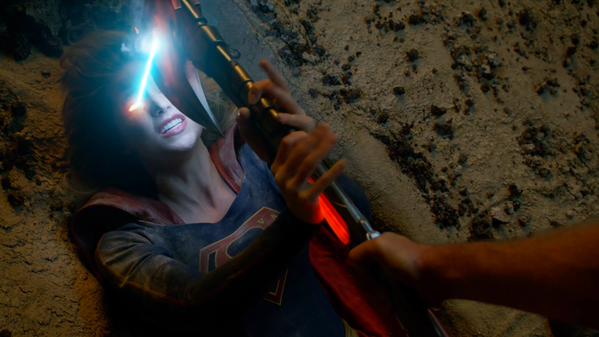
I don't know how much buzz there is for the new Supergirl television show as compared to anything else, but I came across an image of a comic book cover from 1962 that illustrated the day when Superman revealed Supergirl to the world.
In the original canon, Kara Zor-El came to Earth in 1959 after the domed Argo City, which had been thrown clear of the explosion of Krypton, stared emitting radiation dangerous to its inhabitants, even though they weren't exposed to the rays of a yellow sun and thus having super powers (Kryptonite can't hurt a non-super Kryptonian, so this was some form of anti-Kryptonite). As in Kal-El's origin, there was just room in an experimental rocket for one person, young Kara, Kal-El's cousin. Her father Zor-El had been able to monitor Superman's activities on Earth and so not only launched Kara there, but created a costume for her similar to her heroic cousin's.
Superman, upon Kara's arrival and after hearing her story, decided to send her to an orphanage (no such thing as foster families in the late 1950s I guess), telling the administrators that her name was "Linda Lee" and her family had been killed in a flood that destroyed her home town (no records). She hid her identity under a brunette wig and only used her powers in secret. Superman felt she needed practice before doing heroics publicly.
The cover below shows the day, three years later, when Superman decided to tell the world about his younger, Kryptonian cousin, the day when Supergirl became a hero in the light rather than in the shadows.
Eventually, Kara/Linda was adopted by the Danvers, a childless couple (no older sister like in the TV show).
Thought folks might enjoy the look back.
Showing posts with label DC universe. Show all posts
Monday, November 23, 2015
Friday, October 30, 2015
The Pilot Episode of Supergirl: A Review
I hadn't originally intended on watching the pilot episode of Supergirl starring Melissa Benoist in the title role, but it was online, it was free, so I figured, what the heck. I didn't expect to like it all that much, but I was curious how CBS was going to adapt decades of Superman and Supergirl canon. My reaction is mixed.
I've read a few of the other reviews of the pilot, both before and after I saw the episode, and they range from "good but not perfect" to "triumph for everyone wanting a strong female hero for a change". You can see examples at Yahoo News, IGN, The Mary Sue, and The Los Angeles Times.
The episode started out with a summary of how Kara Zor-El came to Earth. Launched from a doomed Krypton just minutes after her infant cousin Kal-El, 12-year old Kara was charged by her parents with taking care of the baby after they both arrived on Earth. Granted, no one would have had a clue where Kal-El was going to land on the alien planet and under what conditions, but sending a mere 12-year-old on such a mission was a long shot at best. Still, the writers had to inject her into the canonical story of how Superman got to our planet somehow.
Then, her space pod is caught in the shock wave caused the Krypton's explosion and is sent hurdling off course and into the Phantom Zone where time doesn't pass.
Some years later (at least as time passes outside the Zone), her ship is mysteriously freed and somehow finds its way to its original destination...Earth. When it lands, the pod opens and Kara is greeted by her cousin, grown to an adult, and already sporting the blue and red.
(At this point, I figured out that this show isn't leveraging the film Man of Steel (2013) starring Henry Cavill and instead represents a separate canon)
You only see Superman in silhouette and he's never called "Superman," but it would be impossible to tell key portions of Kara's story without acknowledgement to her more famous cousin.
Kal-El places the orphaned Kara (really, the kid must be freaking out -- her entire race and home world are long gone, her parents dead, her only relative (an infant cousin who is now 12 years older than she is) and fellow Kryptonian is the most powerful hero on her new alien home planet, and he places her with Jeremiah (Dean Cain) and Eliza (Helen Slater) Danvers (I liked the nice, continuity piece of choosing these two actors, both with ties to the television and film appearances of Superman and Supergirl respectively).
I wonder how Kal-El managed the legal niceties of getting Kara adopted or was able to explain to the authorities (since adoption requires the involvement of the civil court system) who Kara is, where she came from, how her parents died, and why she doesn't have any relatives or home community to take her in...a person with absolutely no recorded history before age 12?
This was glossed over (ignored) and we next meet Kara Danvers (no need to adopt the name from the comic books of Linda Lee Danvers apparently) working as a 24-year-old "gofer" uh, assistant, to Cat Grant, owner of her own media company Cat Co.
In spite of the fact that she has decided to play a low profile in terms of her powers (the world doesn't need another superhero) and to "fit in," she's wearing glasses, which she doesn't need, as if she's maintaining a secret identity. It's true that when she finally decides to adopt the Supergirl persona (although the "girl" part was first coined by Grant), she'd need to separate Kara from the young woman in the red cape, why did she decide to wear glasses in the first place?
Benoist imbues Kara with a wholesome, naive charm and she's instantly likable. Although she's attractive, I kept relating to her more like my best friend's sister than as any sort of "hottie". I was almost taken off guard when she went out on a blind date (with someone who quickly gave her the brush off). I was also slightly surprised when she reacted to Jimmy, uh...James (Mehcad Brooks) Olsen (who admittedly is a solid hunk) with attraction (although she clearly wasn't sure what to do about it). Benoist convincingly portrays Kara as "the girl next door," the friendly, kind, helpful girl, the one you'd never think to ask out.
Kara grew up with an older (adoptive) sister Alex who has a big secret. She's an agent for a government agency created after the first appearance of the alien Superman in orter to investigate other alien appearances on our planet.
Kara doesn't know this, of course...well, not at first. She doesn't even want to be super. Not until she has to rescue her sister's overseas flight from crashing, which she barely manages (hey, even if you're super, you still have to deal with things like mass, momentum, and inertia).
It was cute when her date asked Kara where she's from originally. It was cute when we saw Kara with wide eyed wonder, shoveling down pizza while watching herself on the news rescuing the airliner. In fact, I was beginning to be overwhelmed with cute. Is this show only written for young teens?
With the help of her friend Winn (Jeremy Jordan) Schott (isn't that the last name of the Toyman?), the IT guru where she works, Kara slowly transforms into Supergirl. Kara took a big chance telling (and showing) Winn who she really is. She couldn't have predicted how he'd react. Their boss would no doubt pay a lot of money to anyone who could deliver the exclusive story of who Supergirl is and where she could be found (right under your nose, Cat).
But Winn plays the loyal if nerdy friend and helps design her costume. Well, the first one was without a midriff and our modest Kara wouldn't wear it to the beach, let alone to rescue people.
That's actually one of the things I like about the way the show characterizes Supergirl. It's not about an overwhelmingly sexy, or even cute nymphet Supergirl doing daring do. Kara, if anything, is a bit conservative, both in how she dresses and how she acts and reacts. She's like a lot of people her age, still trying to figure herself out and walking into walls (not literally) half the time. Now she's got to figure out how to be both Kara and Supergirl.
But things get muddy fast. Turns out on one of her first missions, she's all too easily captured by Alex and her boss Hank (David Harewood) Henshaw, the director of the Department of Extranormal Operations (DEO) using Kryptonite darts and holding her in Kryptonite bindings. Henshaw doesn't like aliens (even though the DEO has her spaceship) and demands that Kara stop being Supergirl. Alex backs Henshaw up, at least this time, but circumstances pull the "Maid of Steel" back into the fight.
When Kara's ship left the Phantom Zone, it didn't leave alone. Somehow (a lot of somehows), it brought along Fort Rozz, formerly Krypton's high security prison facility, crammed full of the biggest, baddest, aliens (apparently not all are Kryptonian) in the galaxy...and now they're on Earth conspiring to do what...take over the planet?
That part is left vague, but they're also plotting to bring someone called "the General" to our world, and they sabotaged Alex's flight in an attempt to kill her.
An alien prisoner named Vartox (Owain Yeoman) who wields a mean, super-heated ax, calls Kara on a special high frequency only she can hear (I think I saw this done in one of the old Christopher Reeve Superman movies) to come out and fight. Turns out these aliens not only know Kara but her Kryptonian mother, who was a judge back in the day, and had sentenced all of these interstellar tough guys to Fort Rozz. Now they want revenge against the daughter of their jailer (also a theme from the second Chris Reeve Superman movie).
Long story short, Supergirl almost gets her head handed to her (literally) but her sister arrives just in time with some serious artillery to save her. Although Henshaw again warns Kara to hang up her cape, this time Alex encourages her to be the hero she's destined to be.
In the final battle between Supergirl and Vartox, with the DEO having her back, as Kara is about to lose, Alex delivers a stirring "I believe in you" speech which turns the battle around and Supergirl saves the day (it was pretty cliche and internally, I gagged a little).
Vartox commits suicide rather than be captured, but issues the dire announcement that he's only the beginning, forecasting that future episodes will feature the alien baddie of the week with the mystery of who the General is and what she...that's right, she, wants.
As if I didn't dump enough spoilers on you already, the General is none other than Kara's aunt, leader of the band of miscreants, who would like nothing better than to see her niece dead.
So like Team Arrow and Team Flash, Supergirl now has a team, or more accurately, she's now a covert super agent for the United States Government. That's truly terrifying.
It's also concerning that Henshaw, in the 1990s comic books, became the villainous Cyborg Superman. Shades of a future story arc?
Impressions: The show tries to be a little too cute (didn't I say that enough?). I get that we're supposed to like and even feel protective of Kara, but it's hard to imagine this sweet little millennial getting the chops to play in her cousin's league. I know a hero like Wonder Woman would probably embody more of the feminist ideal, an already strong, developed, self-assured figure, so it's difficult to understand why Supergirl would be appealing as the leading female-driven superhero show on television. I suppose emerging power laced with vulnerability makes her more relatable to young girls and women than a commanding personality like Diana Prince.
From the look and feel of the show, it's seems the main demographic must be between the ages of 12 and 20. Sorry, but a lot of what I watched seemed very juvenile. Maybe I'm jaded by the darkness of most of the other superhero TV shows and films. But the Flash is light hearted and "young," and yet you get the impression that adults are also supposed to relate to the main characters. By comparison, the pilot episode of Supergirl seemed a little more "cartoonish".
I didn't outright dislike the show, but I wasn't immediately hooked either, the way I was by Arrow and The Flash. Also, the show promises to be "formulaistic" as I already mentioned, with a built-in conspiracy delivering the super villain of the week for Kara to sharpen her teeth on (not literally, of course..if you want teeth, watch The Vampire Diaries).
I do believe that the world needs more female oriented superhero shows and films, but I can also acknowledge that all of the source material for each and every one of them today is at least fifty years old. Half a century ago, comic books were overwhelmingly male driven, with just a few token females on various teams (Wonder Woman being one of the notable exceptions) to break up all that "maleness". If entertainment producers want female characters more easily adapted to modern audiences, they need to read more recently created comic books. The 1960s weren't particularly progressive compared to 2015.
All that said, I wish the show success and hope the writers manage to develop the character and her supporting cast and environment into something slightly more mature people can connect with. The show isn't bad, and I know most pilots have a lot of rough edges, but the Supergirl television show has left itself a great deal of room in which it needs to grow.
I've read a few of the other reviews of the pilot, both before and after I saw the episode, and they range from "good but not perfect" to "triumph for everyone wanting a strong female hero for a change". You can see examples at Yahoo News, IGN, The Mary Sue, and The Los Angeles Times.
The episode started out with a summary of how Kara Zor-El came to Earth. Launched from a doomed Krypton just minutes after her infant cousin Kal-El, 12-year old Kara was charged by her parents with taking care of the baby after they both arrived on Earth. Granted, no one would have had a clue where Kal-El was going to land on the alien planet and under what conditions, but sending a mere 12-year-old on such a mission was a long shot at best. Still, the writers had to inject her into the canonical story of how Superman got to our planet somehow.
Then, her space pod is caught in the shock wave caused the Krypton's explosion and is sent hurdling off course and into the Phantom Zone where time doesn't pass.
Some years later (at least as time passes outside the Zone), her ship is mysteriously freed and somehow finds its way to its original destination...Earth. When it lands, the pod opens and Kara is greeted by her cousin, grown to an adult, and already sporting the blue and red.
(At this point, I figured out that this show isn't leveraging the film Man of Steel (2013) starring Henry Cavill and instead represents a separate canon)
You only see Superman in silhouette and he's never called "Superman," but it would be impossible to tell key portions of Kara's story without acknowledgement to her more famous cousin.
Kal-El places the orphaned Kara (really, the kid must be freaking out -- her entire race and home world are long gone, her parents dead, her only relative (an infant cousin who is now 12 years older than she is) and fellow Kryptonian is the most powerful hero on her new alien home planet, and he places her with Jeremiah (Dean Cain) and Eliza (Helen Slater) Danvers (I liked the nice, continuity piece of choosing these two actors, both with ties to the television and film appearances of Superman and Supergirl respectively).
I wonder how Kal-El managed the legal niceties of getting Kara adopted or was able to explain to the authorities (since adoption requires the involvement of the civil court system) who Kara is, where she came from, how her parents died, and why she doesn't have any relatives or home community to take her in...a person with absolutely no recorded history before age 12?
This was glossed over (ignored) and we next meet Kara Danvers (no need to adopt the name from the comic books of Linda Lee Danvers apparently) working as a 24-year-old "gofer" uh, assistant, to Cat Grant, owner of her own media company Cat Co.
In spite of the fact that she has decided to play a low profile in terms of her powers (the world doesn't need another superhero) and to "fit in," she's wearing glasses, which she doesn't need, as if she's maintaining a secret identity. It's true that when she finally decides to adopt the Supergirl persona (although the "girl" part was first coined by Grant), she'd need to separate Kara from the young woman in the red cape, why did she decide to wear glasses in the first place?
Benoist imbues Kara with a wholesome, naive charm and she's instantly likable. Although she's attractive, I kept relating to her more like my best friend's sister than as any sort of "hottie". I was almost taken off guard when she went out on a blind date (with someone who quickly gave her the brush off). I was also slightly surprised when she reacted to Jimmy, uh...James (Mehcad Brooks) Olsen (who admittedly is a solid hunk) with attraction (although she clearly wasn't sure what to do about it). Benoist convincingly portrays Kara as "the girl next door," the friendly, kind, helpful girl, the one you'd never think to ask out.
Kara grew up with an older (adoptive) sister Alex who has a big secret. She's an agent for a government agency created after the first appearance of the alien Superman in orter to investigate other alien appearances on our planet.
Kara doesn't know this, of course...well, not at first. She doesn't even want to be super. Not until she has to rescue her sister's overseas flight from crashing, which she barely manages (hey, even if you're super, you still have to deal with things like mass, momentum, and inertia).
It was cute when her date asked Kara where she's from originally. It was cute when we saw Kara with wide eyed wonder, shoveling down pizza while watching herself on the news rescuing the airliner. In fact, I was beginning to be overwhelmed with cute. Is this show only written for young teens?
With the help of her friend Winn (Jeremy Jordan) Schott (isn't that the last name of the Toyman?), the IT guru where she works, Kara slowly transforms into Supergirl. Kara took a big chance telling (and showing) Winn who she really is. She couldn't have predicted how he'd react. Their boss would no doubt pay a lot of money to anyone who could deliver the exclusive story of who Supergirl is and where she could be found (right under your nose, Cat).
But Winn plays the loyal if nerdy friend and helps design her costume. Well, the first one was without a midriff and our modest Kara wouldn't wear it to the beach, let alone to rescue people.
That's actually one of the things I like about the way the show characterizes Supergirl. It's not about an overwhelmingly sexy, or even cute nymphet Supergirl doing daring do. Kara, if anything, is a bit conservative, both in how she dresses and how she acts and reacts. She's like a lot of people her age, still trying to figure herself out and walking into walls (not literally) half the time. Now she's got to figure out how to be both Kara and Supergirl.
But things get muddy fast. Turns out on one of her first missions, she's all too easily captured by Alex and her boss Hank (David Harewood) Henshaw, the director of the Department of Extranormal Operations (DEO) using Kryptonite darts and holding her in Kryptonite bindings. Henshaw doesn't like aliens (even though the DEO has her spaceship) and demands that Kara stop being Supergirl. Alex backs Henshaw up, at least this time, but circumstances pull the "Maid of Steel" back into the fight.
When Kara's ship left the Phantom Zone, it didn't leave alone. Somehow (a lot of somehows), it brought along Fort Rozz, formerly Krypton's high security prison facility, crammed full of the biggest, baddest, aliens (apparently not all are Kryptonian) in the galaxy...and now they're on Earth conspiring to do what...take over the planet?
That part is left vague, but they're also plotting to bring someone called "the General" to our world, and they sabotaged Alex's flight in an attempt to kill her.
An alien prisoner named Vartox (Owain Yeoman) who wields a mean, super-heated ax, calls Kara on a special high frequency only she can hear (I think I saw this done in one of the old Christopher Reeve Superman movies) to come out and fight. Turns out these aliens not only know Kara but her Kryptonian mother, who was a judge back in the day, and had sentenced all of these interstellar tough guys to Fort Rozz. Now they want revenge against the daughter of their jailer (also a theme from the second Chris Reeve Superman movie).
Long story short, Supergirl almost gets her head handed to her (literally) but her sister arrives just in time with some serious artillery to save her. Although Henshaw again warns Kara to hang up her cape, this time Alex encourages her to be the hero she's destined to be.
In the final battle between Supergirl and Vartox, with the DEO having her back, as Kara is about to lose, Alex delivers a stirring "I believe in you" speech which turns the battle around and Supergirl saves the day (it was pretty cliche and internally, I gagged a little).
Vartox commits suicide rather than be captured, but issues the dire announcement that he's only the beginning, forecasting that future episodes will feature the alien baddie of the week with the mystery of who the General is and what she...that's right, she, wants.
As if I didn't dump enough spoilers on you already, the General is none other than Kara's aunt, leader of the band of miscreants, who would like nothing better than to see her niece dead.
So like Team Arrow and Team Flash, Supergirl now has a team, or more accurately, she's now a covert super agent for the United States Government. That's truly terrifying.
It's also concerning that Henshaw, in the 1990s comic books, became the villainous Cyborg Superman. Shades of a future story arc?
Impressions: The show tries to be a little too cute (didn't I say that enough?). I get that we're supposed to like and even feel protective of Kara, but it's hard to imagine this sweet little millennial getting the chops to play in her cousin's league. I know a hero like Wonder Woman would probably embody more of the feminist ideal, an already strong, developed, self-assured figure, so it's difficult to understand why Supergirl would be appealing as the leading female-driven superhero show on television. I suppose emerging power laced with vulnerability makes her more relatable to young girls and women than a commanding personality like Diana Prince.
From the look and feel of the show, it's seems the main demographic must be between the ages of 12 and 20. Sorry, but a lot of what I watched seemed very juvenile. Maybe I'm jaded by the darkness of most of the other superhero TV shows and films. But the Flash is light hearted and "young," and yet you get the impression that adults are also supposed to relate to the main characters. By comparison, the pilot episode of Supergirl seemed a little more "cartoonish".
I do believe that the world needs more female oriented superhero shows and films, but I can also acknowledge that all of the source material for each and every one of them today is at least fifty years old. Half a century ago, comic books were overwhelmingly male driven, with just a few token females on various teams (Wonder Woman being one of the notable exceptions) to break up all that "maleness". If entertainment producers want female characters more easily adapted to modern audiences, they need to read more recently created comic books. The 1960s weren't particularly progressive compared to 2015.
All that said, I wish the show success and hope the writers manage to develop the character and her supporting cast and environment into something slightly more mature people can connect with. The show isn't bad, and I know most pilots have a lot of rough edges, but the Supergirl television show has left itself a great deal of room in which it needs to grow.
Labels:
DC comics,
DC universe,
review,
supergirl,
Supergirl pilot,
superheroes,
TV show review
Monday, July 8, 2013
Film Review: The Man of Steel
I'm in a little bit of shock. I don't usually see movies so close to their release date. Nevertheless, on Sunday, July 7th, I was sitting in a local movie theatre watching Man of Steel (2013). I couldn't have been happier.
A word of warning, especially if you haven't seen the film yet (and I highly recommend that you do). I'm going to be dropping spoilers all over the place. If you don't like surprises ruined, then save this review until after you've seen the film. Remember, you have been warned.
I love this movie. I really do. It's not a perfect film but it's very, very close. As far as superhero films go, I thought The Dark Knight (2008) completely nailed it, and Heath Ledger's portrayal of the Joker sent it over the top. I thought The Avengers (2012) was just as good, although in a completely different style. I'd have to say that Man of Steel comes very, very close to equaling those two other movies with just a few small problems.
First things first, though.
The Movie
Man of Steel starts out with a bang, almost literally. We're on the planet Krypton. The son of Jor-El (Russell Crowe) and Lara (Ayelet Zurer), Kal-El (when referred to by his Kryptonian name, he's called "Kal" most of the time) is the first natural birth on their planet in centuries. He doesn't have much time to enjoy that distinction.
The planet Krypton is about to explode. This is straight from Superman canon going back at least fifty years. Jor-El confronts the planetary council and begs them to take the only option they have left after centuries of consuming the core of their now unstable planet: space travel. One hundred thousand years past, Krypton had a thriving system of space colonies. They eventually became a more introspective and even xenophobic race and withdrew from space, abandoning all the colony worlds. If they don't revive that tradition and very quickly, the planet's explosion will destroy the Kryptonian civilization.
The old guard in the council refuse to accept this. Jor-El speaks to deaf ears. But General Zod (Michael Shannon) has another plan. Violent overthrow of the government in order to save the essence of what Krypton is. Jor-El approves of saving Kryptonians but not by bloodshed.
Lots of action ensues and not only does Jor-El illegally launch his newborn son into space, but he sends the stolen codex, the genetic record of all Kryptonians, into the void with him, rocketing to an unnamed planet with a yellow sun.
In the battle to prevent Zod from stopping the launch, Jor-El is killed. Zod and his commanders, including Faora-Ul (Antje Traue), are captured and condemned to the Negative Zone. With her husband dead and her son sent into an uncertain future on an alien planet, Lara lives long enough to mourn before being killed along with her entire species as her native world explodes.
A space warp opens and a ship emerges just outside Saturn's orbit. The ship negotiates the rest of its journey with remarkable speed, passing Earth's moon and then entering the atmosphere...
...shift to the present on a fishing boat where a mysterious man with a beard is working, although this is hardly the sort of job he's used to. An emergency call from a burning oil platform. Men trapped inside. The stranger disappears from the boat and the trapped men are confronted by a shirtless man standing in the naked flames unburned...one who can rip a steel door open with his bare hands.
They all make it out and onto a rescue helicopter in time except for the stranger, who manages to keep the flaming, melting superstructure of the rig from collapsing on the aircraft until it can take off.
Clark Kent's (Henry Cavill) life story is told from present to past and back to present in a series of flashbacks. As the stranger travels from town to town in the frozen north, he picks up clues to the mystery he's searching for...an artifact of some kind trapped in a glacier over ten-thousand years old.
He's a quiet man, almost serene at times. He wants to help, even when it's not appreciated. He doesn't quite fit in. He keeps moving.
Enter Lois Lane (Amy Adams) by helicopter at the arctic site where the American military and scientists, including Dr. Emil Hamilton, still can't find a way to investigate whatever is buried in the ice. She almost doesn't notice a worker named "Joe" who is assigned to carry her luggage.
That is, until she sees him later that night outside in the sub-zero weather wearing no coat. She follows him. It almost kills her.
Besides the ship, Clark came from Krypton with two artifacts: the codex and a key displaying his family crest. Clark burns his way through the ice and into what turns out to be an ancient Kryptonian scout ship. He activates the ship with the key and his father's "personality" is uploaded. Jor-El answers all of Kal's questions. Lois isn't so lucky since the ship's security identifies her as an alien.
Clark saves her...the first of many times. He places the wounded woman outside where she's quickly found by others. The ship launches and then lands in another part of the arctic, this time without witnesses. Jor-El tells Kal of his destiny, gives him the undersuit to the battle armor worn by the House of El. It's a suit that is unmistakably familiar to generations of people in search of a hero.
We learn in flashbacks that Clark's amazing calm (no, he's not emotionless) is a result of how his parents brought him up. His mother Martha (Diane Lane) helped young Clark overcome the debilitating sensory overload when the vast information gathering power of his eyes and ears turned on all at once.
His father Jonathan (Kevin Costner) was hard on Clark, desperate to protect him, and he's the one who taught Clark to endure any abuse or insult, no matter how harsh, as opposed to using his vast power to strike back, which would not only kill, but expose young Clark to a government that would most assuredly exploit or destroy him if they knew of his existence.
But sometimes young Clark had to help. A blow out of a school bus tire sends the vehicle over the side of a bridge and into a river. Everyone is going to drown...except one young teenage boy. He's the boy who pushes the bus back onto the bank and then dives under the water to pull out Pete Ross (the teen version played by Jack Foley), who only minutes before had been teasing him.
Jonathan and Martha later try to calm Pete's mother down as she rants on about how Lana (Jadin Gould), Pete, and several other kids saw what Clark did. After all, how could any human being, especially a thirteen year old boy, push a school bus out of a river? This isn't the first time Clark's done something like this, but it's rare enough that it only attracts local attention...for now.
As an adult, Clark has an almost supernatural calm. But he's not perfect. When he's bullied by some drunk in a bar, Clark just walks away. But when the trucker walks outside, his rig is a twisted mess, tangled with cable and tree trunks. Apparently Clark can lose his cool, but only when no one can see and so that no one gets hurt.
When Perry White (Laurence Fishburne) refuses to print Lois's story about the alien stranger and the ancient spacecraft in the Daily Planet, she goes on a personal quest, starting with "Joe" at the arctic site and working backwards, searching records for mention of a dark stranger, a loner with a penchant for helping, and who sometimes seems more than human.
Apparently, it's not hard to follow the trail, which leads the reporter straight to Smallville, Kansas, restaurant manager Pete Ross (as an adult played by Joseph Cranford), and finally, Martha Kent.
Lois meets Clark again at his father's grave. She knows who he is now. And because of who he is, she kills her story. She'll never tell anyone about him as long as she lives...if she can help it.
It might have ended there if not for the message from a ship from the stars: "You are not alone." When Krypton exploded, the Phantom Zone was opened and Zod and his commanders were freed. They converted the "phantom drive" of the prison ship to a warp drive and then searched the old, long dead colony worlds for decades, picking up old technology, looking for the lost Kal-El, until Clark's entrance into the scout ship activated a signal and led Zod straight to Earth.
This is when the world learns that they have had an alien in their midst for thirty-three years. This is when they find out if he's a threat or a hero.
That's really the point of the movie in many ways. Ten and twelve year old boys in 1938 wouldn't have asked themselves how we'd all react if we really found out we weren't alone in the universe. They wouldn't have wondered how the human race would respond to an alien "Superman" whose powers would make it all too easy for him to kill millions. They'd have assumed he was good and a hero and a lot of fun to read about. They wouldn't have a clue how a flawed and panicky mankind would really see a stranger from the stars who could "bend steel in his bare hands."
The love story between Kal and Lois is handled well. She does name him "Superman" in a lull in the action, after Kal surrenders himself to the military and before he is surrendered to Zod in exchange for Zod not destroying Earth. They only finally kiss near the end of the film but the magnetism between them is obvious and forged by her search for his story and her integrity in keeping his secret.
It's Lois who saves Kal on Zod's ship where the Kryptonian environment maintained on board weakens the would be "Man of Steel" and even makes him sick. She uses the key given to her by Kal, since she was turned over to Zod as well, to upload Jor-El, and the simulation of Kal-El's father sends her off the ship in an escape pod along with the secret Jor-El teaches her of returning Zod and his crew back to the Phantom Zone.
Jor-El reprograms the environment on the ship for Earth normal, and Kal's powers are back...but not before a blood sample is taken, which is important later on.
Superman rescues Lois from her damaged space pod and sets her down on Earth. But the battle is on. Zod and his team come to Earth, to Smallville. They want Kal's ship and the codex that is supposed to be inside.
The problem is not only how Superman is supposed to handle numerous super-powered Kryptonian soldiers, all wearing battle armor. It's also how the U.S. military considers all Kryptonian's a threat, including Kal. The human weapons can't really hurt him but the betrayal can, especially since he gave up everything to protect them.
However, after the immediate battle is finished and Kal exploits the one weakness the Kryptonians are sure to have and sends them back to their ship, General Swanwick (Harry Lennix) tells his troops, "this man is not our enemy."
This is also where Clark's calm and his father's love and trust pay off. After the fight is over, Kal pushes the wreckage aside and finds dozens of American troops all pointing their weapons at him. He looks at them. He's serene, almost parental. He slowly, calmly walks up to them and past them. They can't fire. Everyone is in awe of him, not just his powers, but how almost godlike he is.
"This man is not our enemy." It's the first time Kal-El becomes Superman, Earth's greatest protector.
Lois shares the secret of stopping Zod and his lieutenants with Kal. It involves Kal's ship and the Kryptonian key. It may be too late. Zod uses his ship in tandem with something called a "World Engine" to attempt to change Earth's environment into Krypton's. Zod discovered one unpleasant thing in Smallville. Kal's ship didn't contain the codex. His blood sample revealed that Jor-El had encoded all of Kal's cells with the genetics of millions of Kryptonians. They could be used to restore their race using the Genesis chamber in the scout ship. But doing that would exterminate all terrain life...including human beings.
All Zod has to do is kill the son of his enemy and take his blood to make his race live again. It's all Zod knows how to do. It's the one thing that gives Kal the advantage. On Krypton, everyone is artificially nurtured from conception to birth. All their characteristics including their role in society are predetermined. This was true of even Jor-El and Lara, just as it is true of Zod. Kal-El was the first natural birth on Krypton in centuries. Of all Kryptonians, only Kal-El is free to choose his own destiny. It's what saves his life when, after the rest of the Kryptonian soldiers are sent back to the Zone, he is faced with battling a desperate and incredibly dangerous General Zod alone.
Kal-El wins. Superman wins. The world is saved. But the cost is horrible. Kal has to give up everything. His ship, the scout ship. All of Zod's technology. Even the key bearing the crest of the House of El. All that is left of Krypton is its last son...and the DNA of his race now trapped in his body, with no way to release them, to regrow them, to restore their lives. Perhaps even his mother and father are somewhere inside of him.
There's one more cost, the worst of all. In order to save people, Kal had to take a life. It devastates him. But Lois is there to comfort him.
Man of Steel is a virtual rollercoaster ride of action and is paced wonderfully so that the more "narrative" portions of the film take nothing away. I especially loved Clark's relationship with his father Jonathan. As an older teen, Clark chafed at being controlled but in the end, his father, who was also a very calm and parental man, was always right. Even on the day he died.
Heroes
Superman wasn't the only hero. The world was full of them. OK, to be fair, there were also a lot of jerks in the movie, which was part of Clark's problem. When Zod gives him only twenty-four hours to surrender to the authorities, Clark doesn't know what to do. Are human beings worth it? He's an alien but he was raised in Kansas. He turns to the only authority who he thinks can help him, a Priest in a church.
I'm glad this scene was included. Clark was raised by a farm family in a small town in the middle of Kansas. His values from a young age were almost certainly conservative and he probably went to church as a child. Hollywood has been phobic about having their heroes be religious for decades now for fear of offending someone, but the movie, television, and comic book media abandon and important aspect of many people's reality by enforcing a politically correct (and real world incorrect) view of our world.
In his context, church is the only place where Clark could learn why it was right for him to surrender to save a people who might end up hating him just for who he is. The priest, once learning that he's in the same room with a potentially dangerous alien, maintains his composure (after a moment of total shock) and tells Clark that we have to have faith before we can earn trust. It's that message that enables Clark to do the most heroic thing he's ever done...protect the human race even if they aren't worth it.
Except they are.
Jonathan Kent dies when his son Clark is seventeen years old. There's a sudden tornado. Traffic is backed up. Jonathan sends Clark to shelter under a freeway overpass to protect his mother while Jonathan helps rescue other people. Something goes wrong. Jonathan's caught out in the open with a broken ankle. He'll never get to safety in time. Clark struggles against a lifetime of inhibition against using his powers and almost races forward to save the only father he's ever known.
Then he sees his father. Jonathan looks right at Clark and calmly, quietly raises his hand telling Clark to stop. He's almost smiling at his son when the tornado strikes. Clark let his father die because he trusted that his Dad knew what was right. As much as anyone, Jonathan Kent lived and died to show his son what being a hero was all about.
Perry White is a hero. In the destruction caused by Zod's ship and the World Engine, as gravity is turned upside down and inside out, a Planet staffer is caught under some rubble. There isn't time to get her out and destruction is coming. Perry and reporter Steve Lombard could still run away and survive, but then the young woman would die alone. They stay. And halfway around the world, an all but exhausted Superman stops the World Engine just in time.
Colonel Nathan Hardy (Christopher Meloni) is a hero. He's a soldier, so you short of suspect he should be, but even knowing how impossible it is to stop any Kryptonian soldier, he still goes toe to toe with Faora...with a knife. She tells him that a good death is its own reward. A line he'll use against her at their next and last meeting. Even more than General Swanwick, I liked Hardy. At first, I thought he'd be a typical Army hardass, but he was always at the front of the action, never shirking risks his men were taking, protecting them, protecting his people.
Even Emil Hamilton was a hero, on board a crippled aircraft activating Kal's ship at the last second so it could be used to send the Kryptonians back to the Phantom Zone.
Lois Lane is a hero. She kept a secret that if revealed, would have made her internationally famous overnight (true, she'd already won the Pulitzer Prize for Journalism). At first it was out of respect, but eventually it would be love that turned a hard nosed and jaded reporter into a woman with a conscience who would sacrifice even her career for the hero we don't deserve but desperately need.
A Few Problems
Superman supposedly gets his abilities from sunlight. Somehow, his biology allows him to absorb the rays of the yellow sun, store their energy, and turn it into the source for his amazing powers. He generates a field around his body that makes him invulnerable and enables him to fly. Sunlight also powers his strength and his sensory abilities. He can even survive for brief periods in orbital space (and who knows what his limits are in this universe?).
So why does Kryptonian air and Kryptonian gravity suddenly make him weak, sick, and have him spitting up blood?
Here's a much bigger problem. Clark shouldn't have a secret anymore.
It seemed almost easy for Lois to start at the arctic base and work her way backward through Clark's history, eventually tracing him to Smallville. Pete Ross remembered Clark and when Superman crashed into his diner during the battle with the Kryptonians, Pete looks right at his face and knows who he is.
Martha Kent told Lois about her son. I don't know why she trusted Lois.
After Kal rescues Lois from the burning space pod when they escaped from Zod's ship, he leaves her by a country road to go battle Zod who had invaded his mother's farm. Lois gets a ride from a passing police car. They take her to the Kent farm where they can obviously see a costumed Clark Kent talking with his mother.
Later, when its discovered that Kal's ship is the secret to sending the Kryptonian criminals back into the Phantom Zone, the military just retrieve it from the storm cellar under the Kent's barn.
And at the very end of the film, when General Swanwick is asking Superman how he could ever be sure Kal wouldn't turn against American interests, the last son of Krypton replies, "I was raised in Kansas. I'm about as American as you can get."
Duh!
But at the very, very end, Perry White introduces a new stringer to Lois and Steve Lombard and asks them to show him the ropes. It's Clark Kent in a suit and glasses and a winning smile.
Humor
A number of the other reviews I've read of this film have complained that Man of Steel lacks the ability to make fun of itself, that it's too dark, too serious. I know my fear was that too much camp would be inserted into the movie and I'm thankful I was wrong, but most critics say movies about Superman need to have the ability to poke a little fun at themselves.
But this movie does that. I guess no one was paying attention.
The first time Martha sees Clark in his costume, she wryly comments, "Nice suit."
When Kal turned himself in to the military, he was handcuffed. He's sitting in a room talking with Lois while being watched by a lot of soldiers including General Swanwick. He can see all of them and standing to address them, Superman tells them they are afraid of him because they can't control him. He punctuates that statement by breaking the handcuffs, startling everyone behind the glass.
This may have been unintentional, but in the final battle with Zod, the General finally strips off his battle armor revealing his under suit...which looks a lot like Kal's except it has no cape. At one point Zod, having recently learned how to fly, grabs Superman's cape and uses it to whip Clark around and throw him several hundred feet into a building. Inside my head, I heard a tiny voice whisper "no capes."
When new reporter Clark Kent is introduced to Lois Lane for the first time, she says, "Welcome to the Planet," obviously referencing his being from another planet.
British Henry Cavill playing Superman tells General Swanwick that he's as American as they come. That's got to be worth a chuckle.
There weren't a lot of jokes in the movie. It wasn't that kind of film. But I did see that Man of Steel was able to wink at itself from time to time.
Smallville Television Show
There were a few tie-ins but just a few. In the Smallville TV show, Dr. Emil Hamilton is played by actor Alessandro Juliani. In Man of Steel, Juliani plays a minor role as Officer Sekowsky, a technician at the site where the Kryptonian scout ship was found.
Of course, actress Amy Adams plays Lois Lane in the film. However, she also played a high school student in the first season Smallville TV episode Craving (2001).
I know when this film was first announced, an overwhelming number of fans of the Smallville show demanded that Tom Welling and Erica Durance play Clark/Superman and Lois Lane respectively.
Having seen the film, it's tone, it's personality, I just can't see those two fine actors pulling it off the way Henry Cavill and Amy Adams played Clark and Lois. Welling was a great teenage Clark Kent, but even though Cavill is only six years older than Welling, the Smallville actor's youthful face wouldn't have carried over into the maturity that Cavill brought to the role. Cavill is young enough to communicate charm, especially once he puts on the glasses, but old enough to be Superman. Even though during the final episode of Smallville, the Superman suit was CG-ed onto Welling's body, it never seemed to fit.
As far as Durance vs. Adams as Lois, Durance patterned a lot of her portrayal of the role after Margot Kidder's Lois from the Christopher Reeves Superman movies. Lois was disorganized, impulsive, scatter-brained, and she couldn't spell. While Durance played Lois a little more seriously than Kidder, she was never a "real" reporter. Adams brought a serious human being into the film. True, as time progressed, Adams seemed just a tad "sappy" every time Kal was around, but she could bring both a hard edge and competency to her Lois Lane. Durance might have been able to do the same, but the fans would have freaked if she was the same face but a different personality.
Also, Smallville was largely derivative from the earlier Superman films and Man of Steel needed to be a clean reboot. And it was.
DC Universe
Two small tie-ins to the larger DC world. We see a truck with the LexCorp logo on it, promising a future appearance of that company's dastardly CEO. The satellite that Kal and Zod crash into during their final battle had a Wayne Enterprise logo. Either Batman already exists in Kal's world or he soon will.
I know this was long. It's longer than I intended it to be. I had a lot to say about this movie, but I'll sum it up in just a few words. If you haven't seen Man of Steel yet, go! It's worth it. It's the must see movie of the summer of 2013.
A word of warning, especially if you haven't seen the film yet (and I highly recommend that you do). I'm going to be dropping spoilers all over the place. If you don't like surprises ruined, then save this review until after you've seen the film. Remember, you have been warned.
I love this movie. I really do. It's not a perfect film but it's very, very close. As far as superhero films go, I thought The Dark Knight (2008) completely nailed it, and Heath Ledger's portrayal of the Joker sent it over the top. I thought The Avengers (2012) was just as good, although in a completely different style. I'd have to say that Man of Steel comes very, very close to equaling those two other movies with just a few small problems.
First things first, though.
The Movie
Man of Steel starts out with a bang, almost literally. We're on the planet Krypton. The son of Jor-El (Russell Crowe) and Lara (Ayelet Zurer), Kal-El (when referred to by his Kryptonian name, he's called "Kal" most of the time) is the first natural birth on their planet in centuries. He doesn't have much time to enjoy that distinction.
The planet Krypton is about to explode. This is straight from Superman canon going back at least fifty years. Jor-El confronts the planetary council and begs them to take the only option they have left after centuries of consuming the core of their now unstable planet: space travel. One hundred thousand years past, Krypton had a thriving system of space colonies. They eventually became a more introspective and even xenophobic race and withdrew from space, abandoning all the colony worlds. If they don't revive that tradition and very quickly, the planet's explosion will destroy the Kryptonian civilization.
The old guard in the council refuse to accept this. Jor-El speaks to deaf ears. But General Zod (Michael Shannon) has another plan. Violent overthrow of the government in order to save the essence of what Krypton is. Jor-El approves of saving Kryptonians but not by bloodshed.
Lots of action ensues and not only does Jor-El illegally launch his newborn son into space, but he sends the stolen codex, the genetic record of all Kryptonians, into the void with him, rocketing to an unnamed planet with a yellow sun.
In the battle to prevent Zod from stopping the launch, Jor-El is killed. Zod and his commanders, including Faora-Ul (Antje Traue), are captured and condemned to the Negative Zone. With her husband dead and her son sent into an uncertain future on an alien planet, Lara lives long enough to mourn before being killed along with her entire species as her native world explodes.
A space warp opens and a ship emerges just outside Saturn's orbit. The ship negotiates the rest of its journey with remarkable speed, passing Earth's moon and then entering the atmosphere...
...shift to the present on a fishing boat where a mysterious man with a beard is working, although this is hardly the sort of job he's used to. An emergency call from a burning oil platform. Men trapped inside. The stranger disappears from the boat and the trapped men are confronted by a shirtless man standing in the naked flames unburned...one who can rip a steel door open with his bare hands.
They all make it out and onto a rescue helicopter in time except for the stranger, who manages to keep the flaming, melting superstructure of the rig from collapsing on the aircraft until it can take off.
Clark Kent's (Henry Cavill) life story is told from present to past and back to present in a series of flashbacks. As the stranger travels from town to town in the frozen north, he picks up clues to the mystery he's searching for...an artifact of some kind trapped in a glacier over ten-thousand years old.
He's a quiet man, almost serene at times. He wants to help, even when it's not appreciated. He doesn't quite fit in. He keeps moving.
Enter Lois Lane (Amy Adams) by helicopter at the arctic site where the American military and scientists, including Dr. Emil Hamilton, still can't find a way to investigate whatever is buried in the ice. She almost doesn't notice a worker named "Joe" who is assigned to carry her luggage.
That is, until she sees him later that night outside in the sub-zero weather wearing no coat. She follows him. It almost kills her.
Besides the ship, Clark came from Krypton with two artifacts: the codex and a key displaying his family crest. Clark burns his way through the ice and into what turns out to be an ancient Kryptonian scout ship. He activates the ship with the key and his father's "personality" is uploaded. Jor-El answers all of Kal's questions. Lois isn't so lucky since the ship's security identifies her as an alien.
Clark saves her...the first of many times. He places the wounded woman outside where she's quickly found by others. The ship launches and then lands in another part of the arctic, this time without witnesses. Jor-El tells Kal of his destiny, gives him the undersuit to the battle armor worn by the House of El. It's a suit that is unmistakably familiar to generations of people in search of a hero.
We learn in flashbacks that Clark's amazing calm (no, he's not emotionless) is a result of how his parents brought him up. His mother Martha (Diane Lane) helped young Clark overcome the debilitating sensory overload when the vast information gathering power of his eyes and ears turned on all at once.
His father Jonathan (Kevin Costner) was hard on Clark, desperate to protect him, and he's the one who taught Clark to endure any abuse or insult, no matter how harsh, as opposed to using his vast power to strike back, which would not only kill, but expose young Clark to a government that would most assuredly exploit or destroy him if they knew of his existence.
But sometimes young Clark had to help. A blow out of a school bus tire sends the vehicle over the side of a bridge and into a river. Everyone is going to drown...except one young teenage boy. He's the boy who pushes the bus back onto the bank and then dives under the water to pull out Pete Ross (the teen version played by Jack Foley), who only minutes before had been teasing him.
Jonathan and Martha later try to calm Pete's mother down as she rants on about how Lana (Jadin Gould), Pete, and several other kids saw what Clark did. After all, how could any human being, especially a thirteen year old boy, push a school bus out of a river? This isn't the first time Clark's done something like this, but it's rare enough that it only attracts local attention...for now.
As an adult, Clark has an almost supernatural calm. But he's not perfect. When he's bullied by some drunk in a bar, Clark just walks away. But when the trucker walks outside, his rig is a twisted mess, tangled with cable and tree trunks. Apparently Clark can lose his cool, but only when no one can see and so that no one gets hurt.
When Perry White (Laurence Fishburne) refuses to print Lois's story about the alien stranger and the ancient spacecraft in the Daily Planet, she goes on a personal quest, starting with "Joe" at the arctic site and working backwards, searching records for mention of a dark stranger, a loner with a penchant for helping, and who sometimes seems more than human.
Apparently, it's not hard to follow the trail, which leads the reporter straight to Smallville, Kansas, restaurant manager Pete Ross (as an adult played by Joseph Cranford), and finally, Martha Kent.
Lois meets Clark again at his father's grave. She knows who he is now. And because of who he is, she kills her story. She'll never tell anyone about him as long as she lives...if she can help it.
It might have ended there if not for the message from a ship from the stars: "You are not alone." When Krypton exploded, the Phantom Zone was opened and Zod and his commanders were freed. They converted the "phantom drive" of the prison ship to a warp drive and then searched the old, long dead colony worlds for decades, picking up old technology, looking for the lost Kal-El, until Clark's entrance into the scout ship activated a signal and led Zod straight to Earth.
This is when the world learns that they have had an alien in their midst for thirty-three years. This is when they find out if he's a threat or a hero.
That's really the point of the movie in many ways. Ten and twelve year old boys in 1938 wouldn't have asked themselves how we'd all react if we really found out we weren't alone in the universe. They wouldn't have wondered how the human race would respond to an alien "Superman" whose powers would make it all too easy for him to kill millions. They'd have assumed he was good and a hero and a lot of fun to read about. They wouldn't have a clue how a flawed and panicky mankind would really see a stranger from the stars who could "bend steel in his bare hands."
The love story between Kal and Lois is handled well. She does name him "Superman" in a lull in the action, after Kal surrenders himself to the military and before he is surrendered to Zod in exchange for Zod not destroying Earth. They only finally kiss near the end of the film but the magnetism between them is obvious and forged by her search for his story and her integrity in keeping his secret.
It's Lois who saves Kal on Zod's ship where the Kryptonian environment maintained on board weakens the would be "Man of Steel" and even makes him sick. She uses the key given to her by Kal, since she was turned over to Zod as well, to upload Jor-El, and the simulation of Kal-El's father sends her off the ship in an escape pod along with the secret Jor-El teaches her of returning Zod and his crew back to the Phantom Zone.
Jor-El reprograms the environment on the ship for Earth normal, and Kal's powers are back...but not before a blood sample is taken, which is important later on.
Superman rescues Lois from her damaged space pod and sets her down on Earth. But the battle is on. Zod and his team come to Earth, to Smallville. They want Kal's ship and the codex that is supposed to be inside.
The problem is not only how Superman is supposed to handle numerous super-powered Kryptonian soldiers, all wearing battle armor. It's also how the U.S. military considers all Kryptonian's a threat, including Kal. The human weapons can't really hurt him but the betrayal can, especially since he gave up everything to protect them.
However, after the immediate battle is finished and Kal exploits the one weakness the Kryptonians are sure to have and sends them back to their ship, General Swanwick (Harry Lennix) tells his troops, "this man is not our enemy."
This is also where Clark's calm and his father's love and trust pay off. After the fight is over, Kal pushes the wreckage aside and finds dozens of American troops all pointing their weapons at him. He looks at them. He's serene, almost parental. He slowly, calmly walks up to them and past them. They can't fire. Everyone is in awe of him, not just his powers, but how almost godlike he is.
"This man is not our enemy." It's the first time Kal-El becomes Superman, Earth's greatest protector.
Lois shares the secret of stopping Zod and his lieutenants with Kal. It involves Kal's ship and the Kryptonian key. It may be too late. Zod uses his ship in tandem with something called a "World Engine" to attempt to change Earth's environment into Krypton's. Zod discovered one unpleasant thing in Smallville. Kal's ship didn't contain the codex. His blood sample revealed that Jor-El had encoded all of Kal's cells with the genetics of millions of Kryptonians. They could be used to restore their race using the Genesis chamber in the scout ship. But doing that would exterminate all terrain life...including human beings.
All Zod has to do is kill the son of his enemy and take his blood to make his race live again. It's all Zod knows how to do. It's the one thing that gives Kal the advantage. On Krypton, everyone is artificially nurtured from conception to birth. All their characteristics including their role in society are predetermined. This was true of even Jor-El and Lara, just as it is true of Zod. Kal-El was the first natural birth on Krypton in centuries. Of all Kryptonians, only Kal-El is free to choose his own destiny. It's what saves his life when, after the rest of the Kryptonian soldiers are sent back to the Zone, he is faced with battling a desperate and incredibly dangerous General Zod alone.
Kal-El wins. Superman wins. The world is saved. But the cost is horrible. Kal has to give up everything. His ship, the scout ship. All of Zod's technology. Even the key bearing the crest of the House of El. All that is left of Krypton is its last son...and the DNA of his race now trapped in his body, with no way to release them, to regrow them, to restore their lives. Perhaps even his mother and father are somewhere inside of him.
There's one more cost, the worst of all. In order to save people, Kal had to take a life. It devastates him. But Lois is there to comfort him.
Man of Steel is a virtual rollercoaster ride of action and is paced wonderfully so that the more "narrative" portions of the film take nothing away. I especially loved Clark's relationship with his father Jonathan. As an older teen, Clark chafed at being controlled but in the end, his father, who was also a very calm and parental man, was always right. Even on the day he died.
Heroes
Superman wasn't the only hero. The world was full of them. OK, to be fair, there were also a lot of jerks in the movie, which was part of Clark's problem. When Zod gives him only twenty-four hours to surrender to the authorities, Clark doesn't know what to do. Are human beings worth it? He's an alien but he was raised in Kansas. He turns to the only authority who he thinks can help him, a Priest in a church.
I'm glad this scene was included. Clark was raised by a farm family in a small town in the middle of Kansas. His values from a young age were almost certainly conservative and he probably went to church as a child. Hollywood has been phobic about having their heroes be religious for decades now for fear of offending someone, but the movie, television, and comic book media abandon and important aspect of many people's reality by enforcing a politically correct (and real world incorrect) view of our world.
In his context, church is the only place where Clark could learn why it was right for him to surrender to save a people who might end up hating him just for who he is. The priest, once learning that he's in the same room with a potentially dangerous alien, maintains his composure (after a moment of total shock) and tells Clark that we have to have faith before we can earn trust. It's that message that enables Clark to do the most heroic thing he's ever done...protect the human race even if they aren't worth it.
Except they are.
Jonathan Kent dies when his son Clark is seventeen years old. There's a sudden tornado. Traffic is backed up. Jonathan sends Clark to shelter under a freeway overpass to protect his mother while Jonathan helps rescue other people. Something goes wrong. Jonathan's caught out in the open with a broken ankle. He'll never get to safety in time. Clark struggles against a lifetime of inhibition against using his powers and almost races forward to save the only father he's ever known.
Then he sees his father. Jonathan looks right at Clark and calmly, quietly raises his hand telling Clark to stop. He's almost smiling at his son when the tornado strikes. Clark let his father die because he trusted that his Dad knew what was right. As much as anyone, Jonathan Kent lived and died to show his son what being a hero was all about.
Perry White is a hero. In the destruction caused by Zod's ship and the World Engine, as gravity is turned upside down and inside out, a Planet staffer is caught under some rubble. There isn't time to get her out and destruction is coming. Perry and reporter Steve Lombard could still run away and survive, but then the young woman would die alone. They stay. And halfway around the world, an all but exhausted Superman stops the World Engine just in time.
Colonel Nathan Hardy (Christopher Meloni) is a hero. He's a soldier, so you short of suspect he should be, but even knowing how impossible it is to stop any Kryptonian soldier, he still goes toe to toe with Faora...with a knife. She tells him that a good death is its own reward. A line he'll use against her at their next and last meeting. Even more than General Swanwick, I liked Hardy. At first, I thought he'd be a typical Army hardass, but he was always at the front of the action, never shirking risks his men were taking, protecting them, protecting his people.
Even Emil Hamilton was a hero, on board a crippled aircraft activating Kal's ship at the last second so it could be used to send the Kryptonians back to the Phantom Zone.
Lois Lane is a hero. She kept a secret that if revealed, would have made her internationally famous overnight (true, she'd already won the Pulitzer Prize for Journalism). At first it was out of respect, but eventually it would be love that turned a hard nosed and jaded reporter into a woman with a conscience who would sacrifice even her career for the hero we don't deserve but desperately need.
A Few Problems
Superman supposedly gets his abilities from sunlight. Somehow, his biology allows him to absorb the rays of the yellow sun, store their energy, and turn it into the source for his amazing powers. He generates a field around his body that makes him invulnerable and enables him to fly. Sunlight also powers his strength and his sensory abilities. He can even survive for brief periods in orbital space (and who knows what his limits are in this universe?).
So why does Kryptonian air and Kryptonian gravity suddenly make him weak, sick, and have him spitting up blood?
Here's a much bigger problem. Clark shouldn't have a secret anymore.
It seemed almost easy for Lois to start at the arctic base and work her way backward through Clark's history, eventually tracing him to Smallville. Pete Ross remembered Clark and when Superman crashed into his diner during the battle with the Kryptonians, Pete looks right at his face and knows who he is.
Martha Kent told Lois about her son. I don't know why she trusted Lois.
After Kal rescues Lois from the burning space pod when they escaped from Zod's ship, he leaves her by a country road to go battle Zod who had invaded his mother's farm. Lois gets a ride from a passing police car. They take her to the Kent farm where they can obviously see a costumed Clark Kent talking with his mother.
Later, when its discovered that Kal's ship is the secret to sending the Kryptonian criminals back into the Phantom Zone, the military just retrieve it from the storm cellar under the Kent's barn.
And at the very end of the film, when General Swanwick is asking Superman how he could ever be sure Kal wouldn't turn against American interests, the last son of Krypton replies, "I was raised in Kansas. I'm about as American as you can get."
Duh!
But at the very, very end, Perry White introduces a new stringer to Lois and Steve Lombard and asks them to show him the ropes. It's Clark Kent in a suit and glasses and a winning smile.
Humor
A number of the other reviews I've read of this film have complained that Man of Steel lacks the ability to make fun of itself, that it's too dark, too serious. I know my fear was that too much camp would be inserted into the movie and I'm thankful I was wrong, but most critics say movies about Superman need to have the ability to poke a little fun at themselves.
But this movie does that. I guess no one was paying attention.
The first time Martha sees Clark in his costume, she wryly comments, "Nice suit."
When Kal turned himself in to the military, he was handcuffed. He's sitting in a room talking with Lois while being watched by a lot of soldiers including General Swanwick. He can see all of them and standing to address them, Superman tells them they are afraid of him because they can't control him. He punctuates that statement by breaking the handcuffs, startling everyone behind the glass.
This may have been unintentional, but in the final battle with Zod, the General finally strips off his battle armor revealing his under suit...which looks a lot like Kal's except it has no cape. At one point Zod, having recently learned how to fly, grabs Superman's cape and uses it to whip Clark around and throw him several hundred feet into a building. Inside my head, I heard a tiny voice whisper "no capes."
When new reporter Clark Kent is introduced to Lois Lane for the first time, she says, "Welcome to the Planet," obviously referencing his being from another planet.
British Henry Cavill playing Superman tells General Swanwick that he's as American as they come. That's got to be worth a chuckle.
There weren't a lot of jokes in the movie. It wasn't that kind of film. But I did see that Man of Steel was able to wink at itself from time to time.
Smallville Television Show
There were a few tie-ins but just a few. In the Smallville TV show, Dr. Emil Hamilton is played by actor Alessandro Juliani. In Man of Steel, Juliani plays a minor role as Officer Sekowsky, a technician at the site where the Kryptonian scout ship was found.
Of course, actress Amy Adams plays Lois Lane in the film. However, she also played a high school student in the first season Smallville TV episode Craving (2001).
I know when this film was first announced, an overwhelming number of fans of the Smallville show demanded that Tom Welling and Erica Durance play Clark/Superman and Lois Lane respectively.
Having seen the film, it's tone, it's personality, I just can't see those two fine actors pulling it off the way Henry Cavill and Amy Adams played Clark and Lois. Welling was a great teenage Clark Kent, but even though Cavill is only six years older than Welling, the Smallville actor's youthful face wouldn't have carried over into the maturity that Cavill brought to the role. Cavill is young enough to communicate charm, especially once he puts on the glasses, but old enough to be Superman. Even though during the final episode of Smallville, the Superman suit was CG-ed onto Welling's body, it never seemed to fit.
As far as Durance vs. Adams as Lois, Durance patterned a lot of her portrayal of the role after Margot Kidder's Lois from the Christopher Reeves Superman movies. Lois was disorganized, impulsive, scatter-brained, and she couldn't spell. While Durance played Lois a little more seriously than Kidder, she was never a "real" reporter. Adams brought a serious human being into the film. True, as time progressed, Adams seemed just a tad "sappy" every time Kal was around, but she could bring both a hard edge and competency to her Lois Lane. Durance might have been able to do the same, but the fans would have freaked if she was the same face but a different personality.
Also, Smallville was largely derivative from the earlier Superman films and Man of Steel needed to be a clean reboot. And it was.
DC Universe
Two small tie-ins to the larger DC world. We see a truck with the LexCorp logo on it, promising a future appearance of that company's dastardly CEO. The satellite that Kal and Zod crash into during their final battle had a Wayne Enterprise logo. Either Batman already exists in Kal's world or he soon will.
I know this was long. It's longer than I intended it to be. I had a lot to say about this movie, but I'll sum it up in just a few words. If you haven't seen Man of Steel yet, go! It's worth it. It's the must see movie of the summer of 2013.
Friday, May 14, 2010
Underneath the Mask
It's not who I am underneath, but what I do that defines me. -Wayne (as Batman)You have to get up in the morning and write something you love, something to live for. -Ray Bradbury
Who am I? The person you see here isn't all that there is. This is a place where I can be all of the things people don't want me to be and I can say all the things people don't want me to say. I speak cynically but proceed hopefully. The rest of me lies elsewhere.
The above paragraph encloses the words I choose to define myself on my blog, yet as the quote from Batman Begins (2005) shows, it's behavior that defines a person, not anything they may be under the skin, or the mask.
I talk about masks on this blog. What is it that people see when they look at us, our face or our mask? Are we always transparent to our family, friends, and acquaintances, or do we put on a mask for their sakes or for our own? Chances are the latter. According to social role theory:
This is the principle that men and women behave differently in social situations and take different roles, due to the expectations that society puts upon them...
Wikipedia defines a role as:
...a set of connected behaviors, rights and obligations as conceptualized by actors in a social situation. It is an expected or free or continously changing behavior and may have a given individual social status or social position. It is vital to both functionalist and interactionist understandings of society.
Bruce Wayne took on the persona of Batman, not just to be something scary to the bad guys, but because as Bruce Wayne, he couldn't create the impact on his environment that was required to achieve his goals. Clark Kent took on the role of Superman in order to be able to compartmentalize the different ways he needed to express himself, with Clark as the "normal" human persona where he lives his day-to-day life, and Superman as the demonstration of his need and duty to use all of his abilities in the service of humanity.

While you and I are not such dramatic or nobel beings (at least for the most part), we too take on different roles, different masks, depending on the situation and circumstance.
I once had a police officer ask me why he was a confident public speaker while in uniform but such a total klutz at speaking to audiences when in plain clothes. The answer was immediately obvious to me and should be to you if you've been following along with my theme of Masks.
While our masks or our roles are built in for the most part, we do choose to use them or not use them. An extreme example is the character of House on the TV show of the same name, who will say and do just about anything that comes into his head without regard for social norms and expectation. He often reaps the consequences, but not as much as the rest of us might. I guess that's one of the benefits of being (at least in fiction) one of the world's top medical diagnotic experts. People have to put up with you.
Of course, the rest of us don't have to be accepted by anyone. There are those people who feel they should put up with you, regardless of your behavior, but they're usually family and beyond a certain point, even they will push you aside. Even if they do accept you after some completely amazing social gaffe, they are likely never to let you forget what you've done and how they suffered terribly as they "stuck by you" through the mess you caused. So much for "forgive and forget". Even if you're forgiven (provisionally), people, unlike elephants, never forget.
But if you dig around the edges of our social masks, isn't it really cowardace that keeps us hiding who we really are? Is it actually our behavior that defines us when we behave in a way that others expect, rather than the way we want? Are we sacrificing ourselves for the welfare of others or just making sure they'll keep being our acquaintances and friends (and family) by doing what they want and expect?
If the latter is true, then most of us are cowards most of the time. I fall into that category as well, which is why I maintain this blog, so I can write about what I want without the social barrier of my mask.

In the Star Trek: the Next Generation episode Masks it was indeed the masks that defined the characters. The story goes like this:
While the Enterprise makes an astronomical study of a 87 million year old rogue comet, it discovers a ship-like construction, possibly the nucleus, which contains alien artifacts constituting the 'archive' of an Ancient culture. From then on the aliens take over, 'possessing' Data's positronic network to give him several of their personalities, including the talkative Ehad and the feared queen Musaka. Alas they also transform matter and even genetics aboard, so as to turn the ship into a city their style. Picard resolves to stop that by understanding and playing the key alien characters. -Masks Plot Summary
Captain Picard resolves the problem and banishes the Masaka personality dominating Data by donning a mask and posing as Masaka's consort and counterpart Korgano, but it's the mask of Korgano that defines him so that he's no longer seen as Picard (who Masaka/Data would not be influenced by).
Another way then, to look at our social masks is as a means to be able to behave in necessary ways. If what we do, rather than who we are, is our true defining attribute, then the masks we wear are the costuming or armor we need in order to express that behavior.
We learn most of our masks as we grow up. Everytime children display "inappropriate" behavior, their parents (or some adult) usually says "No!" Hearing "no" enough times and really wanting to hear "yes", we modify our behavior, regardless of our internal desires, to elicit that "yes". In other words, we start making masks.
Our masks aren't perfect, because people aren't perfectly socially compliant. We don't always defer our internal wants and needs in the service of social requirements and occasionally, that causes pain and anguish. If the mask cracks or even shatters, we have to perform damage control, get out the paste and clay, form the mask again, or construct a new one.
However, I don't think of masks as cowardance. Sure, people say "honesty is the best policy", but "excessive honesty" comes at a high social price. That price isn't paid just by the individual but by everyone around him or her who's hurt by the "unmasking".
How many people would become vulnerable to Superman's enemies if Clark were to tell the world of his Kryptonian origins? Who would get hurt if Batman were to unmask? Who gets hurt if we unmask ourselves, even if we think it's in secret?
Life is a balance between our "secret" and "true" identities. No one survives or at least survives well by completely and totally suppressing their personal wants and needs, but unlike toddlers, we don't have the privilege of saying and doing everything we want all the time, expecting our "parents" to save us from the consequences.

The masks are necessary. The masks are important. If what we do defines us, then we need the masks in order to fulfill the definition. The Tony Stark of the movies blurred the lines between mask and face when he said "I am Iron Man" at the climax of the first Iron Man film, yet Stark and Iron Man remain separate "personas", each appearing when a particular role needs to be fulfilled.

That's probably the most real-to-life depiction of a super hero relative to us. We don't literally change identities (for the most part) when we take on a role. People still know who we are, regardless of the mask we happen to be wearing at the time, yet we can only behave as the situation requires when we wear the "matching" mask. Tony wears his Iron Man mask when he's battling some armored or robotic foe, but dons his "Tony mask" when dazzling an audience with his wit or trying to seduce a woman (the latter would be hard to do encased head to toe in a titanium alloy shell).
I sometimes don't like the demands of the mask, but I probably am still having trouble balancing the inner and outer person. I suspect we all encounter that issue from time to time. The masks aren't bad, as long as we don't let them rule us. It's how we manage our roles that defines us, giving us the ability to do what we need to do and what we must do when we are called upon.
Why did I write this today?
You have to get up in the morning and write something you love, something to live for. -Ray Bradbury
Labels:
batman,
bruce wayne,
clark kent,
comic books,
DC comics,
DC universe,
expectations,
iron man,
marvel comics,
masks,
social roles,
superman,
tony stark
Thursday, May 13, 2010
Is it Time for a Superman Reboot?
I read a poll recently (which I can no longer find) that asked you to vote for your favorite Superman actor. Christopher Reeve was the runaway favorite, as you might expect. Despite (or maybe because of) Brandon Routh's portrayal of the Man of Steel in the 2006 film Superman Returns, Reeve's series of films as the Last Son of Krypton, starting with Superman (1978) have set the cinematic standard for how the man in the big, red cape is supposed to be done.On the other hand, Tom Welling's Clark Kent on the popular CW TV series Smallville is extremely compelling as evidenced by the fact that the show is on the cusp of its 10th season. Welling's Clark (and not yet Superman) is a very different portrayal in a very different universe, despite the fact that it's based on the same basic canon as Reeve's Superman, complete with the "crystal palace" Fortress at the North Pole (and if the polar icecaps melt due to global warming, will it sink?).

For most people born in 1970 and beyond, Reeve is the costumed Superman and Welling is the heir apparent still waiting to don the cape (and really, really needing to learn how to fly). Yet, if you've seen or taken any of the "Who is your favorite Superman" polls, you know that there have been many more versions of Kal-El, both on the big and small screens.
Fear not. I'm not going to go through an exhaustive inventory of Superman: Serial to Cereal, but rather, I want to compare, at least in general, the comic book version of Superman vs. the live action version. They aren't as close as you might imagine. Should they be closer?
If or when Superman ever appears in the cape on the silver screen again (probably in 3D since the techology is blossoming), it should be a reboot. Frankly (and in my own humble opinion), the canon on which both the Reeve and Welling Supermen are built is over 30 years old and needs some serious reconsideration. The reason the JJ Abrams Star Trek film needed to be a reboot was because the Star Trek franchise was sinking under the weight of its own history, much of it internally inconsistent. I think we may have reached critical mass with the current Superman "official" CW history as well.
Regardless of the ultimate fate of the Smallville series (and no TV show lasts forever), Superman will continue as an, if not the iconic superhero of our times. Like Batman, he will not fade away, but will keep reappearing in somewhat different guises over the course of time. That being the case, who should the next Superman be?
I don't think that the folks who own the TV and film rights to the Man of Steel have taken enough of a look at the comic book version and the fact that DC Comics did their own Superman reboot back in 1985 (after Reeve first established his Superman role). The Silver Age Superman of the 1960s was almost all powerful. He could time travel just be flying real fast, could fly into the core of the sun, move planets just by pushing them, and see light years across space. Even for fantasy, he was completely unbelievable, especially as audiences matured.
The Superman character in the comic book reboot, by comparison, wasn't nearly that powerful. He needed air to breathe, and so couldn't exist indefinitely in space or underwater. He was strong, but not nearly strong enough to change the spin of the earth or to move the moon in its orbit with his bare hands. The costume was ordinary cloth and the little invulnerable force field that surrounded Clark's body managed to cover anything skin tight as well, keeping Clark modestly dressed throughout his many adventures (though the cape was frequently shredded).
One of the high points for me is that both Mom and Dad Kent got to stay alive and in one piece. Both the film and TV versions found it necessary to kill off Jonathan Kent and the Silver Age comics thought that Superman needed to be an orphan right after high school.

The current comic book incarnation of Superman has managed to bulk up considerably over the years with its own history, canon, and Kryptonian mystique. It also contains some of the finest moments in the Superman saga, including the classic Death and Return of Superman up to the current War of the Supermen (and the story's prologue, which includes Zod and a knife which cuts Superman seems to have made its way into Smallville's season 9 finale Salvation).
Only a fraction of the comic book history could ever comfortably fit inside a film series or TV show, but bringing Clark and his story back down to basics and starting to build it again a piece at a time makes a lot of sense (and I suppose I'm about to be burned at the stake for saying such a thing).
I like Tom Welling's "Superman" but he either needs to put on the cape or not stand in the way of a Superman who can and will. The Smallville story has deviated significantly from most of the other Superman stories, which is a good thing, but as mentioned before, Superman is iconic. There are just some things that have to remain always the same for there to be a Superman. Flying is one of them. The costume is another. I think the story can be more "relatable" if a reboot brings him closer to earth and makes him less of a "god" than the films did, but at the same time, lets him truly be "super" unlike the Smallville Clark.

Who is THE Superman? That answer depends on the point of view of the fans, but we can't be afraid to break from what we have now and starting over again. Even in TV years, Smallville's Clark is about 25 years old and actor Tom Welling turned 33 last month. No, he's not ready to start coloring his hair, but he is, or should be, ready to really be Superman. If not him and not in Smallville, then someone else and in another, probably big screen, venue.
Epilogue: Of course, there's always this:
Subscribe to:
Comments (Atom)