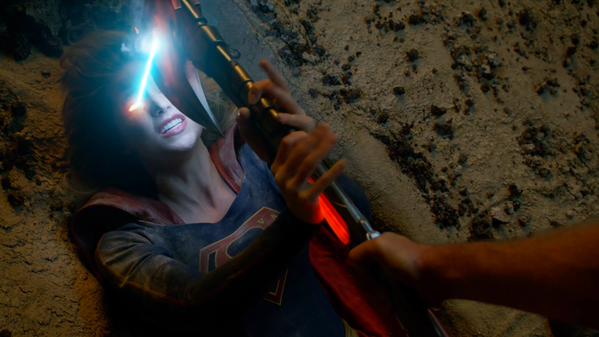
Does Supergirl (played by Melissa Benoist) have pierced ears? If so, how? Being invulnerable, nothing should be able to pierce her earlobes (or anything else) unless she's weakened by Kryptonine.
Evidence:
Look closer. See that right earlobe? It doesn't look like a clip on.
See! I told you. That sure looks like an earring to me, and I can't see how it could be a clip on.
OK, are there other such photos? Most of the time Benoist's hair is down so it's difficult to see her ears but in this photo, it could be an earring (click on each image to see a larger version).
While there doesn't appear to be one here.
Kara, as opposed to Supergirl, most often wears her hair in a ponytail or otherwise off her ears. Let's see what we can see.
Yes, an earring.
Same here.
Same here.
In other words, either her earrings are held on by a magnetic backing (and that would be a pretty strong magnetic field to keep them on her during fight scenes), or the folks at CBS made a big goof.
How else can you explain this?
OK, I'm taking a small detail and blowing it up way out of proportion, but on the other hand, I'm a trivia nut and I really get off on little details like this one.
What next? Superman with unexplained facial piercings?
Oh, I got the first image from the DC Comics blog.
Showing posts with label DC comics. Show all posts
Tuesday, November 3, 2015
Friday, October 30, 2015
The Pilot Episode of Supergirl: A Review
I hadn't originally intended on watching the pilot episode of Supergirl starring Melissa Benoist in the title role, but it was online, it was free, so I figured, what the heck. I didn't expect to like it all that much, but I was curious how CBS was going to adapt decades of Superman and Supergirl canon. My reaction is mixed.
I've read a few of the other reviews of the pilot, both before and after I saw the episode, and they range from "good but not perfect" to "triumph for everyone wanting a strong female hero for a change". You can see examples at Yahoo News, IGN, The Mary Sue, and The Los Angeles Times.
The episode started out with a summary of how Kara Zor-El came to Earth. Launched from a doomed Krypton just minutes after her infant cousin Kal-El, 12-year old Kara was charged by her parents with taking care of the baby after they both arrived on Earth. Granted, no one would have had a clue where Kal-El was going to land on the alien planet and under what conditions, but sending a mere 12-year-old on such a mission was a long shot at best. Still, the writers had to inject her into the canonical story of how Superman got to our planet somehow.
Then, her space pod is caught in the shock wave caused the Krypton's explosion and is sent hurdling off course and into the Phantom Zone where time doesn't pass.
Some years later (at least as time passes outside the Zone), her ship is mysteriously freed and somehow finds its way to its original destination...Earth. When it lands, the pod opens and Kara is greeted by her cousin, grown to an adult, and already sporting the blue and red.
(At this point, I figured out that this show isn't leveraging the film Man of Steel (2013) starring Henry Cavill and instead represents a separate canon)
You only see Superman in silhouette and he's never called "Superman," but it would be impossible to tell key portions of Kara's story without acknowledgement to her more famous cousin.
Kal-El places the orphaned Kara (really, the kid must be freaking out -- her entire race and home world are long gone, her parents dead, her only relative (an infant cousin who is now 12 years older than she is) and fellow Kryptonian is the most powerful hero on her new alien home planet, and he places her with Jeremiah (Dean Cain) and Eliza (Helen Slater) Danvers (I liked the nice, continuity piece of choosing these two actors, both with ties to the television and film appearances of Superman and Supergirl respectively).
I wonder how Kal-El managed the legal niceties of getting Kara adopted or was able to explain to the authorities (since adoption requires the involvement of the civil court system) who Kara is, where she came from, how her parents died, and why she doesn't have any relatives or home community to take her in...a person with absolutely no recorded history before age 12?
This was glossed over (ignored) and we next meet Kara Danvers (no need to adopt the name from the comic books of Linda Lee Danvers apparently) working as a 24-year-old "gofer" uh, assistant, to Cat Grant, owner of her own media company Cat Co.
In spite of the fact that she has decided to play a low profile in terms of her powers (the world doesn't need another superhero) and to "fit in," she's wearing glasses, which she doesn't need, as if she's maintaining a secret identity. It's true that when she finally decides to adopt the Supergirl persona (although the "girl" part was first coined by Grant), she'd need to separate Kara from the young woman in the red cape, why did she decide to wear glasses in the first place?
Benoist imbues Kara with a wholesome, naive charm and she's instantly likable. Although she's attractive, I kept relating to her more like my best friend's sister than as any sort of "hottie". I was almost taken off guard when she went out on a blind date (with someone who quickly gave her the brush off). I was also slightly surprised when she reacted to Jimmy, uh...James (Mehcad Brooks) Olsen (who admittedly is a solid hunk) with attraction (although she clearly wasn't sure what to do about it). Benoist convincingly portrays Kara as "the girl next door," the friendly, kind, helpful girl, the one you'd never think to ask out.
Kara grew up with an older (adoptive) sister Alex who has a big secret. She's an agent for a government agency created after the first appearance of the alien Superman in orter to investigate other alien appearances on our planet.
Kara doesn't know this, of course...well, not at first. She doesn't even want to be super. Not until she has to rescue her sister's overseas flight from crashing, which she barely manages (hey, even if you're super, you still have to deal with things like mass, momentum, and inertia).
It was cute when her date asked Kara where she's from originally. It was cute when we saw Kara with wide eyed wonder, shoveling down pizza while watching herself on the news rescuing the airliner. In fact, I was beginning to be overwhelmed with cute. Is this show only written for young teens?
With the help of her friend Winn (Jeremy Jordan) Schott (isn't that the last name of the Toyman?), the IT guru where she works, Kara slowly transforms into Supergirl. Kara took a big chance telling (and showing) Winn who she really is. She couldn't have predicted how he'd react. Their boss would no doubt pay a lot of money to anyone who could deliver the exclusive story of who Supergirl is and where she could be found (right under your nose, Cat).
But Winn plays the loyal if nerdy friend and helps design her costume. Well, the first one was without a midriff and our modest Kara wouldn't wear it to the beach, let alone to rescue people.
That's actually one of the things I like about the way the show characterizes Supergirl. It's not about an overwhelmingly sexy, or even cute nymphet Supergirl doing daring do. Kara, if anything, is a bit conservative, both in how she dresses and how she acts and reacts. She's like a lot of people her age, still trying to figure herself out and walking into walls (not literally) half the time. Now she's got to figure out how to be both Kara and Supergirl.
But things get muddy fast. Turns out on one of her first missions, she's all too easily captured by Alex and her boss Hank (David Harewood) Henshaw, the director of the Department of Extranormal Operations (DEO) using Kryptonite darts and holding her in Kryptonite bindings. Henshaw doesn't like aliens (even though the DEO has her spaceship) and demands that Kara stop being Supergirl. Alex backs Henshaw up, at least this time, but circumstances pull the "Maid of Steel" back into the fight.
When Kara's ship left the Phantom Zone, it didn't leave alone. Somehow (a lot of somehows), it brought along Fort Rozz, formerly Krypton's high security prison facility, crammed full of the biggest, baddest, aliens (apparently not all are Kryptonian) in the galaxy...and now they're on Earth conspiring to do what...take over the planet?
That part is left vague, but they're also plotting to bring someone called "the General" to our world, and they sabotaged Alex's flight in an attempt to kill her.
An alien prisoner named Vartox (Owain Yeoman) who wields a mean, super-heated ax, calls Kara on a special high frequency only she can hear (I think I saw this done in one of the old Christopher Reeve Superman movies) to come out and fight. Turns out these aliens not only know Kara but her Kryptonian mother, who was a judge back in the day, and had sentenced all of these interstellar tough guys to Fort Rozz. Now they want revenge against the daughter of their jailer (also a theme from the second Chris Reeve Superman movie).
Long story short, Supergirl almost gets her head handed to her (literally) but her sister arrives just in time with some serious artillery to save her. Although Henshaw again warns Kara to hang up her cape, this time Alex encourages her to be the hero she's destined to be.
In the final battle between Supergirl and Vartox, with the DEO having her back, as Kara is about to lose, Alex delivers a stirring "I believe in you" speech which turns the battle around and Supergirl saves the day (it was pretty cliche and internally, I gagged a little).
Vartox commits suicide rather than be captured, but issues the dire announcement that he's only the beginning, forecasting that future episodes will feature the alien baddie of the week with the mystery of who the General is and what she...that's right, she, wants.
As if I didn't dump enough spoilers on you already, the General is none other than Kara's aunt, leader of the band of miscreants, who would like nothing better than to see her niece dead.
So like Team Arrow and Team Flash, Supergirl now has a team, or more accurately, she's now a covert super agent for the United States Government. That's truly terrifying.
It's also concerning that Henshaw, in the 1990s comic books, became the villainous Cyborg Superman. Shades of a future story arc?
Impressions: The show tries to be a little too cute (didn't I say that enough?). I get that we're supposed to like and even feel protective of Kara, but it's hard to imagine this sweet little millennial getting the chops to play in her cousin's league. I know a hero like Wonder Woman would probably embody more of the feminist ideal, an already strong, developed, self-assured figure, so it's difficult to understand why Supergirl would be appealing as the leading female-driven superhero show on television. I suppose emerging power laced with vulnerability makes her more relatable to young girls and women than a commanding personality like Diana Prince.
From the look and feel of the show, it's seems the main demographic must be between the ages of 12 and 20. Sorry, but a lot of what I watched seemed very juvenile. Maybe I'm jaded by the darkness of most of the other superhero TV shows and films. But the Flash is light hearted and "young," and yet you get the impression that adults are also supposed to relate to the main characters. By comparison, the pilot episode of Supergirl seemed a little more "cartoonish".
I didn't outright dislike the show, but I wasn't immediately hooked either, the way I was by Arrow and The Flash. Also, the show promises to be "formulaistic" as I already mentioned, with a built-in conspiracy delivering the super villain of the week for Kara to sharpen her teeth on (not literally, of course..if you want teeth, watch The Vampire Diaries).
I do believe that the world needs more female oriented superhero shows and films, but I can also acknowledge that all of the source material for each and every one of them today is at least fifty years old. Half a century ago, comic books were overwhelmingly male driven, with just a few token females on various teams (Wonder Woman being one of the notable exceptions) to break up all that "maleness". If entertainment producers want female characters more easily adapted to modern audiences, they need to read more recently created comic books. The 1960s weren't particularly progressive compared to 2015.
All that said, I wish the show success and hope the writers manage to develop the character and her supporting cast and environment into something slightly more mature people can connect with. The show isn't bad, and I know most pilots have a lot of rough edges, but the Supergirl television show has left itself a great deal of room in which it needs to grow.
I've read a few of the other reviews of the pilot, both before and after I saw the episode, and they range from "good but not perfect" to "triumph for everyone wanting a strong female hero for a change". You can see examples at Yahoo News, IGN, The Mary Sue, and The Los Angeles Times.
The episode started out with a summary of how Kara Zor-El came to Earth. Launched from a doomed Krypton just minutes after her infant cousin Kal-El, 12-year old Kara was charged by her parents with taking care of the baby after they both arrived on Earth. Granted, no one would have had a clue where Kal-El was going to land on the alien planet and under what conditions, but sending a mere 12-year-old on such a mission was a long shot at best. Still, the writers had to inject her into the canonical story of how Superman got to our planet somehow.
Then, her space pod is caught in the shock wave caused the Krypton's explosion and is sent hurdling off course and into the Phantom Zone where time doesn't pass.
Some years later (at least as time passes outside the Zone), her ship is mysteriously freed and somehow finds its way to its original destination...Earth. When it lands, the pod opens and Kara is greeted by her cousin, grown to an adult, and already sporting the blue and red.
(At this point, I figured out that this show isn't leveraging the film Man of Steel (2013) starring Henry Cavill and instead represents a separate canon)
You only see Superman in silhouette and he's never called "Superman," but it would be impossible to tell key portions of Kara's story without acknowledgement to her more famous cousin.
Kal-El places the orphaned Kara (really, the kid must be freaking out -- her entire race and home world are long gone, her parents dead, her only relative (an infant cousin who is now 12 years older than she is) and fellow Kryptonian is the most powerful hero on her new alien home planet, and he places her with Jeremiah (Dean Cain) and Eliza (Helen Slater) Danvers (I liked the nice, continuity piece of choosing these two actors, both with ties to the television and film appearances of Superman and Supergirl respectively).
I wonder how Kal-El managed the legal niceties of getting Kara adopted or was able to explain to the authorities (since adoption requires the involvement of the civil court system) who Kara is, where she came from, how her parents died, and why she doesn't have any relatives or home community to take her in...a person with absolutely no recorded history before age 12?
This was glossed over (ignored) and we next meet Kara Danvers (no need to adopt the name from the comic books of Linda Lee Danvers apparently) working as a 24-year-old "gofer" uh, assistant, to Cat Grant, owner of her own media company Cat Co.
In spite of the fact that she has decided to play a low profile in terms of her powers (the world doesn't need another superhero) and to "fit in," she's wearing glasses, which she doesn't need, as if she's maintaining a secret identity. It's true that when she finally decides to adopt the Supergirl persona (although the "girl" part was first coined by Grant), she'd need to separate Kara from the young woman in the red cape, why did she decide to wear glasses in the first place?
Benoist imbues Kara with a wholesome, naive charm and she's instantly likable. Although she's attractive, I kept relating to her more like my best friend's sister than as any sort of "hottie". I was almost taken off guard when she went out on a blind date (with someone who quickly gave her the brush off). I was also slightly surprised when she reacted to Jimmy, uh...James (Mehcad Brooks) Olsen (who admittedly is a solid hunk) with attraction (although she clearly wasn't sure what to do about it). Benoist convincingly portrays Kara as "the girl next door," the friendly, kind, helpful girl, the one you'd never think to ask out.
Kara grew up with an older (adoptive) sister Alex who has a big secret. She's an agent for a government agency created after the first appearance of the alien Superman in orter to investigate other alien appearances on our planet.
Kara doesn't know this, of course...well, not at first. She doesn't even want to be super. Not until she has to rescue her sister's overseas flight from crashing, which she barely manages (hey, even if you're super, you still have to deal with things like mass, momentum, and inertia).
It was cute when her date asked Kara where she's from originally. It was cute when we saw Kara with wide eyed wonder, shoveling down pizza while watching herself on the news rescuing the airliner. In fact, I was beginning to be overwhelmed with cute. Is this show only written for young teens?
With the help of her friend Winn (Jeremy Jordan) Schott (isn't that the last name of the Toyman?), the IT guru where she works, Kara slowly transforms into Supergirl. Kara took a big chance telling (and showing) Winn who she really is. She couldn't have predicted how he'd react. Their boss would no doubt pay a lot of money to anyone who could deliver the exclusive story of who Supergirl is and where she could be found (right under your nose, Cat).
But Winn plays the loyal if nerdy friend and helps design her costume. Well, the first one was without a midriff and our modest Kara wouldn't wear it to the beach, let alone to rescue people.
That's actually one of the things I like about the way the show characterizes Supergirl. It's not about an overwhelmingly sexy, or even cute nymphet Supergirl doing daring do. Kara, if anything, is a bit conservative, both in how she dresses and how she acts and reacts. She's like a lot of people her age, still trying to figure herself out and walking into walls (not literally) half the time. Now she's got to figure out how to be both Kara and Supergirl.
But things get muddy fast. Turns out on one of her first missions, she's all too easily captured by Alex and her boss Hank (David Harewood) Henshaw, the director of the Department of Extranormal Operations (DEO) using Kryptonite darts and holding her in Kryptonite bindings. Henshaw doesn't like aliens (even though the DEO has her spaceship) and demands that Kara stop being Supergirl. Alex backs Henshaw up, at least this time, but circumstances pull the "Maid of Steel" back into the fight.
When Kara's ship left the Phantom Zone, it didn't leave alone. Somehow (a lot of somehows), it brought along Fort Rozz, formerly Krypton's high security prison facility, crammed full of the biggest, baddest, aliens (apparently not all are Kryptonian) in the galaxy...and now they're on Earth conspiring to do what...take over the planet?
That part is left vague, but they're also plotting to bring someone called "the General" to our world, and they sabotaged Alex's flight in an attempt to kill her.
An alien prisoner named Vartox (Owain Yeoman) who wields a mean, super-heated ax, calls Kara on a special high frequency only she can hear (I think I saw this done in one of the old Christopher Reeve Superman movies) to come out and fight. Turns out these aliens not only know Kara but her Kryptonian mother, who was a judge back in the day, and had sentenced all of these interstellar tough guys to Fort Rozz. Now they want revenge against the daughter of their jailer (also a theme from the second Chris Reeve Superman movie).
Long story short, Supergirl almost gets her head handed to her (literally) but her sister arrives just in time with some serious artillery to save her. Although Henshaw again warns Kara to hang up her cape, this time Alex encourages her to be the hero she's destined to be.
In the final battle between Supergirl and Vartox, with the DEO having her back, as Kara is about to lose, Alex delivers a stirring "I believe in you" speech which turns the battle around and Supergirl saves the day (it was pretty cliche and internally, I gagged a little).
Vartox commits suicide rather than be captured, but issues the dire announcement that he's only the beginning, forecasting that future episodes will feature the alien baddie of the week with the mystery of who the General is and what she...that's right, she, wants.
As if I didn't dump enough spoilers on you already, the General is none other than Kara's aunt, leader of the band of miscreants, who would like nothing better than to see her niece dead.
So like Team Arrow and Team Flash, Supergirl now has a team, or more accurately, she's now a covert super agent for the United States Government. That's truly terrifying.
It's also concerning that Henshaw, in the 1990s comic books, became the villainous Cyborg Superman. Shades of a future story arc?
Impressions: The show tries to be a little too cute (didn't I say that enough?). I get that we're supposed to like and even feel protective of Kara, but it's hard to imagine this sweet little millennial getting the chops to play in her cousin's league. I know a hero like Wonder Woman would probably embody more of the feminist ideal, an already strong, developed, self-assured figure, so it's difficult to understand why Supergirl would be appealing as the leading female-driven superhero show on television. I suppose emerging power laced with vulnerability makes her more relatable to young girls and women than a commanding personality like Diana Prince.
From the look and feel of the show, it's seems the main demographic must be between the ages of 12 and 20. Sorry, but a lot of what I watched seemed very juvenile. Maybe I'm jaded by the darkness of most of the other superhero TV shows and films. But the Flash is light hearted and "young," and yet you get the impression that adults are also supposed to relate to the main characters. By comparison, the pilot episode of Supergirl seemed a little more "cartoonish".
I do believe that the world needs more female oriented superhero shows and films, but I can also acknowledge that all of the source material for each and every one of them today is at least fifty years old. Half a century ago, comic books were overwhelmingly male driven, with just a few token females on various teams (Wonder Woman being one of the notable exceptions) to break up all that "maleness". If entertainment producers want female characters more easily adapted to modern audiences, they need to read more recently created comic books. The 1960s weren't particularly progressive compared to 2015.
All that said, I wish the show success and hope the writers manage to develop the character and her supporting cast and environment into something slightly more mature people can connect with. The show isn't bad, and I know most pilots have a lot of rough edges, but the Supergirl television show has left itself a great deal of room in which it needs to grow.
Labels:
DC comics,
DC universe,
review,
supergirl,
Supergirl pilot,
superheroes,
TV show review
Sunday, June 15, 2014
DVD Review of Arrow the Pilot Episode
I've heard nothing but good about the television series Arrow (2012 - ) for quite some time, but I rarely watch shows while they are current, so I have been missing out. I was considering renting the DVDs of the first season when I saw a discounted box set of season one in the store yesterday. Throwing caution and my budget to the winds, I bought it. Last night I watched episode 1 of season 1: The Pilot.
Assuming Stephen Amell, who plays Oliver Queen/Arrow, does his own stunts, I'm impressed. The episode starts out like a shot with this mad figure scrambling quickly over rough terrain, running up seemingly impossible angles, and then shooting an arrow an incredible distance down to the beach of an island to explosively ignite a wood pyre, signaling his rescuers.
The mystery begins from the very start of the show. Who is this guy? How did he get on the island? What happened to him there?
The story of Oliver Queen of five years ago is told in flashbacks, with just enough information to tell the audience this is no simple "stranded" story. There are actually multiple mysteries. Who is Oliver's father and why, after their yacht exploded in the South China Sea, was he willing to do anything, including commit murder and then suicide, to insure Oliver's survival? Why does Robert Queen (Jamey Sheridan) tell Oliver the truth only at the end, and expect his son to right all of Queen's wrongs in Starling (not "Star") City? How did he know that Oliver would not only survive, but that his spoiled, playboy son would take on the mission set before him as well as acquire the drive and the skills to do so?
As Oliver's doctor told his mother Moira (Susana Thompson), he may not be the same son she knew five years before. That's something of an understatement.
The original comic book story was very simple fare by comparison. Millionaire playboy Oliver Queen is shipwrecked on an island for some years and, in order to survive, he taught himself archery. After he is rescued, for no particular reason, Oliver takes on a ward, Roy Harper, creates identities for them as Green Arrow and Speedy, and recreates all of Batman's gimmicks and gadgets (Arrow Cave, Arrow Car, Arrow branded everything) redone in an archery motif, and then fights crime with a bunch of tricked out arrows.
Of course, this was back in the day when comic books were written primarily for children. The 1970s saw Ollie evolve after losing his fortune (Roy grew up, moved away, and became a heroin addict) into an angry maverick with a hyper-developed drive to help the underdog and massive distrust of the establishment. But that was then.
Green Arrow, prior to this series, was most recently featured in a live action show in the landmark television series Smallville, but Justin Hartley's emerald archer was no where near as dark as how he is played by Amell. He was still darker than the world's ultimate boy scout Clark Kent (Tom Welling), but in order to keep Smallville at a certain level of "goodness," Hartley's version of "Arrow" could only fall so far.
Not so this Arrow who commits cold-blooded murder because "No one can know my secret." I only know this person from one episode of the show, but I would guess that his secret isn't just that he plans to fight crime while wearing a green hood and shooting arrows.
In fact, with few exceptions, Queen's arrows have no gimmicks and they do what arrows are supposed to do: put holes in things and people, including fatal holes.
Oliver's family is just as mysterious and troubled as he is. His mother was remarried (presumably they had Robert Queen declared legally dead since there was no definitive proof -- that is "a body" -- he was deceased) to Walter Steele (Colin Salmon, formerly "Charles" in the Pierce Brosnan "James Bond" films), his teenage sister Thea ("Speedy") is into drugs, and his best friend and "wingman" Tommy Merlyn (Colin Donnell) has been spending time in the sheets with his ex-girlfriend Laurel Dinah Lance (Katie Cassidy).
But while re-connecting to his former life is heavily on Oliver's mind, the greater weight in contained in a small notebook of names, the first one on the list (actually, it's in the middle of the list) is Adam Hunt (Brian Markinson).
Oliver isn't after the common thug in the street. He's pursuing men formerly associated with his father, men who all had a hand in the ruin of Starling City, men who Oliver will make (literally) pay, and he'll do anything to succeed...anything.
Oliver's baptism of fire is a kidnap attempt by a group of thugs wearing skull masks. They seem to know more about Oliver than the audience does. Did Tommy wake up in time to see his best friend take these guys out with ridiculous ease or was he telling the truth when he later said he was still too drugged to see more than a blurred movement?
Five years ago, Oliver was on the yacht having an affair with Sara Lance, Laurel's sister. Laurel isn't the only one who blames Oliver for her death. The detective in charge of investigating Oliver's and Tommy's kidnapping is their father Quentin Lance (Paul Blackthorne). Starling City must be a small town for people to cross-connect so closely.
Oliver came back from that island with not only enhanced survival skills, but the ability to speak Russian. Also, he's not only scarred and burned (which didn't happen in the yacht sinking) but tattooed front and back. He couldn't have tattooed his back by himself, so he wasn't alone on that island for those five years.
By threat and brute force, "Arrow" (his alter ego isn't given a name in the pilot) extorts $40 million from Hunt but leaves him alive. His brand of justice or revenge doesn't demand death but it does demand a lot of money, which is funneled into the bank accounts of (presumably) Hunt's victims.
After the kidnapping attempt, "Mommy Dearest" assigns a bodyguard to Oliver, an ex-military type named John Diggle (David Ramsey). How is Oliver going to sneak out at night with his own personal shadow tagging along? You can only grab and knock out a guy so many times before he starts to get suspicious.
The pilot episode is full of surprises, particularly how Oliver's mother was the one who arranged for him to be kidnapped in the first place.
Nothing is as simple as it seems. What was Robert Queen, Oliver, Sara, and four other people doing aboard a yacht in the South China Sea? Did the yacht sink because it was caught in a storm or did something more sinister happen? The last we see of Sara, she's falling into the water and disappears. Robert, Oliver, and one other person survive the initial sinking. Did Sara really die or will we see her again?
It almost seems as if Oliver's destiny to become "Arrow" and to avenge the wrongs done in Starling City was set in motion even before the yacht sank. Is there a master player or organization manipulating events behind the scenes?
Laurel Lance is named after the comic book character Black Canary. Does she have a future as a superhero? Oliver called his sister "Speedy" which is the comic book identity of Green Arrow's teenage sidekick. Would this show create a brother-sister crime fighting team? Who is Tommy? There are indications he's not just the happy-go-lucky pal he seems to be on the surface. What does his relationship with Laurel mean? Why would Sara betray her sister by sleeping with her sister's boyfriend?
The pilot episode of Arrow creates a good balance of mystery and action right from the beginning. It's as if Oliver, in trying to rediscover his life in Starling City is also rediscovering himself. We have seen only a tiny fraction of what happened after the yacht sank five years ago and Oliver was inexorably swept to the island which would become his home, prison, training ground, and I suspect so much more. What else will the series reveal about the secret of Oliver Queen and the person who will be known as "Arrow"? I'll post my impressions as I continue to review the first season of this series.
Assuming Stephen Amell, who plays Oliver Queen/Arrow, does his own stunts, I'm impressed. The episode starts out like a shot with this mad figure scrambling quickly over rough terrain, running up seemingly impossible angles, and then shooting an arrow an incredible distance down to the beach of an island to explosively ignite a wood pyre, signaling his rescuers.
The mystery begins from the very start of the show. Who is this guy? How did he get on the island? What happened to him there?
The story of Oliver Queen of five years ago is told in flashbacks, with just enough information to tell the audience this is no simple "stranded" story. There are actually multiple mysteries. Who is Oliver's father and why, after their yacht exploded in the South China Sea, was he willing to do anything, including commit murder and then suicide, to insure Oliver's survival? Why does Robert Queen (Jamey Sheridan) tell Oliver the truth only at the end, and expect his son to right all of Queen's wrongs in Starling (not "Star") City? How did he know that Oliver would not only survive, but that his spoiled, playboy son would take on the mission set before him as well as acquire the drive and the skills to do so?
As Oliver's doctor told his mother Moira (Susana Thompson), he may not be the same son she knew five years before. That's something of an understatement.
The original comic book story was very simple fare by comparison. Millionaire playboy Oliver Queen is shipwrecked on an island for some years and, in order to survive, he taught himself archery. After he is rescued, for no particular reason, Oliver takes on a ward, Roy Harper, creates identities for them as Green Arrow and Speedy, and recreates all of Batman's gimmicks and gadgets (Arrow Cave, Arrow Car, Arrow branded everything) redone in an archery motif, and then fights crime with a bunch of tricked out arrows.
Of course, this was back in the day when comic books were written primarily for children. The 1970s saw Ollie evolve after losing his fortune (Roy grew up, moved away, and became a heroin addict) into an angry maverick with a hyper-developed drive to help the underdog and massive distrust of the establishment. But that was then.
Green Arrow, prior to this series, was most recently featured in a live action show in the landmark television series Smallville, but Justin Hartley's emerald archer was no where near as dark as how he is played by Amell. He was still darker than the world's ultimate boy scout Clark Kent (Tom Welling), but in order to keep Smallville at a certain level of "goodness," Hartley's version of "Arrow" could only fall so far.
Not so this Arrow who commits cold-blooded murder because "No one can know my secret." I only know this person from one episode of the show, but I would guess that his secret isn't just that he plans to fight crime while wearing a green hood and shooting arrows.
In fact, with few exceptions, Queen's arrows have no gimmicks and they do what arrows are supposed to do: put holes in things and people, including fatal holes.
Oliver's family is just as mysterious and troubled as he is. His mother was remarried (presumably they had Robert Queen declared legally dead since there was no definitive proof -- that is "a body" -- he was deceased) to Walter Steele (Colin Salmon, formerly "Charles" in the Pierce Brosnan "James Bond" films), his teenage sister Thea ("Speedy") is into drugs, and his best friend and "wingman" Tommy Merlyn (Colin Donnell) has been spending time in the sheets with his ex-girlfriend Laurel Dinah Lance (Katie Cassidy).
But while re-connecting to his former life is heavily on Oliver's mind, the greater weight in contained in a small notebook of names, the first one on the list (actually, it's in the middle of the list) is Adam Hunt (Brian Markinson).
Oliver isn't after the common thug in the street. He's pursuing men formerly associated with his father, men who all had a hand in the ruin of Starling City, men who Oliver will make (literally) pay, and he'll do anything to succeed...anything.
Oliver's baptism of fire is a kidnap attempt by a group of thugs wearing skull masks. They seem to know more about Oliver than the audience does. Did Tommy wake up in time to see his best friend take these guys out with ridiculous ease or was he telling the truth when he later said he was still too drugged to see more than a blurred movement?
Oliver came back from that island with not only enhanced survival skills, but the ability to speak Russian. Also, he's not only scarred and burned (which didn't happen in the yacht sinking) but tattooed front and back. He couldn't have tattooed his back by himself, so he wasn't alone on that island for those five years.
By threat and brute force, "Arrow" (his alter ego isn't given a name in the pilot) extorts $40 million from Hunt but leaves him alive. His brand of justice or revenge doesn't demand death but it does demand a lot of money, which is funneled into the bank accounts of (presumably) Hunt's victims.
After the kidnapping attempt, "Mommy Dearest" assigns a bodyguard to Oliver, an ex-military type named John Diggle (David Ramsey). How is Oliver going to sneak out at night with his own personal shadow tagging along? You can only grab and knock out a guy so many times before he starts to get suspicious.
The pilot episode is full of surprises, particularly how Oliver's mother was the one who arranged for him to be kidnapped in the first place.
Nothing is as simple as it seems. What was Robert Queen, Oliver, Sara, and four other people doing aboard a yacht in the South China Sea? Did the yacht sink because it was caught in a storm or did something more sinister happen? The last we see of Sara, she's falling into the water and disappears. Robert, Oliver, and one other person survive the initial sinking. Did Sara really die or will we see her again?
It almost seems as if Oliver's destiny to become "Arrow" and to avenge the wrongs done in Starling City was set in motion even before the yacht sank. Is there a master player or organization manipulating events behind the scenes?
Laurel Lance is named after the comic book character Black Canary. Does she have a future as a superhero? Oliver called his sister "Speedy" which is the comic book identity of Green Arrow's teenage sidekick. Would this show create a brother-sister crime fighting team? Who is Tommy? There are indications he's not just the happy-go-lucky pal he seems to be on the surface. What does his relationship with Laurel mean? Why would Sara betray her sister by sleeping with her sister's boyfriend?
The pilot episode of Arrow creates a good balance of mystery and action right from the beginning. It's as if Oliver, in trying to rediscover his life in Starling City is also rediscovering himself. We have seen only a tiny fraction of what happened after the yacht sank five years ago and Oliver was inexorably swept to the island which would become his home, prison, training ground, and I suspect so much more. What else will the series reveal about the secret of Oliver Queen and the person who will be known as "Arrow"? I'll post my impressions as I continue to review the first season of this series.
Labels:
action,
Arrow,
CW,
DC comics,
DVD review,
green arrow,
oliver queen,
review,
superhero,
television series
Monday, July 8, 2013
Film Review: The Man of Steel
I'm in a little bit of shock. I don't usually see movies so close to their release date. Nevertheless, on Sunday, July 7th, I was sitting in a local movie theatre watching Man of Steel (2013). I couldn't have been happier.
A word of warning, especially if you haven't seen the film yet (and I highly recommend that you do). I'm going to be dropping spoilers all over the place. If you don't like surprises ruined, then save this review until after you've seen the film. Remember, you have been warned.
I love this movie. I really do. It's not a perfect film but it's very, very close. As far as superhero films go, I thought The Dark Knight (2008) completely nailed it, and Heath Ledger's portrayal of the Joker sent it over the top. I thought The Avengers (2012) was just as good, although in a completely different style. I'd have to say that Man of Steel comes very, very close to equaling those two other movies with just a few small problems.
First things first, though.
The Movie
Man of Steel starts out with a bang, almost literally. We're on the planet Krypton. The son of Jor-El (Russell Crowe) and Lara (Ayelet Zurer), Kal-El (when referred to by his Kryptonian name, he's called "Kal" most of the time) is the first natural birth on their planet in centuries. He doesn't have much time to enjoy that distinction.
The planet Krypton is about to explode. This is straight from Superman canon going back at least fifty years. Jor-El confronts the planetary council and begs them to take the only option they have left after centuries of consuming the core of their now unstable planet: space travel. One hundred thousand years past, Krypton had a thriving system of space colonies. They eventually became a more introspective and even xenophobic race and withdrew from space, abandoning all the colony worlds. If they don't revive that tradition and very quickly, the planet's explosion will destroy the Kryptonian civilization.
The old guard in the council refuse to accept this. Jor-El speaks to deaf ears. But General Zod (Michael Shannon) has another plan. Violent overthrow of the government in order to save the essence of what Krypton is. Jor-El approves of saving Kryptonians but not by bloodshed.
Lots of action ensues and not only does Jor-El illegally launch his newborn son into space, but he sends the stolen codex, the genetic record of all Kryptonians, into the void with him, rocketing to an unnamed planet with a yellow sun.
In the battle to prevent Zod from stopping the launch, Jor-El is killed. Zod and his commanders, including Faora-Ul (Antje Traue), are captured and condemned to the Negative Zone. With her husband dead and her son sent into an uncertain future on an alien planet, Lara lives long enough to mourn before being killed along with her entire species as her native world explodes.
A space warp opens and a ship emerges just outside Saturn's orbit. The ship negotiates the rest of its journey with remarkable speed, passing Earth's moon and then entering the atmosphere...
...shift to the present on a fishing boat where a mysterious man with a beard is working, although this is hardly the sort of job he's used to. An emergency call from a burning oil platform. Men trapped inside. The stranger disappears from the boat and the trapped men are confronted by a shirtless man standing in the naked flames unburned...one who can rip a steel door open with his bare hands.
They all make it out and onto a rescue helicopter in time except for the stranger, who manages to keep the flaming, melting superstructure of the rig from collapsing on the aircraft until it can take off.
Clark Kent's (Henry Cavill) life story is told from present to past and back to present in a series of flashbacks. As the stranger travels from town to town in the frozen north, he picks up clues to the mystery he's searching for...an artifact of some kind trapped in a glacier over ten-thousand years old.
He's a quiet man, almost serene at times. He wants to help, even when it's not appreciated. He doesn't quite fit in. He keeps moving.
Enter Lois Lane (Amy Adams) by helicopter at the arctic site where the American military and scientists, including Dr. Emil Hamilton, still can't find a way to investigate whatever is buried in the ice. She almost doesn't notice a worker named "Joe" who is assigned to carry her luggage.
That is, until she sees him later that night outside in the sub-zero weather wearing no coat. She follows him. It almost kills her.
Besides the ship, Clark came from Krypton with two artifacts: the codex and a key displaying his family crest. Clark burns his way through the ice and into what turns out to be an ancient Kryptonian scout ship. He activates the ship with the key and his father's "personality" is uploaded. Jor-El answers all of Kal's questions. Lois isn't so lucky since the ship's security identifies her as an alien.
Clark saves her...the first of many times. He places the wounded woman outside where she's quickly found by others. The ship launches and then lands in another part of the arctic, this time without witnesses. Jor-El tells Kal of his destiny, gives him the undersuit to the battle armor worn by the House of El. It's a suit that is unmistakably familiar to generations of people in search of a hero.
We learn in flashbacks that Clark's amazing calm (no, he's not emotionless) is a result of how his parents brought him up. His mother Martha (Diane Lane) helped young Clark overcome the debilitating sensory overload when the vast information gathering power of his eyes and ears turned on all at once.
His father Jonathan (Kevin Costner) was hard on Clark, desperate to protect him, and he's the one who taught Clark to endure any abuse or insult, no matter how harsh, as opposed to using his vast power to strike back, which would not only kill, but expose young Clark to a government that would most assuredly exploit or destroy him if they knew of his existence.
But sometimes young Clark had to help. A blow out of a school bus tire sends the vehicle over the side of a bridge and into a river. Everyone is going to drown...except one young teenage boy. He's the boy who pushes the bus back onto the bank and then dives under the water to pull out Pete Ross (the teen version played by Jack Foley), who only minutes before had been teasing him.
Jonathan and Martha later try to calm Pete's mother down as she rants on about how Lana (Jadin Gould), Pete, and several other kids saw what Clark did. After all, how could any human being, especially a thirteen year old boy, push a school bus out of a river? This isn't the first time Clark's done something like this, but it's rare enough that it only attracts local attention...for now.
As an adult, Clark has an almost supernatural calm. But he's not perfect. When he's bullied by some drunk in a bar, Clark just walks away. But when the trucker walks outside, his rig is a twisted mess, tangled with cable and tree trunks. Apparently Clark can lose his cool, but only when no one can see and so that no one gets hurt.
When Perry White (Laurence Fishburne) refuses to print Lois's story about the alien stranger and the ancient spacecraft in the Daily Planet, she goes on a personal quest, starting with "Joe" at the arctic site and working backwards, searching records for mention of a dark stranger, a loner with a penchant for helping, and who sometimes seems more than human.
Apparently, it's not hard to follow the trail, which leads the reporter straight to Smallville, Kansas, restaurant manager Pete Ross (as an adult played by Joseph Cranford), and finally, Martha Kent.
Lois meets Clark again at his father's grave. She knows who he is now. And because of who he is, she kills her story. She'll never tell anyone about him as long as she lives...if she can help it.
It might have ended there if not for the message from a ship from the stars: "You are not alone." When Krypton exploded, the Phantom Zone was opened and Zod and his commanders were freed. They converted the "phantom drive" of the prison ship to a warp drive and then searched the old, long dead colony worlds for decades, picking up old technology, looking for the lost Kal-El, until Clark's entrance into the scout ship activated a signal and led Zod straight to Earth.
This is when the world learns that they have had an alien in their midst for thirty-three years. This is when they find out if he's a threat or a hero.
That's really the point of the movie in many ways. Ten and twelve year old boys in 1938 wouldn't have asked themselves how we'd all react if we really found out we weren't alone in the universe. They wouldn't have wondered how the human race would respond to an alien "Superman" whose powers would make it all too easy for him to kill millions. They'd have assumed he was good and a hero and a lot of fun to read about. They wouldn't have a clue how a flawed and panicky mankind would really see a stranger from the stars who could "bend steel in his bare hands."
The love story between Kal and Lois is handled well. She does name him "Superman" in a lull in the action, after Kal surrenders himself to the military and before he is surrendered to Zod in exchange for Zod not destroying Earth. They only finally kiss near the end of the film but the magnetism between them is obvious and forged by her search for his story and her integrity in keeping his secret.
It's Lois who saves Kal on Zod's ship where the Kryptonian environment maintained on board weakens the would be "Man of Steel" and even makes him sick. She uses the key given to her by Kal, since she was turned over to Zod as well, to upload Jor-El, and the simulation of Kal-El's father sends her off the ship in an escape pod along with the secret Jor-El teaches her of returning Zod and his crew back to the Phantom Zone.
Jor-El reprograms the environment on the ship for Earth normal, and Kal's powers are back...but not before a blood sample is taken, which is important later on.
Superman rescues Lois from her damaged space pod and sets her down on Earth. But the battle is on. Zod and his team come to Earth, to Smallville. They want Kal's ship and the codex that is supposed to be inside.
The problem is not only how Superman is supposed to handle numerous super-powered Kryptonian soldiers, all wearing battle armor. It's also how the U.S. military considers all Kryptonian's a threat, including Kal. The human weapons can't really hurt him but the betrayal can, especially since he gave up everything to protect them.
However, after the immediate battle is finished and Kal exploits the one weakness the Kryptonians are sure to have and sends them back to their ship, General Swanwick (Harry Lennix) tells his troops, "this man is not our enemy."
This is also where Clark's calm and his father's love and trust pay off. After the fight is over, Kal pushes the wreckage aside and finds dozens of American troops all pointing their weapons at him. He looks at them. He's serene, almost parental. He slowly, calmly walks up to them and past them. They can't fire. Everyone is in awe of him, not just his powers, but how almost godlike he is.
"This man is not our enemy." It's the first time Kal-El becomes Superman, Earth's greatest protector.
Lois shares the secret of stopping Zod and his lieutenants with Kal. It involves Kal's ship and the Kryptonian key. It may be too late. Zod uses his ship in tandem with something called a "World Engine" to attempt to change Earth's environment into Krypton's. Zod discovered one unpleasant thing in Smallville. Kal's ship didn't contain the codex. His blood sample revealed that Jor-El had encoded all of Kal's cells with the genetics of millions of Kryptonians. They could be used to restore their race using the Genesis chamber in the scout ship. But doing that would exterminate all terrain life...including human beings.
All Zod has to do is kill the son of his enemy and take his blood to make his race live again. It's all Zod knows how to do. It's the one thing that gives Kal the advantage. On Krypton, everyone is artificially nurtured from conception to birth. All their characteristics including their role in society are predetermined. This was true of even Jor-El and Lara, just as it is true of Zod. Kal-El was the first natural birth on Krypton in centuries. Of all Kryptonians, only Kal-El is free to choose his own destiny. It's what saves his life when, after the rest of the Kryptonian soldiers are sent back to the Zone, he is faced with battling a desperate and incredibly dangerous General Zod alone.
Kal-El wins. Superman wins. The world is saved. But the cost is horrible. Kal has to give up everything. His ship, the scout ship. All of Zod's technology. Even the key bearing the crest of the House of El. All that is left of Krypton is its last son...and the DNA of his race now trapped in his body, with no way to release them, to regrow them, to restore their lives. Perhaps even his mother and father are somewhere inside of him.
There's one more cost, the worst of all. In order to save people, Kal had to take a life. It devastates him. But Lois is there to comfort him.
Man of Steel is a virtual rollercoaster ride of action and is paced wonderfully so that the more "narrative" portions of the film take nothing away. I especially loved Clark's relationship with his father Jonathan. As an older teen, Clark chafed at being controlled but in the end, his father, who was also a very calm and parental man, was always right. Even on the day he died.
Heroes
Superman wasn't the only hero. The world was full of them. OK, to be fair, there were also a lot of jerks in the movie, which was part of Clark's problem. When Zod gives him only twenty-four hours to surrender to the authorities, Clark doesn't know what to do. Are human beings worth it? He's an alien but he was raised in Kansas. He turns to the only authority who he thinks can help him, a Priest in a church.
I'm glad this scene was included. Clark was raised by a farm family in a small town in the middle of Kansas. His values from a young age were almost certainly conservative and he probably went to church as a child. Hollywood has been phobic about having their heroes be religious for decades now for fear of offending someone, but the movie, television, and comic book media abandon and important aspect of many people's reality by enforcing a politically correct (and real world incorrect) view of our world.
In his context, church is the only place where Clark could learn why it was right for him to surrender to save a people who might end up hating him just for who he is. The priest, once learning that he's in the same room with a potentially dangerous alien, maintains his composure (after a moment of total shock) and tells Clark that we have to have faith before we can earn trust. It's that message that enables Clark to do the most heroic thing he's ever done...protect the human race even if they aren't worth it.
Except they are.
Jonathan Kent dies when his son Clark is seventeen years old. There's a sudden tornado. Traffic is backed up. Jonathan sends Clark to shelter under a freeway overpass to protect his mother while Jonathan helps rescue other people. Something goes wrong. Jonathan's caught out in the open with a broken ankle. He'll never get to safety in time. Clark struggles against a lifetime of inhibition against using his powers and almost races forward to save the only father he's ever known.
Then he sees his father. Jonathan looks right at Clark and calmly, quietly raises his hand telling Clark to stop. He's almost smiling at his son when the tornado strikes. Clark let his father die because he trusted that his Dad knew what was right. As much as anyone, Jonathan Kent lived and died to show his son what being a hero was all about.
Perry White is a hero. In the destruction caused by Zod's ship and the World Engine, as gravity is turned upside down and inside out, a Planet staffer is caught under some rubble. There isn't time to get her out and destruction is coming. Perry and reporter Steve Lombard could still run away and survive, but then the young woman would die alone. They stay. And halfway around the world, an all but exhausted Superman stops the World Engine just in time.
Colonel Nathan Hardy (Christopher Meloni) is a hero. He's a soldier, so you short of suspect he should be, but even knowing how impossible it is to stop any Kryptonian soldier, he still goes toe to toe with Faora...with a knife. She tells him that a good death is its own reward. A line he'll use against her at their next and last meeting. Even more than General Swanwick, I liked Hardy. At first, I thought he'd be a typical Army hardass, but he was always at the front of the action, never shirking risks his men were taking, protecting them, protecting his people.
Even Emil Hamilton was a hero, on board a crippled aircraft activating Kal's ship at the last second so it could be used to send the Kryptonians back to the Phantom Zone.
Lois Lane is a hero. She kept a secret that if revealed, would have made her internationally famous overnight (true, she'd already won the Pulitzer Prize for Journalism). At first it was out of respect, but eventually it would be love that turned a hard nosed and jaded reporter into a woman with a conscience who would sacrifice even her career for the hero we don't deserve but desperately need.
A Few Problems
Superman supposedly gets his abilities from sunlight. Somehow, his biology allows him to absorb the rays of the yellow sun, store their energy, and turn it into the source for his amazing powers. He generates a field around his body that makes him invulnerable and enables him to fly. Sunlight also powers his strength and his sensory abilities. He can even survive for brief periods in orbital space (and who knows what his limits are in this universe?).
So why does Kryptonian air and Kryptonian gravity suddenly make him weak, sick, and have him spitting up blood?
Here's a much bigger problem. Clark shouldn't have a secret anymore.
It seemed almost easy for Lois to start at the arctic base and work her way backward through Clark's history, eventually tracing him to Smallville. Pete Ross remembered Clark and when Superman crashed into his diner during the battle with the Kryptonians, Pete looks right at his face and knows who he is.
Martha Kent told Lois about her son. I don't know why she trusted Lois.
After Kal rescues Lois from the burning space pod when they escaped from Zod's ship, he leaves her by a country road to go battle Zod who had invaded his mother's farm. Lois gets a ride from a passing police car. They take her to the Kent farm where they can obviously see a costumed Clark Kent talking with his mother.
Later, when its discovered that Kal's ship is the secret to sending the Kryptonian criminals back into the Phantom Zone, the military just retrieve it from the storm cellar under the Kent's barn.
And at the very end of the film, when General Swanwick is asking Superman how he could ever be sure Kal wouldn't turn against American interests, the last son of Krypton replies, "I was raised in Kansas. I'm about as American as you can get."
Duh!
But at the very, very end, Perry White introduces a new stringer to Lois and Steve Lombard and asks them to show him the ropes. It's Clark Kent in a suit and glasses and a winning smile.
Humor
A number of the other reviews I've read of this film have complained that Man of Steel lacks the ability to make fun of itself, that it's too dark, too serious. I know my fear was that too much camp would be inserted into the movie and I'm thankful I was wrong, but most critics say movies about Superman need to have the ability to poke a little fun at themselves.
But this movie does that. I guess no one was paying attention.
The first time Martha sees Clark in his costume, she wryly comments, "Nice suit."
When Kal turned himself in to the military, he was handcuffed. He's sitting in a room talking with Lois while being watched by a lot of soldiers including General Swanwick. He can see all of them and standing to address them, Superman tells them they are afraid of him because they can't control him. He punctuates that statement by breaking the handcuffs, startling everyone behind the glass.
This may have been unintentional, but in the final battle with Zod, the General finally strips off his battle armor revealing his under suit...which looks a lot like Kal's except it has no cape. At one point Zod, having recently learned how to fly, grabs Superman's cape and uses it to whip Clark around and throw him several hundred feet into a building. Inside my head, I heard a tiny voice whisper "no capes."
When new reporter Clark Kent is introduced to Lois Lane for the first time, she says, "Welcome to the Planet," obviously referencing his being from another planet.
British Henry Cavill playing Superman tells General Swanwick that he's as American as they come. That's got to be worth a chuckle.
There weren't a lot of jokes in the movie. It wasn't that kind of film. But I did see that Man of Steel was able to wink at itself from time to time.
Smallville Television Show
There were a few tie-ins but just a few. In the Smallville TV show, Dr. Emil Hamilton is played by actor Alessandro Juliani. In Man of Steel, Juliani plays a minor role as Officer Sekowsky, a technician at the site where the Kryptonian scout ship was found.
Of course, actress Amy Adams plays Lois Lane in the film. However, she also played a high school student in the first season Smallville TV episode Craving (2001).
I know when this film was first announced, an overwhelming number of fans of the Smallville show demanded that Tom Welling and Erica Durance play Clark/Superman and Lois Lane respectively.
Having seen the film, it's tone, it's personality, I just can't see those two fine actors pulling it off the way Henry Cavill and Amy Adams played Clark and Lois. Welling was a great teenage Clark Kent, but even though Cavill is only six years older than Welling, the Smallville actor's youthful face wouldn't have carried over into the maturity that Cavill brought to the role. Cavill is young enough to communicate charm, especially once he puts on the glasses, but old enough to be Superman. Even though during the final episode of Smallville, the Superman suit was CG-ed onto Welling's body, it never seemed to fit.
As far as Durance vs. Adams as Lois, Durance patterned a lot of her portrayal of the role after Margot Kidder's Lois from the Christopher Reeves Superman movies. Lois was disorganized, impulsive, scatter-brained, and she couldn't spell. While Durance played Lois a little more seriously than Kidder, she was never a "real" reporter. Adams brought a serious human being into the film. True, as time progressed, Adams seemed just a tad "sappy" every time Kal was around, but she could bring both a hard edge and competency to her Lois Lane. Durance might have been able to do the same, but the fans would have freaked if she was the same face but a different personality.
Also, Smallville was largely derivative from the earlier Superman films and Man of Steel needed to be a clean reboot. And it was.
DC Universe
Two small tie-ins to the larger DC world. We see a truck with the LexCorp logo on it, promising a future appearance of that company's dastardly CEO. The satellite that Kal and Zod crash into during their final battle had a Wayne Enterprise logo. Either Batman already exists in Kal's world or he soon will.
I know this was long. It's longer than I intended it to be. I had a lot to say about this movie, but I'll sum it up in just a few words. If you haven't seen Man of Steel yet, go! It's worth it. It's the must see movie of the summer of 2013.
A word of warning, especially if you haven't seen the film yet (and I highly recommend that you do). I'm going to be dropping spoilers all over the place. If you don't like surprises ruined, then save this review until after you've seen the film. Remember, you have been warned.
I love this movie. I really do. It's not a perfect film but it's very, very close. As far as superhero films go, I thought The Dark Knight (2008) completely nailed it, and Heath Ledger's portrayal of the Joker sent it over the top. I thought The Avengers (2012) was just as good, although in a completely different style. I'd have to say that Man of Steel comes very, very close to equaling those two other movies with just a few small problems.
First things first, though.
The Movie
Man of Steel starts out with a bang, almost literally. We're on the planet Krypton. The son of Jor-El (Russell Crowe) and Lara (Ayelet Zurer), Kal-El (when referred to by his Kryptonian name, he's called "Kal" most of the time) is the first natural birth on their planet in centuries. He doesn't have much time to enjoy that distinction.
The planet Krypton is about to explode. This is straight from Superman canon going back at least fifty years. Jor-El confronts the planetary council and begs them to take the only option they have left after centuries of consuming the core of their now unstable planet: space travel. One hundred thousand years past, Krypton had a thriving system of space colonies. They eventually became a more introspective and even xenophobic race and withdrew from space, abandoning all the colony worlds. If they don't revive that tradition and very quickly, the planet's explosion will destroy the Kryptonian civilization.
The old guard in the council refuse to accept this. Jor-El speaks to deaf ears. But General Zod (Michael Shannon) has another plan. Violent overthrow of the government in order to save the essence of what Krypton is. Jor-El approves of saving Kryptonians but not by bloodshed.
Lots of action ensues and not only does Jor-El illegally launch his newborn son into space, but he sends the stolen codex, the genetic record of all Kryptonians, into the void with him, rocketing to an unnamed planet with a yellow sun.
In the battle to prevent Zod from stopping the launch, Jor-El is killed. Zod and his commanders, including Faora-Ul (Antje Traue), are captured and condemned to the Negative Zone. With her husband dead and her son sent into an uncertain future on an alien planet, Lara lives long enough to mourn before being killed along with her entire species as her native world explodes.
A space warp opens and a ship emerges just outside Saturn's orbit. The ship negotiates the rest of its journey with remarkable speed, passing Earth's moon and then entering the atmosphere...
...shift to the present on a fishing boat where a mysterious man with a beard is working, although this is hardly the sort of job he's used to. An emergency call from a burning oil platform. Men trapped inside. The stranger disappears from the boat and the trapped men are confronted by a shirtless man standing in the naked flames unburned...one who can rip a steel door open with his bare hands.
They all make it out and onto a rescue helicopter in time except for the stranger, who manages to keep the flaming, melting superstructure of the rig from collapsing on the aircraft until it can take off.
Clark Kent's (Henry Cavill) life story is told from present to past and back to present in a series of flashbacks. As the stranger travels from town to town in the frozen north, he picks up clues to the mystery he's searching for...an artifact of some kind trapped in a glacier over ten-thousand years old.
He's a quiet man, almost serene at times. He wants to help, even when it's not appreciated. He doesn't quite fit in. He keeps moving.
Enter Lois Lane (Amy Adams) by helicopter at the arctic site where the American military and scientists, including Dr. Emil Hamilton, still can't find a way to investigate whatever is buried in the ice. She almost doesn't notice a worker named "Joe" who is assigned to carry her luggage.
That is, until she sees him later that night outside in the sub-zero weather wearing no coat. She follows him. It almost kills her.
Besides the ship, Clark came from Krypton with two artifacts: the codex and a key displaying his family crest. Clark burns his way through the ice and into what turns out to be an ancient Kryptonian scout ship. He activates the ship with the key and his father's "personality" is uploaded. Jor-El answers all of Kal's questions. Lois isn't so lucky since the ship's security identifies her as an alien.
Clark saves her...the first of many times. He places the wounded woman outside where she's quickly found by others. The ship launches and then lands in another part of the arctic, this time without witnesses. Jor-El tells Kal of his destiny, gives him the undersuit to the battle armor worn by the House of El. It's a suit that is unmistakably familiar to generations of people in search of a hero.
We learn in flashbacks that Clark's amazing calm (no, he's not emotionless) is a result of how his parents brought him up. His mother Martha (Diane Lane) helped young Clark overcome the debilitating sensory overload when the vast information gathering power of his eyes and ears turned on all at once.
His father Jonathan (Kevin Costner) was hard on Clark, desperate to protect him, and he's the one who taught Clark to endure any abuse or insult, no matter how harsh, as opposed to using his vast power to strike back, which would not only kill, but expose young Clark to a government that would most assuredly exploit or destroy him if they knew of his existence.
But sometimes young Clark had to help. A blow out of a school bus tire sends the vehicle over the side of a bridge and into a river. Everyone is going to drown...except one young teenage boy. He's the boy who pushes the bus back onto the bank and then dives under the water to pull out Pete Ross (the teen version played by Jack Foley), who only minutes before had been teasing him.
Jonathan and Martha later try to calm Pete's mother down as she rants on about how Lana (Jadin Gould), Pete, and several other kids saw what Clark did. After all, how could any human being, especially a thirteen year old boy, push a school bus out of a river? This isn't the first time Clark's done something like this, but it's rare enough that it only attracts local attention...for now.
As an adult, Clark has an almost supernatural calm. But he's not perfect. When he's bullied by some drunk in a bar, Clark just walks away. But when the trucker walks outside, his rig is a twisted mess, tangled with cable and tree trunks. Apparently Clark can lose his cool, but only when no one can see and so that no one gets hurt.
When Perry White (Laurence Fishburne) refuses to print Lois's story about the alien stranger and the ancient spacecraft in the Daily Planet, she goes on a personal quest, starting with "Joe" at the arctic site and working backwards, searching records for mention of a dark stranger, a loner with a penchant for helping, and who sometimes seems more than human.
Apparently, it's not hard to follow the trail, which leads the reporter straight to Smallville, Kansas, restaurant manager Pete Ross (as an adult played by Joseph Cranford), and finally, Martha Kent.
Lois meets Clark again at his father's grave. She knows who he is now. And because of who he is, she kills her story. She'll never tell anyone about him as long as she lives...if she can help it.
It might have ended there if not for the message from a ship from the stars: "You are not alone." When Krypton exploded, the Phantom Zone was opened and Zod and his commanders were freed. They converted the "phantom drive" of the prison ship to a warp drive and then searched the old, long dead colony worlds for decades, picking up old technology, looking for the lost Kal-El, until Clark's entrance into the scout ship activated a signal and led Zod straight to Earth.
This is when the world learns that they have had an alien in their midst for thirty-three years. This is when they find out if he's a threat or a hero.
That's really the point of the movie in many ways. Ten and twelve year old boys in 1938 wouldn't have asked themselves how we'd all react if we really found out we weren't alone in the universe. They wouldn't have wondered how the human race would respond to an alien "Superman" whose powers would make it all too easy for him to kill millions. They'd have assumed he was good and a hero and a lot of fun to read about. They wouldn't have a clue how a flawed and panicky mankind would really see a stranger from the stars who could "bend steel in his bare hands."
The love story between Kal and Lois is handled well. She does name him "Superman" in a lull in the action, after Kal surrenders himself to the military and before he is surrendered to Zod in exchange for Zod not destroying Earth. They only finally kiss near the end of the film but the magnetism between them is obvious and forged by her search for his story and her integrity in keeping his secret.
It's Lois who saves Kal on Zod's ship where the Kryptonian environment maintained on board weakens the would be "Man of Steel" and even makes him sick. She uses the key given to her by Kal, since she was turned over to Zod as well, to upload Jor-El, and the simulation of Kal-El's father sends her off the ship in an escape pod along with the secret Jor-El teaches her of returning Zod and his crew back to the Phantom Zone.
Jor-El reprograms the environment on the ship for Earth normal, and Kal's powers are back...but not before a blood sample is taken, which is important later on.
Superman rescues Lois from her damaged space pod and sets her down on Earth. But the battle is on. Zod and his team come to Earth, to Smallville. They want Kal's ship and the codex that is supposed to be inside.
The problem is not only how Superman is supposed to handle numerous super-powered Kryptonian soldiers, all wearing battle armor. It's also how the U.S. military considers all Kryptonian's a threat, including Kal. The human weapons can't really hurt him but the betrayal can, especially since he gave up everything to protect them.
However, after the immediate battle is finished and Kal exploits the one weakness the Kryptonians are sure to have and sends them back to their ship, General Swanwick (Harry Lennix) tells his troops, "this man is not our enemy."
This is also where Clark's calm and his father's love and trust pay off. After the fight is over, Kal pushes the wreckage aside and finds dozens of American troops all pointing their weapons at him. He looks at them. He's serene, almost parental. He slowly, calmly walks up to them and past them. They can't fire. Everyone is in awe of him, not just his powers, but how almost godlike he is.
"This man is not our enemy." It's the first time Kal-El becomes Superman, Earth's greatest protector.
Lois shares the secret of stopping Zod and his lieutenants with Kal. It involves Kal's ship and the Kryptonian key. It may be too late. Zod uses his ship in tandem with something called a "World Engine" to attempt to change Earth's environment into Krypton's. Zod discovered one unpleasant thing in Smallville. Kal's ship didn't contain the codex. His blood sample revealed that Jor-El had encoded all of Kal's cells with the genetics of millions of Kryptonians. They could be used to restore their race using the Genesis chamber in the scout ship. But doing that would exterminate all terrain life...including human beings.
All Zod has to do is kill the son of his enemy and take his blood to make his race live again. It's all Zod knows how to do. It's the one thing that gives Kal the advantage. On Krypton, everyone is artificially nurtured from conception to birth. All their characteristics including their role in society are predetermined. This was true of even Jor-El and Lara, just as it is true of Zod. Kal-El was the first natural birth on Krypton in centuries. Of all Kryptonians, only Kal-El is free to choose his own destiny. It's what saves his life when, after the rest of the Kryptonian soldiers are sent back to the Zone, he is faced with battling a desperate and incredibly dangerous General Zod alone.
Kal-El wins. Superman wins. The world is saved. But the cost is horrible. Kal has to give up everything. His ship, the scout ship. All of Zod's technology. Even the key bearing the crest of the House of El. All that is left of Krypton is its last son...and the DNA of his race now trapped in his body, with no way to release them, to regrow them, to restore their lives. Perhaps even his mother and father are somewhere inside of him.
There's one more cost, the worst of all. In order to save people, Kal had to take a life. It devastates him. But Lois is there to comfort him.
Man of Steel is a virtual rollercoaster ride of action and is paced wonderfully so that the more "narrative" portions of the film take nothing away. I especially loved Clark's relationship with his father Jonathan. As an older teen, Clark chafed at being controlled but in the end, his father, who was also a very calm and parental man, was always right. Even on the day he died.
Heroes
Superman wasn't the only hero. The world was full of them. OK, to be fair, there were also a lot of jerks in the movie, which was part of Clark's problem. When Zod gives him only twenty-four hours to surrender to the authorities, Clark doesn't know what to do. Are human beings worth it? He's an alien but he was raised in Kansas. He turns to the only authority who he thinks can help him, a Priest in a church.
I'm glad this scene was included. Clark was raised by a farm family in a small town in the middle of Kansas. His values from a young age were almost certainly conservative and he probably went to church as a child. Hollywood has been phobic about having their heroes be religious for decades now for fear of offending someone, but the movie, television, and comic book media abandon and important aspect of many people's reality by enforcing a politically correct (and real world incorrect) view of our world.
In his context, church is the only place where Clark could learn why it was right for him to surrender to save a people who might end up hating him just for who he is. The priest, once learning that he's in the same room with a potentially dangerous alien, maintains his composure (after a moment of total shock) and tells Clark that we have to have faith before we can earn trust. It's that message that enables Clark to do the most heroic thing he's ever done...protect the human race even if they aren't worth it.
Except they are.
Jonathan Kent dies when his son Clark is seventeen years old. There's a sudden tornado. Traffic is backed up. Jonathan sends Clark to shelter under a freeway overpass to protect his mother while Jonathan helps rescue other people. Something goes wrong. Jonathan's caught out in the open with a broken ankle. He'll never get to safety in time. Clark struggles against a lifetime of inhibition against using his powers and almost races forward to save the only father he's ever known.
Then he sees his father. Jonathan looks right at Clark and calmly, quietly raises his hand telling Clark to stop. He's almost smiling at his son when the tornado strikes. Clark let his father die because he trusted that his Dad knew what was right. As much as anyone, Jonathan Kent lived and died to show his son what being a hero was all about.
Perry White is a hero. In the destruction caused by Zod's ship and the World Engine, as gravity is turned upside down and inside out, a Planet staffer is caught under some rubble. There isn't time to get her out and destruction is coming. Perry and reporter Steve Lombard could still run away and survive, but then the young woman would die alone. They stay. And halfway around the world, an all but exhausted Superman stops the World Engine just in time.
Colonel Nathan Hardy (Christopher Meloni) is a hero. He's a soldier, so you short of suspect he should be, but even knowing how impossible it is to stop any Kryptonian soldier, he still goes toe to toe with Faora...with a knife. She tells him that a good death is its own reward. A line he'll use against her at their next and last meeting. Even more than General Swanwick, I liked Hardy. At first, I thought he'd be a typical Army hardass, but he was always at the front of the action, never shirking risks his men were taking, protecting them, protecting his people.
Even Emil Hamilton was a hero, on board a crippled aircraft activating Kal's ship at the last second so it could be used to send the Kryptonians back to the Phantom Zone.
Lois Lane is a hero. She kept a secret that if revealed, would have made her internationally famous overnight (true, she'd already won the Pulitzer Prize for Journalism). At first it was out of respect, but eventually it would be love that turned a hard nosed and jaded reporter into a woman with a conscience who would sacrifice even her career for the hero we don't deserve but desperately need.
A Few Problems
Superman supposedly gets his abilities from sunlight. Somehow, his biology allows him to absorb the rays of the yellow sun, store their energy, and turn it into the source for his amazing powers. He generates a field around his body that makes him invulnerable and enables him to fly. Sunlight also powers his strength and his sensory abilities. He can even survive for brief periods in orbital space (and who knows what his limits are in this universe?).
So why does Kryptonian air and Kryptonian gravity suddenly make him weak, sick, and have him spitting up blood?
Here's a much bigger problem. Clark shouldn't have a secret anymore.
It seemed almost easy for Lois to start at the arctic base and work her way backward through Clark's history, eventually tracing him to Smallville. Pete Ross remembered Clark and when Superman crashed into his diner during the battle with the Kryptonians, Pete looks right at his face and knows who he is.
Martha Kent told Lois about her son. I don't know why she trusted Lois.
After Kal rescues Lois from the burning space pod when they escaped from Zod's ship, he leaves her by a country road to go battle Zod who had invaded his mother's farm. Lois gets a ride from a passing police car. They take her to the Kent farm where they can obviously see a costumed Clark Kent talking with his mother.
Later, when its discovered that Kal's ship is the secret to sending the Kryptonian criminals back into the Phantom Zone, the military just retrieve it from the storm cellar under the Kent's barn.
And at the very end of the film, when General Swanwick is asking Superman how he could ever be sure Kal wouldn't turn against American interests, the last son of Krypton replies, "I was raised in Kansas. I'm about as American as you can get."
Duh!
But at the very, very end, Perry White introduces a new stringer to Lois and Steve Lombard and asks them to show him the ropes. It's Clark Kent in a suit and glasses and a winning smile.
Humor
A number of the other reviews I've read of this film have complained that Man of Steel lacks the ability to make fun of itself, that it's too dark, too serious. I know my fear was that too much camp would be inserted into the movie and I'm thankful I was wrong, but most critics say movies about Superman need to have the ability to poke a little fun at themselves.
But this movie does that. I guess no one was paying attention.
The first time Martha sees Clark in his costume, she wryly comments, "Nice suit."
When Kal turned himself in to the military, he was handcuffed. He's sitting in a room talking with Lois while being watched by a lot of soldiers including General Swanwick. He can see all of them and standing to address them, Superman tells them they are afraid of him because they can't control him. He punctuates that statement by breaking the handcuffs, startling everyone behind the glass.
This may have been unintentional, but in the final battle with Zod, the General finally strips off his battle armor revealing his under suit...which looks a lot like Kal's except it has no cape. At one point Zod, having recently learned how to fly, grabs Superman's cape and uses it to whip Clark around and throw him several hundred feet into a building. Inside my head, I heard a tiny voice whisper "no capes."
When new reporter Clark Kent is introduced to Lois Lane for the first time, she says, "Welcome to the Planet," obviously referencing his being from another planet.
British Henry Cavill playing Superman tells General Swanwick that he's as American as they come. That's got to be worth a chuckle.
There weren't a lot of jokes in the movie. It wasn't that kind of film. But I did see that Man of Steel was able to wink at itself from time to time.
Smallville Television Show
There were a few tie-ins but just a few. In the Smallville TV show, Dr. Emil Hamilton is played by actor Alessandro Juliani. In Man of Steel, Juliani plays a minor role as Officer Sekowsky, a technician at the site where the Kryptonian scout ship was found.
Of course, actress Amy Adams plays Lois Lane in the film. However, she also played a high school student in the first season Smallville TV episode Craving (2001).
I know when this film was first announced, an overwhelming number of fans of the Smallville show demanded that Tom Welling and Erica Durance play Clark/Superman and Lois Lane respectively.
Having seen the film, it's tone, it's personality, I just can't see those two fine actors pulling it off the way Henry Cavill and Amy Adams played Clark and Lois. Welling was a great teenage Clark Kent, but even though Cavill is only six years older than Welling, the Smallville actor's youthful face wouldn't have carried over into the maturity that Cavill brought to the role. Cavill is young enough to communicate charm, especially once he puts on the glasses, but old enough to be Superman. Even though during the final episode of Smallville, the Superman suit was CG-ed onto Welling's body, it never seemed to fit.
As far as Durance vs. Adams as Lois, Durance patterned a lot of her portrayal of the role after Margot Kidder's Lois from the Christopher Reeves Superman movies. Lois was disorganized, impulsive, scatter-brained, and she couldn't spell. While Durance played Lois a little more seriously than Kidder, she was never a "real" reporter. Adams brought a serious human being into the film. True, as time progressed, Adams seemed just a tad "sappy" every time Kal was around, but she could bring both a hard edge and competency to her Lois Lane. Durance might have been able to do the same, but the fans would have freaked if she was the same face but a different personality.
Also, Smallville was largely derivative from the earlier Superman films and Man of Steel needed to be a clean reboot. And it was.
DC Universe
Two small tie-ins to the larger DC world. We see a truck with the LexCorp logo on it, promising a future appearance of that company's dastardly CEO. The satellite that Kal and Zod crash into during their final battle had a Wayne Enterprise logo. Either Batman already exists in Kal's world or he soon will.
I know this was long. It's longer than I intended it to be. I had a lot to say about this movie, but I'll sum it up in just a few words. If you haven't seen Man of Steel yet, go! It's worth it. It's the must see movie of the summer of 2013.
Saturday, June 8, 2013
DVD Review: Green Lantern (2011)
So I finally got around to seeing the 2011 film version of Green Lantern. The movie was generally panned by critics and audiences alike, but I felt that I owed it to myself to see if it was really that bad.
First, the stuff I liked.
Taika Waititi as Tom Kalmaku was great. I was wondering how or if the film was going to include Hal's best friend "Pieface." OK, Tom was introduced in 1960 when (white) people didn't consider it racist to call the Inuit people "Eskimos" or to refer to an Inuit native as "Pieface." Pie, uh...Tom was originally Hal's aircraft mechanic at Ferris Aircraft and Hal's best friend (on earth) but he got an upgrade to best friend and engineer. In the silver age GL comics, Tom actually chronicled Hal's adventures (that book would be worth a lot of money) not unlike Dr. Watson's role relative to the adventures of Sherlock Holmes. Sometimes, the reader is treated to a GL adventure from Tom's POV.
In the film, Tom is a fun and smart engineer who can readily out think Hal but who still makes for a good "wingman" and reminder of just what an irresponsible jerk Hal can be sometimes.
Peter Sarsgaard in the role of Hector Hammond pre-transformation. He was brilliant, quirky, but likable and approachable. In spite of his intelligence, he was vulnerable and always living in the shadow of his powerful Senator father. If "Daddy Dearest" had just left him alone and kept him out of the investigation into Abin Sur and his spaceship, Hector would have gotten along just fine. It kind of ruinned it when the Parallax fear energy started infecting him, resulting in him murdering his own father (the guy was a douche, but not worth an execution by fire douche) and committing other heinous crimes including turning the earth over to a superpowerful alien (the aforementioned Parallex) for destruction.
Blake Lively as Carol Ferris. I thought she struck the right balance between corporate responsibility and human vulnerability, the heir apparent of the Ferris Aircraft "empire." She could be a little too "dippy" at times, especially for a woman who knows how to handle all of that responsibility, but in the end, she managed to keep her head long enough to save Hal from Parallex's clutches so he could retrieve his ring and save the day.
I was a little disappointed that the writers made her a test pilot and a corporate executive, not because I have anything against women being test pilots, but Carol was always the yang to Hal's yin, the level headed responsible person to Hal's irresponsible adventurer. Putting them both in high performance aircraft and literally making her Hal's wingman crossed the line and disrupted the balance between their characters. Carol and Hal shouldn't be on the same playing field.
I'm glad the movie maintained Hal's family including his brothers and nephew. The silver age GL comics always made a point to show Hal and his brothers together, each one having their own skill sets and all of them being highly competitive as brothers. It humanized Hal for the readers in a way the "only children" heroes of the 1960s (Superman, Batman, Flash, and so on) never did. In real life, most of us have some sort of family.
The scene between Hal and his young nephew Jason was one of the better ones in the film. Hal, the fun, favorite uncle, who screwed up and almost got himself killed, freaking out young Jason, not unlike how Hal felt the day he watched his father die as a test pilot in an experimental jet.
The portrayals of Sinestro (Mark Strong), Tomar-Re (Geoffrey Rush), and Kilowog (Michael Clarke Duncan) were great. Although the dedication and heroism of Sinestro was an especially strong presence in the film (foreshadowing Sinestro's fall from grace later on), Rush's Tomar-Re was my favorite among the "alien" GL's. As a kid, Tomar-Re was my favorite GL after Hal. He was Hal's best friend in the Corps in the silver age comics. Although the DC writers may not have intended it, the friendship between Hal Jordan and Tomar-Re showed that no matter how different, how alien two intelligent, compassionate beings can be, it's the desire to do good and to uphold justice that beings us together. Fitting that their relationship should have started during the early civil rights era.
In the film, Rush lends a calmness and warmth to Tomar-Re's voice. You can trust him. He's a little bemused at Hal pretty much all the time, but it's like a father relating to a young child who knows one day that child will grow to far surpass him. Tomar-Re is the kind of friend (and father figure) who would give a son just the right amount of encouragement and the time it takes for Hal to grow up.
What didn't I like.
Everything else.
From the first few moments of the film and the opening narration, I could tell I was going to be disappointed. It was like reading a comic book and not a particularly well written one. The opening just screamed at me: "Don't take this film seriously." In relation to the Dark Knight Trilogy and the soon to be released film Man of Steel (the trailers look fabulous), Green Lantern was nothing to write home about.
I think Ryan Reynolds was well cast to play the version of Hal Jordan the writers created, but he wasn't the Hal Jordan. In the original comic books, Hal already had the heart of a warrior and a hero. He had the personality of a policeman, albeit a somewhat rigid one. Right and wrong were polar opposites and in his heart, he always knew the difference, a fact that writer Dennis O'Neal used to good advantage when he and artist Neal Adams created the now legendary story No Evil Shall Escape My Sight (Green Lantern #76 - 1970).
Of course "perfect" heroes, such as DC tended to create in the 1950s and 60s don't make good movie characters because they have no room to grow. But having grown up loving the Hal Jordan Green Lantern and wishing for a really good film version of my favorite DC hero, I just didn't "feel it" watching Reynolds play Hal on the screen.
Frankly, I think the film's approach was all wrong. I'd never have introduced the "outer space" aspects of what it is to be a Green Lantern and certainly wouldn't have introduced the Corps and the Guardians so early in the game.
Hal had virtually no time to come to terms with the ring and the lantern before being whisked away to Oa, and even then, his training was about fifteen minutes long before Hal "quit," took the power ring, and with his tail tucked between his legs, scurried back to earth.
In the early silver age comics, Hal didn't know anything about the Corps. He periodically got "orders" from the lantern about specific "assignments" but he didn't know where they came from or what they meant beyond the immediate mission. I would have liked to have seen Hal trying to deal with the ring and the lantern more on his own first, discovering himself as a hero but only beginning to get a glimpse at the true implications of wielding that kind of power.
The writers could have even introduced a sort of "symbiotic" relationship between Hal and the ring, as if they both had something to give each other, the ring giving Hal power and Hal giving the ring the means to use it for good.
In spite of the fact that Hal was given a virtually overwhelming villain to defeat and the task of protecting the planet earth, I just didn't get any sort of personal angst or anguish...something to really overcome. Sure, Hector Hammond captured Carol and threatened to infect her with the Parallax energy, but I was really hoping Hal would have been able to face something even more personal (or maybe it was just the writing and the performances that didn't convey what I was looking for).
I recall in the issue 34 (1966) Green Lantern story "End of a Gladiator," Hal learned about the ring's "mortality fail safe." An emergency store of energy that's available, even when the ring's energy charge is exhausted, that can save a Green Lantern's life, even when the ring wielder is unconscious. During a battle between GL and one of his foes, Tom is mortally wounded. The villain tricked Green Lantern into thinking he had recently charged his ring, but in fact, it was an illusion and at the height of the battle, Hal's ring runs out of power. On the one hand, Hal is about to be shot. If he does nothing, the ring's emergency reserve will save his life. On the other hand, Tom is seconds from death. Hal does the impossible and orders the ring to use the emergency reserve to save Tom's life. Tom lives, but Hal is shot and presumed dead (a highly unusual set of circumstances results in his being revived).
It's that kind of conflict that would have made the climax of the film. The stakes didn't have to be a world, just the struggle for discovery of how heroic, how courageous, how honest Green Lantern member Hal Jordan could be.
In spite of all the special effects, the best efforts of the actors involved, and the decades of source material to be drawn from, Green Lantern the legendary hero of my childhood never materialized on the screen in 2011. It was just another movie.
With the potential for a DC Universe set of films culminating in one or more JLA movies in the future, I'm hoping for a Green Lantern reboot. Let's do it better next time.
First, the stuff I liked.
Taika Waititi as Tom Kalmaku was great. I was wondering how or if the film was going to include Hal's best friend "Pieface." OK, Tom was introduced in 1960 when (white) people didn't consider it racist to call the Inuit people "Eskimos" or to refer to an Inuit native as "Pieface." Pie, uh...Tom was originally Hal's aircraft mechanic at Ferris Aircraft and Hal's best friend (on earth) but he got an upgrade to best friend and engineer. In the silver age GL comics, Tom actually chronicled Hal's adventures (that book would be worth a lot of money) not unlike Dr. Watson's role relative to the adventures of Sherlock Holmes. Sometimes, the reader is treated to a GL adventure from Tom's POV.
In the film, Tom is a fun and smart engineer who can readily out think Hal but who still makes for a good "wingman" and reminder of just what an irresponsible jerk Hal can be sometimes.
Peter Sarsgaard in the role of Hector Hammond pre-transformation. He was brilliant, quirky, but likable and approachable. In spite of his intelligence, he was vulnerable and always living in the shadow of his powerful Senator father. If "Daddy Dearest" had just left him alone and kept him out of the investigation into Abin Sur and his spaceship, Hector would have gotten along just fine. It kind of ruinned it when the Parallax fear energy started infecting him, resulting in him murdering his own father (the guy was a douche, but not worth an execution by fire douche) and committing other heinous crimes including turning the earth over to a superpowerful alien (the aforementioned Parallex) for destruction.
Blake Lively as Carol Ferris. I thought she struck the right balance between corporate responsibility and human vulnerability, the heir apparent of the Ferris Aircraft "empire." She could be a little too "dippy" at times, especially for a woman who knows how to handle all of that responsibility, but in the end, she managed to keep her head long enough to save Hal from Parallex's clutches so he could retrieve his ring and save the day.
I was a little disappointed that the writers made her a test pilot and a corporate executive, not because I have anything against women being test pilots, but Carol was always the yang to Hal's yin, the level headed responsible person to Hal's irresponsible adventurer. Putting them both in high performance aircraft and literally making her Hal's wingman crossed the line and disrupted the balance between their characters. Carol and Hal shouldn't be on the same playing field.
I'm glad the movie maintained Hal's family including his brothers and nephew. The silver age GL comics always made a point to show Hal and his brothers together, each one having their own skill sets and all of them being highly competitive as brothers. It humanized Hal for the readers in a way the "only children" heroes of the 1960s (Superman, Batman, Flash, and so on) never did. In real life, most of us have some sort of family.
The scene between Hal and his young nephew Jason was one of the better ones in the film. Hal, the fun, favorite uncle, who screwed up and almost got himself killed, freaking out young Jason, not unlike how Hal felt the day he watched his father die as a test pilot in an experimental jet.
The portrayals of Sinestro (Mark Strong), Tomar-Re (Geoffrey Rush), and Kilowog (Michael Clarke Duncan) were great. Although the dedication and heroism of Sinestro was an especially strong presence in the film (foreshadowing Sinestro's fall from grace later on), Rush's Tomar-Re was my favorite among the "alien" GL's. As a kid, Tomar-Re was my favorite GL after Hal. He was Hal's best friend in the Corps in the silver age comics. Although the DC writers may not have intended it, the friendship between Hal Jordan and Tomar-Re showed that no matter how different, how alien two intelligent, compassionate beings can be, it's the desire to do good and to uphold justice that beings us together. Fitting that their relationship should have started during the early civil rights era.
In the film, Rush lends a calmness and warmth to Tomar-Re's voice. You can trust him. He's a little bemused at Hal pretty much all the time, but it's like a father relating to a young child who knows one day that child will grow to far surpass him. Tomar-Re is the kind of friend (and father figure) who would give a son just the right amount of encouragement and the time it takes for Hal to grow up.
What didn't I like.
Everything else.
From the first few moments of the film and the opening narration, I could tell I was going to be disappointed. It was like reading a comic book and not a particularly well written one. The opening just screamed at me: "Don't take this film seriously." In relation to the Dark Knight Trilogy and the soon to be released film Man of Steel (the trailers look fabulous), Green Lantern was nothing to write home about.
I think Ryan Reynolds was well cast to play the version of Hal Jordan the writers created, but he wasn't the Hal Jordan. In the original comic books, Hal already had the heart of a warrior and a hero. He had the personality of a policeman, albeit a somewhat rigid one. Right and wrong were polar opposites and in his heart, he always knew the difference, a fact that writer Dennis O'Neal used to good advantage when he and artist Neal Adams created the now legendary story No Evil Shall Escape My Sight (Green Lantern #76 - 1970).
Of course "perfect" heroes, such as DC tended to create in the 1950s and 60s don't make good movie characters because they have no room to grow. But having grown up loving the Hal Jordan Green Lantern and wishing for a really good film version of my favorite DC hero, I just didn't "feel it" watching Reynolds play Hal on the screen.
Frankly, I think the film's approach was all wrong. I'd never have introduced the "outer space" aspects of what it is to be a Green Lantern and certainly wouldn't have introduced the Corps and the Guardians so early in the game.
Hal had virtually no time to come to terms with the ring and the lantern before being whisked away to Oa, and even then, his training was about fifteen minutes long before Hal "quit," took the power ring, and with his tail tucked between his legs, scurried back to earth.
In the early silver age comics, Hal didn't know anything about the Corps. He periodically got "orders" from the lantern about specific "assignments" but he didn't know where they came from or what they meant beyond the immediate mission. I would have liked to have seen Hal trying to deal with the ring and the lantern more on his own first, discovering himself as a hero but only beginning to get a glimpse at the true implications of wielding that kind of power.
The writers could have even introduced a sort of "symbiotic" relationship between Hal and the ring, as if they both had something to give each other, the ring giving Hal power and Hal giving the ring the means to use it for good.
In spite of the fact that Hal was given a virtually overwhelming villain to defeat and the task of protecting the planet earth, I just didn't get any sort of personal angst or anguish...something to really overcome. Sure, Hector Hammond captured Carol and threatened to infect her with the Parallax energy, but I was really hoping Hal would have been able to face something even more personal (or maybe it was just the writing and the performances that didn't convey what I was looking for).
I recall in the issue 34 (1966) Green Lantern story "End of a Gladiator," Hal learned about the ring's "mortality fail safe." An emergency store of energy that's available, even when the ring's energy charge is exhausted, that can save a Green Lantern's life, even when the ring wielder is unconscious. During a battle between GL and one of his foes, Tom is mortally wounded. The villain tricked Green Lantern into thinking he had recently charged his ring, but in fact, it was an illusion and at the height of the battle, Hal's ring runs out of power. On the one hand, Hal is about to be shot. If he does nothing, the ring's emergency reserve will save his life. On the other hand, Tom is seconds from death. Hal does the impossible and orders the ring to use the emergency reserve to save Tom's life. Tom lives, but Hal is shot and presumed dead (a highly unusual set of circumstances results in his being revived).
It's that kind of conflict that would have made the climax of the film. The stakes didn't have to be a world, just the struggle for discovery of how heroic, how courageous, how honest Green Lantern member Hal Jordan could be.
In spite of all the special effects, the best efforts of the actors involved, and the decades of source material to be drawn from, Green Lantern the legendary hero of my childhood never materialized on the screen in 2011. It was just another movie.
With the potential for a DC Universe set of films culminating in one or more JLA movies in the future, I'm hoping for a Green Lantern reboot. Let's do it better next time.
Labels:
2011,
DC,
DC comics,
DVD review,
film review,
green lantern
Friday, June 7, 2013
Batman: Year One (2011) A DVD Review
Two men come to Gotham City: Bruce Wayne after years abroad feeding his lifelong obsession for justice and Jim Gordon after being too honest a cop with the wrong people elsewhere. After learning painful lessons about the city's corruption on its streets and police department respectively, this pair learn how to fight back their own way. With that, Gotham's evildoers from top to bottom are terrorized by the mysterious Batman and the equally heroic Gordon is assigned to catch him by comrades who both hate and fear him themselves. In the ensuing manhunt, both find much in common as the seeds of an unexpected friendship are laid with additional friends and rivals helping to start the legend.
-Written by Kenneth Chisholm
That a summary of the video Batman: Year One (2011) which I saw on DVD a couple of weeks ago. I saw and subsequently reviewed the 1989 Keaton/Nicholson Batman film on the same weekend, but I couldn't summon whatever I needed to write my "Year One" review at the same time.
Maybe that's because the video reminded me so much of the Batman: Year One graphic novel (2007 -- originally published February through May 1987 in the regular Batman comic book series) by Frank Miller and David Mazzucchelli. The graphic novel gained rave reviews if you can believe Amazon (and most people do), and I remember the work favorably as well. Why do I feel so "cold" about the video based off the graphic novel?
Maybe because it was so similar to its 136 page source. I mean, having read the graphic novel, why did I need to see the 64 minute video?
Don't we want films made from books to be true to their source? Well, yes and no. If I were talking about a text-only novel, there'd be no visual component except what was generated in my head as I was reading. With a graphic novel, you get words and pictures. With an animated video you get spoken words and moving pictures, but it (in this case) looks pretty much the same.
It was as if the makers of the animated film said, "Let's make the graphic novel story again but make it move." In other words, I didn't learn anything new or have much of a different experience than when I read the graphic novel a few years ago. Any film should be more than just a moving, talking version of its source. I want to have a different experience, related enough to the original to recognize it, but different enough to be worth my while.
If I had a choice, I'd probably just read the comic book version again because print typically includes more story detail that's cut for time in a film presentation.
This isn't to say that I didn't enjoy the animated film. It was watchable and entertaining. I could certainly see the portions that linked into Batman Begins (2005), such as Batman "calling for backup."
You see the less than honorable side of a relatively young Jim Gordon, cheating on his pregnant wife, struggling to rise above his failures, fighting criminals with almost the same darkness as Batman. You see a young Bruce Wayne donning the mantle of the Bat for the first time, making rookie mistakes that almost get him killed, nearly killing the legend along with him. You see a different "Catwoman" with a (apparently) lesbian twist (it's only hinted at, but you get that vibe).
If you've never read the graphic novel or the original series of comic books, you'll enjoy the film. If you've read the graphic novel, seeing the film will be like deja vu. It's that simple.
If I watch Batman animated films, I'll try to pick those that don't follow the print material so closely. I want to be surprised as the story unfolds in front of my eyes.
-Written by Kenneth Chisholm
That a summary of the video Batman: Year One (2011) which I saw on DVD a couple of weeks ago. I saw and subsequently reviewed the 1989 Keaton/Nicholson Batman film on the same weekend, but I couldn't summon whatever I needed to write my "Year One" review at the same time.
Maybe that's because the video reminded me so much of the Batman: Year One graphic novel (2007 -- originally published February through May 1987 in the regular Batman comic book series) by Frank Miller and David Mazzucchelli. The graphic novel gained rave reviews if you can believe Amazon (and most people do), and I remember the work favorably as well. Why do I feel so "cold" about the video based off the graphic novel?
Maybe because it was so similar to its 136 page source. I mean, having read the graphic novel, why did I need to see the 64 minute video?
Don't we want films made from books to be true to their source? Well, yes and no. If I were talking about a text-only novel, there'd be no visual component except what was generated in my head as I was reading. With a graphic novel, you get words and pictures. With an animated video you get spoken words and moving pictures, but it (in this case) looks pretty much the same.
It was as if the makers of the animated film said, "Let's make the graphic novel story again but make it move." In other words, I didn't learn anything new or have much of a different experience than when I read the graphic novel a few years ago. Any film should be more than just a moving, talking version of its source. I want to have a different experience, related enough to the original to recognize it, but different enough to be worth my while.
If I had a choice, I'd probably just read the comic book version again because print typically includes more story detail that's cut for time in a film presentation.
This isn't to say that I didn't enjoy the animated film. It was watchable and entertaining. I could certainly see the portions that linked into Batman Begins (2005), such as Batman "calling for backup."
You see the less than honorable side of a relatively young Jim Gordon, cheating on his pregnant wife, struggling to rise above his failures, fighting criminals with almost the same darkness as Batman. You see a young Bruce Wayne donning the mantle of the Bat for the first time, making rookie mistakes that almost get him killed, nearly killing the legend along with him. You see a different "Catwoman" with a (apparently) lesbian twist (it's only hinted at, but you get that vibe).
If you've never read the graphic novel or the original series of comic books, you'll enjoy the film. If you've read the graphic novel, seeing the film will be like deja vu. It's that simple.
If I watch Batman animated films, I'll try to pick those that don't follow the print material so closely. I want to be surprised as the story unfolds in front of my eyes.
Labels:
batman,
batman year one,
bruce wayne,
DC,
DC comics,
DVD review,
fallen heroes,
origin
Friday, April 12, 2013
Tuesday, December 25, 2012
DVD Review: Smallville Season 1, The Pilot
Somebody, save me. No, not really. I was in the public library the other day looking at the DVDs and saw that the Smallville season 1 collection was available. That's kind of unusual. Almost none of the Smallville DVDs are on the shelves for very long and in fact, season 1 was the only season of Smallville there. On a whim, and because I have only seen each season once, I decided to check out the first season of Smallville from the library. Figured it would be entertaining holiday fare, since I took a few days off for Christmas.
I remember the first time I saw the pilot episode. I had no idea what to expect. Well, scratch that. I had an idea of what to expect. I was just wrong. For one thing, I didn't expect a meteor shower of kryptonite. I didn't expect Lana's parents to be blown to bits. And who the heck is Aunt Nell?
I thought casting John Schneider and Annette O'Toole as Jonathan and Martha Kent was brilliant but unexpected (a young Ma and Pa Kent). I didn't realize just how much of a divergent trajectory Smallville would take from previous Superman canon. Actually, I wouldn't realize that for quite some time and eventually, it would get to be a real problem, but in the pilot episode, it worked out well.
Smallville has always been an uneven series. Some episodes just rocked while others were total dogs. So far, I'm about halfway through the first season and some of them are just ridiculous. It's amazing how kryptonite gives individual "meteor freaks" abilities that go so well with their personalities and personal problems (a fat girl who suddenly loses weight but has to eat a ton of fat to keep from starving?).
In the pilot, Clark already has powers but they're not fully developed. This was a real boon, since the audience can experience Clark's evolution toward becoming Superman along with him, which is the point of the series. He's fast, he's strong, he's durable, but that's about all he's got in the pilot. Oh, and he's very charming in a shy sort of way. Having achieved his abilities slowly and having been raised by parents who are caring and strong, Clark has been given the perfect platform for not abusing what he's got while at the same time, struggling to be popular in high school like any other 15 year old boy (I had some trouble picturing Welling and a number of the other "students" as that young, though).
Nobody knows what kryptonite is. They do know about meteor rock, but only Chloe suspects that the stuff has anything to do with the weirdness that's been happening in and around Smallville for the past twelve years or so. Meteor freaks would be the main catalyst in the first season, providing Clark with most of the foes he would battle. Most of them aren't bad people, just human beings whose bodies have been involuntarily changed and mutated by radiation exposure. The annoying thing about these freaks though is how they just disappear after Clark beats them. Sure, some die, but others are just (supposedly) taken away by the authorities. I think that's explained in subsequent seasons, but never entirely to my satisfaction.
These are super-powered metahumans, many who know that Clark is "special" himself. No one ever tells the cops, "Oh, by the way, the kid who stopped me has a punch like a crashing jet plane and can move about as fast?"
Lex Luthor.
More than any other character in the pilot and first season, he stands out as the somewhat dangerous but loyal big brother Clark never had. While driven by his own conflicts with his father Lionel (wonderfully played by John Glover), Lex is positively affected, not just by having Clark save his life, but by who Clark is. For most of Lex's life, he's been influenced by people who were primarily interested in power and manipulating others. Clark, super powers or no, is a truly transparent (except for his secrets), authentic human being (well, he looks human) who doesn't want anything from Lex except just to be friends.
Lex does everything he can do to help Clark and his family, though his methods definitely come from the "dark side" of being a Luthor, his intentions at this point are good. Lex's behavior shows us that he loves his friends (and as far as we know, Clark is his only friend) and hates his enemies. He's a great guy to have in your corner, but never, ever cross him or he'll find a way to get you.
Chloe Sullivan.
I hadn't realized just how annoying she was in the beginning. She's bitchy, and cranky, and sarcastic, and geez, would somebody shut her up. Quick to judge, slow to forgive, opinionated, and kind of full of herself. In some ways, she's like Lex in that she doesn't care who she hurts to get what she wants, which in her case, is the next "wall of weird" story. Unlike Lex, she's not calculating about it and in fact, she is rather careless, pursuing the goal without seeing the consequences. She matures as the show continues, but as I recall, by the series ending, she was still a little cold-hearted and goal driven.
In the beginning, she's a bright but unpopular person. Her hair always looks like a small explosion has scattered it at odd angles. She's the ugly duckling who is jealous of Clark's attention to Lana's beautiful swan. At one point in the first season, she calls the school paper her identity and in another episode, she refers to her laptop as her life. At age 15, Chloe is only as good and as interesting as what she writes about, which is probably why she goes after the unusual stories, rather than sticking to typical school activities. She's a proto-Lois Lane and is displaced by Lois in season four and afterward, which is why she has to develop other skill sets to stay interesting as a character. But in season 1, the writers of Smallville seemed to think Clark needed to play off of a Lois-type character from the very beginning.
Lana Lang.
Cute. Not as superficial as she seems for a cheerleader. Like most kids, she's trying to find out who she is and where she's going, which is another big point of the first season, since that's Clark's quest in spades. Having her parents die in the meteor shower when she was three mirrors Clark's own mystery, not having known his birth parents at all or even what planet they were from. Lana at least has Nell to fill in the blanks, along with pictures, diaries, and other documentation. Clark has a spaceship that, as of the middle of the first season, he's seen only once (as the series progresses, we get to see tons and tons of Kryptonian stuff and people and it finally gets rather oppressive how much we learn about a planet that blew up a long time ago). And of course, Lana has to wear that pesky little kryptonite necklace which disappears at odd times allowing her and Clark to actually have a conversation while standing closer than five feet apart. By the middle of season 1, Clark is weaning her from wearing it, which makes developing a friendship that includes more than phone calls and email easier to film.
Whitney Fordman.
He's not as big a pain as I remember him. Most of the time, he's actually a nice guy, for a jock with limited internal resources. He's authentically devoted to Lana, insecure enough to be jealous of Clark, worried about his future, and struggling with his father's heart disease (something Clark will have to deal with in his own Dad as time goes on). He's actually an OK guy and I can see why Lana likes him. On the other hand, Lana is smart enough to outgrow Whitney in a few years which is why it's a good thing he's eventually killed off. Oh, and that makes room for Clark to move in and hook up with her...until Lois shows up by season four.
Pete Ross.
Every guy needs a buddy and Pete is Clark's. Besides Lana and Clark's parents, Pete is one of the few people that comes from the silver age comic books. Of course, back in the 1960s, Pete is tall and blond and white...kind of like how Whitney looks. Of course, this is the early 21st century and in real life, even Smallville has a diverse population. I also didn't realize how well actor Sam Jones III was built. We expect the occasional beefcake shot of Clark in the boys locker room, but I noted Pete looking really buff himself.
Truth be told, Pete is really Chloe's buddy more than Clark's. In the pilot, Pete and Chloe bet whether or not Clark makes it to the bus stop in time to get his ride to school, and again whether or not Clark will stumble and act like a buffoon when he gets anywhere near Lana. Chloe and Pete are most often the two people you see actually working on stories for the Torch (Smallville High's school paper) and just as friends, they go to the homecoming dance together (neither being popular enough to score their own dates). Pete joins the football team to increase his popularity, which is natural, but you never get an impression that he's there to do much more than back up Clark and Chloe.
Relationships.
The whole "shipper" emphasis of Smallville wasn't in full swing in season 1 since the audience is still trying to figure out who people are supposed to be. We do see the beginnings, though. Whitney and Lana are dating, but Clark is totally pining for Lana. Somewhere inside, Lana realizes this but it doesn't come to fruition this early in the game. Lex, for his part, sees all this and repeatedly tries to set up situations where Clark and Lana are together. Chloe has a "thing" for Clark, but it's not so overpowering that she doesn't have interests in another guy (such as womanizing student Sean Kelvin, played by Michael Coristine in the episode Cool). Eventually, this will develop into a "shipper" issue of Clark/Lana vs. Clark/Chloe, but we aren't there yet.
And thankfully, that's all of the "shipper" drama we get to see in season 1. At this point, there's still a strong teenage angst thread running through the series, which I'm sure is present to satisfy the demands of its target audience, but for me, Smallville season 1 is mainly about watching Clark discover who he is as the future "Man of Steel."
Conclusion.
I particularly like the pilot episode of Smallville and a number of developments in Clark as a person and a "superhero" in season 1. It's "good clean fun," so to speak. I'm even thinking of getting season 2 after I'm done with this set of disks.
I remember the first time I saw the pilot episode. I had no idea what to expect. Well, scratch that. I had an idea of what to expect. I was just wrong. For one thing, I didn't expect a meteor shower of kryptonite. I didn't expect Lana's parents to be blown to bits. And who the heck is Aunt Nell?
I thought casting John Schneider and Annette O'Toole as Jonathan and Martha Kent was brilliant but unexpected (a young Ma and Pa Kent). I didn't realize just how much of a divergent trajectory Smallville would take from previous Superman canon. Actually, I wouldn't realize that for quite some time and eventually, it would get to be a real problem, but in the pilot episode, it worked out well.
Smallville has always been an uneven series. Some episodes just rocked while others were total dogs. So far, I'm about halfway through the first season and some of them are just ridiculous. It's amazing how kryptonite gives individual "meteor freaks" abilities that go so well with their personalities and personal problems (a fat girl who suddenly loses weight but has to eat a ton of fat to keep from starving?).
In the pilot, Clark already has powers but they're not fully developed. This was a real boon, since the audience can experience Clark's evolution toward becoming Superman along with him, which is the point of the series. He's fast, he's strong, he's durable, but that's about all he's got in the pilot. Oh, and he's very charming in a shy sort of way. Having achieved his abilities slowly and having been raised by parents who are caring and strong, Clark has been given the perfect platform for not abusing what he's got while at the same time, struggling to be popular in high school like any other 15 year old boy (I had some trouble picturing Welling and a number of the other "students" as that young, though).
Nobody knows what kryptonite is. They do know about meteor rock, but only Chloe suspects that the stuff has anything to do with the weirdness that's been happening in and around Smallville for the past twelve years or so. Meteor freaks would be the main catalyst in the first season, providing Clark with most of the foes he would battle. Most of them aren't bad people, just human beings whose bodies have been involuntarily changed and mutated by radiation exposure. The annoying thing about these freaks though is how they just disappear after Clark beats them. Sure, some die, but others are just (supposedly) taken away by the authorities. I think that's explained in subsequent seasons, but never entirely to my satisfaction.
These are super-powered metahumans, many who know that Clark is "special" himself. No one ever tells the cops, "Oh, by the way, the kid who stopped me has a punch like a crashing jet plane and can move about as fast?"
Lex Luthor.
More than any other character in the pilot and first season, he stands out as the somewhat dangerous but loyal big brother Clark never had. While driven by his own conflicts with his father Lionel (wonderfully played by John Glover), Lex is positively affected, not just by having Clark save his life, but by who Clark is. For most of Lex's life, he's been influenced by people who were primarily interested in power and manipulating others. Clark, super powers or no, is a truly transparent (except for his secrets), authentic human being (well, he looks human) who doesn't want anything from Lex except just to be friends.
Lex does everything he can do to help Clark and his family, though his methods definitely come from the "dark side" of being a Luthor, his intentions at this point are good. Lex's behavior shows us that he loves his friends (and as far as we know, Clark is his only friend) and hates his enemies. He's a great guy to have in your corner, but never, ever cross him or he'll find a way to get you.
Chloe Sullivan.
I hadn't realized just how annoying she was in the beginning. She's bitchy, and cranky, and sarcastic, and geez, would somebody shut her up. Quick to judge, slow to forgive, opinionated, and kind of full of herself. In some ways, she's like Lex in that she doesn't care who she hurts to get what she wants, which in her case, is the next "wall of weird" story. Unlike Lex, she's not calculating about it and in fact, she is rather careless, pursuing the goal without seeing the consequences. She matures as the show continues, but as I recall, by the series ending, she was still a little cold-hearted and goal driven.
In the beginning, she's a bright but unpopular person. Her hair always looks like a small explosion has scattered it at odd angles. She's the ugly duckling who is jealous of Clark's attention to Lana's beautiful swan. At one point in the first season, she calls the school paper her identity and in another episode, she refers to her laptop as her life. At age 15, Chloe is only as good and as interesting as what she writes about, which is probably why she goes after the unusual stories, rather than sticking to typical school activities. She's a proto-Lois Lane and is displaced by Lois in season four and afterward, which is why she has to develop other skill sets to stay interesting as a character. But in season 1, the writers of Smallville seemed to think Clark needed to play off of a Lois-type character from the very beginning.
Lana Lang.
Cute. Not as superficial as she seems for a cheerleader. Like most kids, she's trying to find out who she is and where she's going, which is another big point of the first season, since that's Clark's quest in spades. Having her parents die in the meteor shower when she was three mirrors Clark's own mystery, not having known his birth parents at all or even what planet they were from. Lana at least has Nell to fill in the blanks, along with pictures, diaries, and other documentation. Clark has a spaceship that, as of the middle of the first season, he's seen only once (as the series progresses, we get to see tons and tons of Kryptonian stuff and people and it finally gets rather oppressive how much we learn about a planet that blew up a long time ago). And of course, Lana has to wear that pesky little kryptonite necklace which disappears at odd times allowing her and Clark to actually have a conversation while standing closer than five feet apart. By the middle of season 1, Clark is weaning her from wearing it, which makes developing a friendship that includes more than phone calls and email easier to film.
Whitney Fordman.
He's not as big a pain as I remember him. Most of the time, he's actually a nice guy, for a jock with limited internal resources. He's authentically devoted to Lana, insecure enough to be jealous of Clark, worried about his future, and struggling with his father's heart disease (something Clark will have to deal with in his own Dad as time goes on). He's actually an OK guy and I can see why Lana likes him. On the other hand, Lana is smart enough to outgrow Whitney in a few years which is why it's a good thing he's eventually killed off. Oh, and that makes room for Clark to move in and hook up with her...until Lois shows up by season four.
Pete Ross.
Every guy needs a buddy and Pete is Clark's. Besides Lana and Clark's parents, Pete is one of the few people that comes from the silver age comic books. Of course, back in the 1960s, Pete is tall and blond and white...kind of like how Whitney looks. Of course, this is the early 21st century and in real life, even Smallville has a diverse population. I also didn't realize how well actor Sam Jones III was built. We expect the occasional beefcake shot of Clark in the boys locker room, but I noted Pete looking really buff himself.
Truth be told, Pete is really Chloe's buddy more than Clark's. In the pilot, Pete and Chloe bet whether or not Clark makes it to the bus stop in time to get his ride to school, and again whether or not Clark will stumble and act like a buffoon when he gets anywhere near Lana. Chloe and Pete are most often the two people you see actually working on stories for the Torch (Smallville High's school paper) and just as friends, they go to the homecoming dance together (neither being popular enough to score their own dates). Pete joins the football team to increase his popularity, which is natural, but you never get an impression that he's there to do much more than back up Clark and Chloe.
Relationships.
The whole "shipper" emphasis of Smallville wasn't in full swing in season 1 since the audience is still trying to figure out who people are supposed to be. We do see the beginnings, though. Whitney and Lana are dating, but Clark is totally pining for Lana. Somewhere inside, Lana realizes this but it doesn't come to fruition this early in the game. Lex, for his part, sees all this and repeatedly tries to set up situations where Clark and Lana are together. Chloe has a "thing" for Clark, but it's not so overpowering that she doesn't have interests in another guy (such as womanizing student Sean Kelvin, played by Michael Coristine in the episode Cool). Eventually, this will develop into a "shipper" issue of Clark/Lana vs. Clark/Chloe, but we aren't there yet.
And thankfully, that's all of the "shipper" drama we get to see in season 1. At this point, there's still a strong teenage angst thread running through the series, which I'm sure is present to satisfy the demands of its target audience, but for me, Smallville season 1 is mainly about watching Clark discover who he is as the future "Man of Steel."
Conclusion.
I particularly like the pilot episode of Smallville and a number of developments in Clark as a person and a "superhero" in season 1. It's "good clean fun," so to speak. I'm even thinking of getting season 2 after I'm done with this set of disks.
Labels:
comic books,
DC comics,
DVD review,
season 1,
smallville,
superman,
television
Thursday, November 4, 2010
The Dark Dreams of the Sandman
I've been spending some time reading a series of graphic novels that collectively are called Sandman Mystery Theatre. This is a darker, detective noir version of the original DC Comics Sandman who is generally associated with the Justice Society of America. The original "theatre" series ran for 70 issues between 1993 and 1999 and targets an adult audience (due to themes such as extreme violence and sexual sequences among others). I wasn't aware of the series during the original run but am consumed with it now.First off, I'm kind of a sucker both for the genre and for the period (1930s). OK, America just coming out of the depression and about to go into World War II was no bed of roses, but there is a certain romance, at least in the fictionalized version of the period, that is very attractive. If you don't believe me, go watch Raiders of the Lost Ark (1981) again.

Wesley Dodds (the Sandman's alter ego) has been reshaped into a more reclusive, slightly portly image of the original hero. While he still wears a World War I vintage gas mask, he traded in his costume for a trench coat and more resembles the H.G. Wells version of The Invisible Man (film 1933). While Dodds is friendly, if a bit odd, the Sandman is down right mysterious and a little scary.
His relationship with Dian Belmont, daughter of the New York City District Attorney is (according to Wikipedia, anyway) reminiscent of the relationship between Nick and Nora Charles in The Thin Man films. Actually, I don't find their relationship to have the same sort of bantering humor as Nick and Nora have in the Thin Man movie series. For one thing, Wesley is always plagued by the dreams that drive him to wear the mask and pursue some of the most gruesome murders in the annals of fiction. Also, Dian is at once a flighty socialite and a pissy wench, the latter due to her not quite understanding why Wesley has to be the Sandman.
Reading Sandman Mystery Theatre is definitely a way to pursue your darker side and on that level, I'm thoroughly enjoying this series. Of course, if you tend to be the brooding type anyway, you might find yourself feeling a little too dark. The separation between 1939 and now helps to keep the reader from becoming completely sucked in, but topics such as cannibalism, rape, racism, Nazis and lots and lots of murder can prey on the mind.
On the one hand, I could see this being done as a great mystery/noir/period movie, but on the other hand, done badly, it would end up as just another flop in the vein of The Shadow (1994) and The Phantom (1996).

A more conventional and modernized version of the Sandman was briefly seen in the Smallville Season 9 episode Absolute Justice but it only offered the audience a brief taste of the character (although Hawkman and Dr. Fate were well portrayed). I thought that Absolute Justice was one of the finest Smallville episodes ever aired which, to my way of thinking, indicates that the Sandman and his JSA companions could have a future on television. I'd like the Sandman Mystery Theatre rendition to end up in a TV show or film, but I may have to settle (maybe) for a JSA TV show instead.
In the meantime, I've got a few more "novels" to read in the series and perhaps some evening after putting down the book and turning out the light, I'll have my own "dark dreams".
Labels:
comic books,
DC comics,
mystery,
noir,
sandman,
sandman mystery theatre
Subscribe to:
Comments (Atom)