So I finally got around to seeing the 2011 film version of Green Lantern. The movie was generally panned by critics and audiences alike, but I felt that I owed it to myself to see if it was really that bad.
First, the stuff I liked.
Taika Waititi as Tom Kalmaku was great. I was wondering how or if the film was going to include Hal's best friend "Pieface." OK, Tom was introduced in 1960 when (white) people didn't consider it racist to call the Inuit people "Eskimos" or to refer to an Inuit native as "Pieface." Pie, uh...Tom was originally Hal's aircraft mechanic at Ferris Aircraft and Hal's best friend (on earth) but he got an upgrade to best friend and engineer. In the silver age GL comics, Tom actually chronicled Hal's adventures (that book would be worth a lot of money) not unlike Dr. Watson's role relative to the adventures of Sherlock Holmes. Sometimes, the reader is treated to a GL adventure from Tom's POV.
In the film, Tom is a fun and smart engineer who can readily out think Hal but who still makes for a good "wingman" and reminder of just what an irresponsible jerk Hal can be sometimes.
Peter Sarsgaard in the role of Hector Hammond pre-transformation. He was brilliant, quirky, but likable and approachable. In spite of his intelligence, he was vulnerable and always living in the shadow of his powerful Senator father. If "Daddy Dearest" had just left him alone and kept him out of the investigation into Abin Sur and his spaceship, Hector would have gotten along just fine. It kind of ruinned it when the Parallax fear energy started infecting him, resulting in him murdering his own father (the guy was a douche, but not worth an execution by fire douche) and committing other heinous crimes including turning the earth over to a superpowerful alien (the aforementioned Parallex) for destruction.
Blake Lively as Carol Ferris. I thought she struck the right balance between corporate responsibility and human vulnerability, the heir apparent of the Ferris Aircraft "empire." She could be a little too "dippy" at times, especially for a woman who knows how to handle all of that responsibility, but in the end, she managed to keep her head long enough to save Hal from Parallex's clutches so he could retrieve his ring and save the day.
I was a little disappointed that the writers made her a test pilot and a corporate executive, not because I have anything against women being test pilots, but Carol was always the yang to Hal's yin, the level headed responsible person to Hal's irresponsible adventurer. Putting them both in high performance aircraft and literally making her Hal's wingman crossed the line and disrupted the balance between their characters. Carol and Hal shouldn't be on the same playing field.
I'm glad the movie maintained Hal's family including his brothers and nephew. The silver age GL comics always made a point to show Hal and his brothers together, each one having their own skill sets and all of them being highly competitive as brothers. It humanized Hal for the readers in a way the "only children" heroes of the 1960s (Superman, Batman, Flash, and so on) never did. In real life, most of us have some sort of family.
The scene between Hal and his young nephew Jason was one of the better ones in the film. Hal, the fun, favorite uncle, who screwed up and almost got himself killed, freaking out young Jason, not unlike how Hal felt the day he watched his father die as a test pilot in an experimental jet.
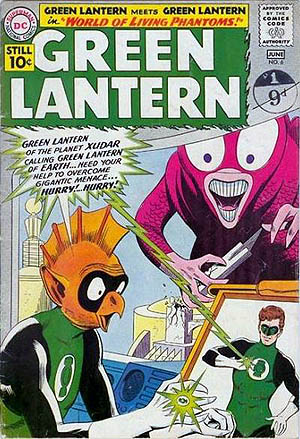
The portrayals of Sinestro (Mark Strong), Tomar-Re (Geoffrey Rush), and Kilowog (Michael Clarke Duncan) were great. Although the dedication and heroism of Sinestro was an especially strong presence in the film (foreshadowing Sinestro's fall from grace later on), Rush's Tomar-Re was my favorite among the "alien" GL's. As a kid, Tomar-Re was my favorite GL after Hal. He was Hal's best friend in the Corps in the silver age comics. Although the DC writers may not have intended it, the friendship between Hal Jordan and Tomar-Re showed that no matter how different, how alien two intelligent, compassionate beings can be, it's the desire to do good and to uphold justice that beings us together. Fitting that their relationship should have started during the early civil rights era.
In the film, Rush lends a calmness and warmth to Tomar-Re's voice. You can trust him. He's a little bemused at Hal pretty much all the time, but it's like a father relating to a young child who knows one day that child will grow to far surpass him. Tomar-Re is the kind of friend (and father figure) who would give a son just the right amount of encouragement and the time it takes for Hal to grow up.
What didn't I like.
Everything else.
From the first few moments of the film and the opening narration, I could tell I was going to be disappointed. It was like reading a comic book and not a particularly well written one. The opening just screamed at me: "Don't take this film seriously." In relation to the Dark Knight Trilogy and the soon to be released film Man of Steel (the trailers look fabulous), Green Lantern was nothing to write home about.
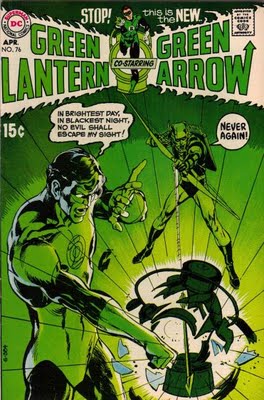
I think Ryan Reynolds was well cast to play the version of Hal Jordan the writers created, but he wasn't the Hal Jordan. In the original comic books, Hal already had the heart of a warrior and a hero. He had the personality of a policeman, albeit a somewhat rigid one. Right and wrong were polar opposites and in his heart, he always knew the difference, a fact that writer Dennis O'Neal used to good advantage when he and artist Neal Adams created the now legendary story No Evil Shall Escape My Sight (Green Lantern #76 - 1970).
Of course "perfect" heroes, such as DC tended to create in the 1950s and 60s don't make good movie characters because they have no room to grow. But having grown up loving the Hal Jordan Green Lantern and wishing for a really good film version of my favorite DC hero, I just didn't "feel it" watching Reynolds play Hal on the screen.
Frankly, I think the film's approach was all wrong. I'd never have introduced the "outer space" aspects of what it is to be a Green Lantern and certainly wouldn't have introduced the Corps and the Guardians so early in the game.
Hal had virtually no time to come to terms with the ring and the lantern before being whisked away to Oa, and even then, his training was about fifteen minutes long before Hal "quit," took the power ring, and with his tail tucked between his legs, scurried back to earth.
In the early silver age comics, Hal didn't know anything about the Corps. He periodically got "orders" from the lantern about specific "assignments" but he didn't know where they came from or what they meant beyond the immediate mission. I would have liked to have seen Hal trying to deal with the ring and the lantern more on his own first, discovering himself as a hero but only beginning to get a glimpse at the true implications of wielding that kind of power.
The writers could have even introduced a sort of "symbiotic" relationship between Hal and the ring, as if they both had something to give each other, the ring giving Hal power and Hal giving the ring the means to use it for good.
In spite of the fact that Hal was given a virtually overwhelming villain to defeat and the task of protecting the planet earth, I just didn't get any sort of personal angst or anguish...something to really overcome. Sure, Hector Hammond captured Carol and threatened to infect her with the Parallax energy, but I was really hoping Hal would have been able to face something even more personal (or maybe it was just the writing and the performances that didn't convey what I was looking for).
I recall in the issue 34 (1966) Green Lantern story "End of a Gladiator," Hal learned about the ring's "mortality fail safe." An emergency store of energy that's available, even when the ring's energy charge is exhausted, that can save a Green Lantern's life, even when the ring wielder is unconscious. During a battle between GL and one of his foes, Tom is mortally wounded. The villain tricked Green Lantern into thinking he had recently charged his ring, but in fact, it was an illusion and at the height of the battle, Hal's ring runs out of power. On the one hand, Hal is about to be shot. If he does nothing, the ring's emergency reserve will save his life. On the other hand, Tom is seconds from death. Hal does the impossible and orders the ring to use the emergency reserve to save Tom's life. Tom lives, but Hal is shot and presumed dead (a highly unusual set of circumstances results in his being revived).
It's that kind of conflict that would have made the climax of the film. The stakes didn't have to be a world, just the struggle for discovery of how heroic, how courageous, how honest Green Lantern member Hal Jordan could be.
In spite of all the special effects, the best efforts of the actors involved, and the decades of source material to be drawn from, Green Lantern the legendary hero of my childhood never materialized on the screen in 2011. It was just another movie.
With the potential for a DC Universe set of films culminating in one or more JLA movies in the future, I'm hoping for a Green Lantern reboot. Let's do it better next time.
Showing posts with label DC. Show all posts
Saturday, June 8, 2013
Friday, June 7, 2013
Batman: Year One (2011) A DVD Review
Two men come to Gotham City: Bruce Wayne after years abroad feeding his lifelong obsession for justice and Jim Gordon after being too honest a cop with the wrong people elsewhere. After learning painful lessons about the city's corruption on its streets and police department respectively, this pair learn how to fight back their own way. With that, Gotham's evildoers from top to bottom are terrorized by the mysterious Batman and the equally heroic Gordon is assigned to catch him by comrades who both hate and fear him themselves. In the ensuing manhunt, both find much in common as the seeds of an unexpected friendship are laid with additional friends and rivals helping to start the legend.
-Written by Kenneth Chisholm
That a summary of the video Batman: Year One (2011) which I saw on DVD a couple of weeks ago. I saw and subsequently reviewed the 1989 Keaton/Nicholson Batman film on the same weekend, but I couldn't summon whatever I needed to write my "Year One" review at the same time.
Maybe that's because the video reminded me so much of the Batman: Year One graphic novel (2007 -- originally published February through May 1987 in the regular Batman comic book series) by Frank Miller and David Mazzucchelli. The graphic novel gained rave reviews if you can believe Amazon (and most people do), and I remember the work favorably as well. Why do I feel so "cold" about the video based off the graphic novel?
Maybe because it was so similar to its 136 page source. I mean, having read the graphic novel, why did I need to see the 64 minute video?
Don't we want films made from books to be true to their source? Well, yes and no. If I were talking about a text-only novel, there'd be no visual component except what was generated in my head as I was reading. With a graphic novel, you get words and pictures. With an animated video you get spoken words and moving pictures, but it (in this case) looks pretty much the same.
It was as if the makers of the animated film said, "Let's make the graphic novel story again but make it move." In other words, I didn't learn anything new or have much of a different experience than when I read the graphic novel a few years ago. Any film should be more than just a moving, talking version of its source. I want to have a different experience, related enough to the original to recognize it, but different enough to be worth my while.
If I had a choice, I'd probably just read the comic book version again because print typically includes more story detail that's cut for time in a film presentation.
This isn't to say that I didn't enjoy the animated film. It was watchable and entertaining. I could certainly see the portions that linked into Batman Begins (2005), such as Batman "calling for backup."
You see the less than honorable side of a relatively young Jim Gordon, cheating on his pregnant wife, struggling to rise above his failures, fighting criminals with almost the same darkness as Batman. You see a young Bruce Wayne donning the mantle of the Bat for the first time, making rookie mistakes that almost get him killed, nearly killing the legend along with him. You see a different "Catwoman" with a (apparently) lesbian twist (it's only hinted at, but you get that vibe).
If you've never read the graphic novel or the original series of comic books, you'll enjoy the film. If you've read the graphic novel, seeing the film will be like deja vu. It's that simple.
If I watch Batman animated films, I'll try to pick those that don't follow the print material so closely. I want to be surprised as the story unfolds in front of my eyes.
-Written by Kenneth Chisholm
That a summary of the video Batman: Year One (2011) which I saw on DVD a couple of weeks ago. I saw and subsequently reviewed the 1989 Keaton/Nicholson Batman film on the same weekend, but I couldn't summon whatever I needed to write my "Year One" review at the same time.
Maybe that's because the video reminded me so much of the Batman: Year One graphic novel (2007 -- originally published February through May 1987 in the regular Batman comic book series) by Frank Miller and David Mazzucchelli. The graphic novel gained rave reviews if you can believe Amazon (and most people do), and I remember the work favorably as well. Why do I feel so "cold" about the video based off the graphic novel?
Maybe because it was so similar to its 136 page source. I mean, having read the graphic novel, why did I need to see the 64 minute video?
Don't we want films made from books to be true to their source? Well, yes and no. If I were talking about a text-only novel, there'd be no visual component except what was generated in my head as I was reading. With a graphic novel, you get words and pictures. With an animated video you get spoken words and moving pictures, but it (in this case) looks pretty much the same.
It was as if the makers of the animated film said, "Let's make the graphic novel story again but make it move." In other words, I didn't learn anything new or have much of a different experience than when I read the graphic novel a few years ago. Any film should be more than just a moving, talking version of its source. I want to have a different experience, related enough to the original to recognize it, but different enough to be worth my while.
If I had a choice, I'd probably just read the comic book version again because print typically includes more story detail that's cut for time in a film presentation.
This isn't to say that I didn't enjoy the animated film. It was watchable and entertaining. I could certainly see the portions that linked into Batman Begins (2005), such as Batman "calling for backup."
You see the less than honorable side of a relatively young Jim Gordon, cheating on his pregnant wife, struggling to rise above his failures, fighting criminals with almost the same darkness as Batman. You see a young Bruce Wayne donning the mantle of the Bat for the first time, making rookie mistakes that almost get him killed, nearly killing the legend along with him. You see a different "Catwoman" with a (apparently) lesbian twist (it's only hinted at, but you get that vibe).
If you've never read the graphic novel or the original series of comic books, you'll enjoy the film. If you've read the graphic novel, seeing the film will be like deja vu. It's that simple.
If I watch Batman animated films, I'll try to pick those that don't follow the print material so closely. I want to be surprised as the story unfolds in front of my eyes.
Labels:
batman,
batman year one,
bruce wayne,
DC,
DC comics,
DVD review,
fallen heroes,
origin
Monday, August 27, 2012
Review: The Dark Knight Rises
The Dark Knight Rises. The Dark Knight Descends. The Dark Knight Trilogy is over.
No, it wasn't the best of the three films by far and indeed, it may have been the worst. That's not to say that it was "bad," just that it didn't amaze and enthrall me like the first two films.
Batman Begins (2005) amazed me just because I've always been disappointed with all of the live-action Batman films prior to this one. Up until "Begins," I thought the best screen version of Batman was the WB animated series from the 1990s. After seeing Bale's Batman, the animated series (still quite good) seemed like just a cartoon.
"Batman Begins" showed everyone that superheroes could be "adult fiction" and reminded us all that Batman was supposed to be "dark".
The Dark Knight (2008) totally blew away "Begins." Part of it was the more realistic cityscapes. Chicago was used instead of a fictionalized Gotham and I absolutely loved the Hong Kong sequence. Nolan totally expanded Batman's universe from his first film and the Dark Knight became infinitely more "real." Of course, Heath Ledger's "Joker" completely stole the show, making his performance and this film a legend in fantasy film making.
That's quite a build up to "Rises" and there's always the danger that when you fly so high, there's a big fall is coming.
I wouldn't say "Rises" crashed and burned, but it had really big boots to fill after "TDK" and it didn't fill those boots.
I was worried that in trying to include Catwoman, Bane, Talia al Ghul and (briefly) Ras al Ghul, the film would suffer from too many villains and not enough development. That really wasn't the problem here and except for how Ras was handled, I thought the balance between all of the main "bad guys" was handled fairly well. It was just that all of the little puzzle pieces didn't quite fit together.
In TDK, all of the story elements, the characters, every little detail, fit hand and glove. Everything was in place. Nothing was wasted. The film was very "organized." That's not another way of saying "predictable" or "boring" but "efficient" and "seamless". I didn't spend any time analyzing the film while watching it, I just watched and enjoyed.
Not so with "TDKR".
All of the jumping around from place to place to place, and from flashback to flashback to flashback was distracting, distracting, distracting. I think I managed to keep up, but it was an effort and watching a story shouldn't be about trying to figure out what the filmmaker is saying, but allowing the narrative to flow over you like a dream.
The film is watchable. It's good. It just could have been better and maybe even a little shorter.
Stuff I liked (warning: Spoilers):
Anne Hathaway nailed it as Catwoman/Selina Kyle. Smart, agile, sexy, edgy, and even just a bit vulnerable.
Marion Cotillard played Talia al Ghul after all. Good. She needed to be part of the trilogy, though I'm sorry she and Bruce couldn't have forged more of a history before the end.
Joseph Gordon-Levitt as Blake. He's the obvious heir apparent to the "Mantle of the Bat" and even if I hadn't read other accounts of the film before finally seeing it, this would have been obvious from the start. I think we all knew that Batman wasn't going to survive the end of this film, but the hope of a "Dark Knight" type character had to be kept alive. There is no Gotham City with out a protector in black.
The Bane/Talia connection. I more or less liked this because I didn't see it coming. I also didn't like it because the explanation of Bane, Talia, Ras, League of Shadows, and why Gotham was brought to the edge of total destruction was not only rushed and forced, but it didn't really make a terrific amount of sense.
And yet, the weirdness of this "love affair" between two cold-blooded killers abruptly made them both less than monsters and almost human.
Bruce's secret isn't invulnerable. Blake figures it out just by seeing Bruce's face and knowing there's a Batman. Of course it was also because Blake's history parallels Bruce's, so one lost, hurt, and angry child recognizes another. Bane also figures it out which is terrifying. It's one thing that Blake knows because the guy just oozes "trust me" and "I'm a good guy," but Bane! It's a horrible thing when your worst enemy knows your every secret, turns you into a cripple, and then tosses you into the pit of hell.
Stuff I didn't like:
Ras al Ghul was a hallucination that lasted a couple of minutes tops. So what?
It is true that Bruce's initial return as Batman was supposed to be a failure. Alfred even pointed out that he wasn't actually Batman anymore, just Bruce in a costume. Bane proved this by beating Batman to a pulp and breaking his back (which was demanded because that's what Bane is supposed to do to Bruce). But it's like I didn't believe it. The tragedy of Batman's defeat would have been much greater if he had regained more of his "Batman-ness"; if we could have believed he had a chance against Bane before being destroyed by him.
Heck, the theme of the film is even hope before disaster. There was no hope when Batman first faced Bane. We all knew he didn't have a chance.
Fusion reactor can be turned into a bomb. Yawn. OK, convenient plot device (literally) so Bane could have access to an atomic bomb without having to sneak it in, but first of all, to me, nuclear fusion reactors were just too fantastic for this movie and there was no build up...just Wayne blowing half his fortune to build one, then mothballing it because it maybe could be turned into a bomb (like nuclear fusion wouldn't be dangerous enough anyway). It was just too odd. It didn't fit.
Hardly anyone seemed like themselves. Bruce, Alfred, Fox, Gordon all seemed like they were sleepwalking through their roles. All of the personality, the humor, the "themness" of these characters was missing. It was as if they couldn't wait to finish filming their scenes so they could go off and do something else. The heart of the Batman films was just plain missing.
Robin. Oh for Chrissake, Robin? Blake's "real" name had to be Robin? Yuk.
Change "Blake" to "Drake" and you already have a Robin connection without having to be obvious or dumb.
Occupy Wall Street on steroids was another obvious element that was shoved down the audience's throat. What would happen if the "occupy" movement turned violent? Get all the 1%ers, try them, and kill them. Kill the police or otherwise get rid of them. Return the "power to the people." Really? If it actually worked out the way the film predicts, then we have some idea of why every revolution ends with the radicals becoming "the man."
Bruce has a medical exam before returning as Batman the first time. His body is shot. Given the description of his injuries, there's no way in hell he could have come back as the Dark Knight, especially after his back injury. No amount of "prison workouts" fixes no cartilage in the knees, elbows, and shoulders. Replacement surgery fixes that but he'd still never be Batman again. A Lazarus Pit fixes that too, but I'll get to that in a minute.
I sort of loved and hated the "happy ending." I guess I always wanted Bruce to survive because it creates the vain hope that if "Robin" or "Nightwing" or whoever really needs a hand, Batman would be there to back him up. I also like a happy ending just because the part of me that believes in justice thinks good guys should win in the end and "live happily ever after". On the other hand, it was also kind of sappy and given the knowledge of Alfred's annual vacation plan we are given earlier in the film, we all knew it was going to happen.
Stuff I wished for:
Ras al Ghul really coming back. Given the plot and direction of the story, the film would have become quite a bit more complicated had Ras shown up alive, but competing with his daughter and the man he hated more than Bruce for control of the League of Shadows would have been an incredible showdown.
The Lazarus Pit. Part of me thought that Bane would actually kill Batman, that it would happen further into the film, and that a lovesick Talia (yeah, the film would have to be a lot different) would take Bruce's body to a Lazarus Pit to resurrect him. It would have been absolutely cool. The movie would have to be completely rewritten but it would have been totally awesome!
I could go on and on about the film. It's a flawed work of art. I'll be bitching for weeks about it. I'm sorry it ended this way. But for better or for worse. it ended. The ride is over.
Nolan used TKDR to try and pull together all of the perceived "loose threads" created in the first two films but particularly in "Begins." He tried too hard.
But if DC plans to make a Justice League film, the Dark Knight must not rise again, but be reinvented. What will he be like then?
No, it wasn't the best of the three films by far and indeed, it may have been the worst. That's not to say that it was "bad," just that it didn't amaze and enthrall me like the first two films.
Batman Begins (2005) amazed me just because I've always been disappointed with all of the live-action Batman films prior to this one. Up until "Begins," I thought the best screen version of Batman was the WB animated series from the 1990s. After seeing Bale's Batman, the animated series (still quite good) seemed like just a cartoon.
"Batman Begins" showed everyone that superheroes could be "adult fiction" and reminded us all that Batman was supposed to be "dark".
The Dark Knight (2008) totally blew away "Begins." Part of it was the more realistic cityscapes. Chicago was used instead of a fictionalized Gotham and I absolutely loved the Hong Kong sequence. Nolan totally expanded Batman's universe from his first film and the Dark Knight became infinitely more "real." Of course, Heath Ledger's "Joker" completely stole the show, making his performance and this film a legend in fantasy film making.
That's quite a build up to "Rises" and there's always the danger that when you fly so high, there's a big fall is coming.
I wouldn't say "Rises" crashed and burned, but it had really big boots to fill after "TDK" and it didn't fill those boots.
I was worried that in trying to include Catwoman, Bane, Talia al Ghul and (briefly) Ras al Ghul, the film would suffer from too many villains and not enough development. That really wasn't the problem here and except for how Ras was handled, I thought the balance between all of the main "bad guys" was handled fairly well. It was just that all of the little puzzle pieces didn't quite fit together.
In TDK, all of the story elements, the characters, every little detail, fit hand and glove. Everything was in place. Nothing was wasted. The film was very "organized." That's not another way of saying "predictable" or "boring" but "efficient" and "seamless". I didn't spend any time analyzing the film while watching it, I just watched and enjoyed.
Not so with "TDKR".
All of the jumping around from place to place to place, and from flashback to flashback to flashback was distracting, distracting, distracting. I think I managed to keep up, but it was an effort and watching a story shouldn't be about trying to figure out what the filmmaker is saying, but allowing the narrative to flow over you like a dream.
The film is watchable. It's good. It just could have been better and maybe even a little shorter.
Stuff I liked (warning: Spoilers):
Anne Hathaway nailed it as Catwoman/Selina Kyle. Smart, agile, sexy, edgy, and even just a bit vulnerable.
Marion Cotillard played Talia al Ghul after all. Good. She needed to be part of the trilogy, though I'm sorry she and Bruce couldn't have forged more of a history before the end.
Joseph Gordon-Levitt as Blake. He's the obvious heir apparent to the "Mantle of the Bat" and even if I hadn't read other accounts of the film before finally seeing it, this would have been obvious from the start. I think we all knew that Batman wasn't going to survive the end of this film, but the hope of a "Dark Knight" type character had to be kept alive. There is no Gotham City with out a protector in black.
The Bane/Talia connection. I more or less liked this because I didn't see it coming. I also didn't like it because the explanation of Bane, Talia, Ras, League of Shadows, and why Gotham was brought to the edge of total destruction was not only rushed and forced, but it didn't really make a terrific amount of sense.
And yet, the weirdness of this "love affair" between two cold-blooded killers abruptly made them both less than monsters and almost human.
Bruce's secret isn't invulnerable. Blake figures it out just by seeing Bruce's face and knowing there's a Batman. Of course it was also because Blake's history parallels Bruce's, so one lost, hurt, and angry child recognizes another. Bane also figures it out which is terrifying. It's one thing that Blake knows because the guy just oozes "trust me" and "I'm a good guy," but Bane! It's a horrible thing when your worst enemy knows your every secret, turns you into a cripple, and then tosses you into the pit of hell.
Stuff I didn't like:
Ras al Ghul was a hallucination that lasted a couple of minutes tops. So what?
It is true that Bruce's initial return as Batman was supposed to be a failure. Alfred even pointed out that he wasn't actually Batman anymore, just Bruce in a costume. Bane proved this by beating Batman to a pulp and breaking his back (which was demanded because that's what Bane is supposed to do to Bruce). But it's like I didn't believe it. The tragedy of Batman's defeat would have been much greater if he had regained more of his "Batman-ness"; if we could have believed he had a chance against Bane before being destroyed by him.
Heck, the theme of the film is even hope before disaster. There was no hope when Batman first faced Bane. We all knew he didn't have a chance.
Fusion reactor can be turned into a bomb. Yawn. OK, convenient plot device (literally) so Bane could have access to an atomic bomb without having to sneak it in, but first of all, to me, nuclear fusion reactors were just too fantastic for this movie and there was no build up...just Wayne blowing half his fortune to build one, then mothballing it because it maybe could be turned into a bomb (like nuclear fusion wouldn't be dangerous enough anyway). It was just too odd. It didn't fit.
Hardly anyone seemed like themselves. Bruce, Alfred, Fox, Gordon all seemed like they were sleepwalking through their roles. All of the personality, the humor, the "themness" of these characters was missing. It was as if they couldn't wait to finish filming their scenes so they could go off and do something else. The heart of the Batman films was just plain missing.
Robin. Oh for Chrissake, Robin? Blake's "real" name had to be Robin? Yuk.
Change "Blake" to "Drake" and you already have a Robin connection without having to be obvious or dumb.
Occupy Wall Street on steroids was another obvious element that was shoved down the audience's throat. What would happen if the "occupy" movement turned violent? Get all the 1%ers, try them, and kill them. Kill the police or otherwise get rid of them. Return the "power to the people." Really? If it actually worked out the way the film predicts, then we have some idea of why every revolution ends with the radicals becoming "the man."
Bruce has a medical exam before returning as Batman the first time. His body is shot. Given the description of his injuries, there's no way in hell he could have come back as the Dark Knight, especially after his back injury. No amount of "prison workouts" fixes no cartilage in the knees, elbows, and shoulders. Replacement surgery fixes that but he'd still never be Batman again. A Lazarus Pit fixes that too, but I'll get to that in a minute.
I sort of loved and hated the "happy ending." I guess I always wanted Bruce to survive because it creates the vain hope that if "Robin" or "Nightwing" or whoever really needs a hand, Batman would be there to back him up. I also like a happy ending just because the part of me that believes in justice thinks good guys should win in the end and "live happily ever after". On the other hand, it was also kind of sappy and given the knowledge of Alfred's annual vacation plan we are given earlier in the film, we all knew it was going to happen.
Stuff I wished for:
Ras al Ghul really coming back. Given the plot and direction of the story, the film would have become quite a bit more complicated had Ras shown up alive, but competing with his daughter and the man he hated more than Bruce for control of the League of Shadows would have been an incredible showdown.
The Lazarus Pit. Part of me thought that Bane would actually kill Batman, that it would happen further into the film, and that a lovesick Talia (yeah, the film would have to be a lot different) would take Bruce's body to a Lazarus Pit to resurrect him. It would have been absolutely cool. The movie would have to be completely rewritten but it would have been totally awesome!
I could go on and on about the film. It's a flawed work of art. I'll be bitching for weeks about it. I'm sorry it ended this way. But for better or for worse. it ended. The ride is over.
Nolan used TKDR to try and pull together all of the perceived "loose threads" created in the first two films but particularly in "Begins." He tried too hard.
But if DC plans to make a Justice League film, the Dark Knight must not rise again, but be reinvented. What will he be like then?
Labels:
batman,
DC,
film review,
review,
the dark knight,
The Dark Knight Rises
Wednesday, August 1, 2012
Subscribe to:
Comments (Atom)


