Showing posts with label science fiction. Show all posts

Tuesday, June 18, 2013

Review of Star Trek Into Darkness

It's been out for about a month now and I finally got around to seeing Star Trek Into Darkness (2013). First of all I must say that I think it was a better film than the original Star Trek (2009). It's not that the first film was bad, but it had just a ton of plot holes that I still can't get past. The current film feels much more cohesive, if derivative (but I'll get to that).

Oh, if you haven't seen this movie yet, this is your one and only warning that my review contains major spoilers. You have been warned.

The movie starts out with Kirk and Bones on an alien planet where Kirk has pissed off the locals by taking some sort of artifact or god or something. They're running for their lives and Kirk, confronted by a huge monster that came out of nowhere, stuns the beastie, only to learn from McCoy that it was their ride.

Meanwhile, Spock, Uhura, and Sulu are in a shuttlecraft heading into a live, about-to-erupt volcano to stop the fireworks. Failure to do so will result in every living being on the planet dying (that's some badass volcano), even though their orders from star fleet said only to survey the planet, not save it.

Spock is lowered down in some super heat resistant suit with a fusion bomb (why that would make a giant volcano inert is beyond me). His line to the shuttle breaks and the heat threatens to destroy the shuttlecraft so Sulu is forced to fly (limp) back to the Enterprise, which is hiding under the nearby ocean.

Spock is alone and if he can't get out of there in just a minute or so, Young Spock will die and there'll be no Genesis planet to revive him.

Kirk breaks the prime directive to save Spock by pulling the Enterprise out of its watery cover so they can beam Spock back. All the pre-industrialization aliens see the ship and there are strong indications that it becomes their new god.

In the original series, Kirk broke the prime directive with such regularity, it seemed like the law was made to be broken.

Not so in the reboot movies. Kirk loses his command (thanks to Spock filing a truthful report...Jim's log was full of "half-truths") and the Enterprise goes back to Pike. Kirk goes back to school.

Fortunately villainy is afoot and the mysterious John Harrison saves the life of a star fleet officer's daughter in exchange for that officer blowing up an archive...which just happens to really be a secret star fleet weapons development center (or should I say "centre") in the heart of 23rd century London.

Pike calls in some favors and gets Kirk assigned as his first officer (Spock is reassigned to the USS Bradbury and Kirk is still pissed at him for not understanding why Kirk broke every rule in the book to save his life). Kirk is the only one to figure out (but not in time) that after a disaster such as the one in London, all starship captains and first officers are called into a mandatory confab at Star Fleet headquarters...a perfect set up.

And it was. Harrison swoops in with a ship and peppers their meeting room with gunfire. I must say Star Fleet air security was really lax. In the 21st century, air traffic controllers and the military know when an aircraft is anywhere near restricted air space. If the room in the film had been the White House, the President would have been toast.

Admiral Marcus makes it. Kirk not only makes it but brings down the attacker (but Harrison beams himself halfway across the galaxy before his ship actually crashes) Spock makes it.

Pike isn't so lucky.

Amazingly Admiral Marcus gives Kirk his command back, reassigns Spock as first officer, and gives Kirk seventy-two highly classified photon torpedoes to kill the attacker with, who has beamed himself to an uninhabited area on Chronos, the Klingon homeworld. Kirk's orders are to hang at the edge of Klingon space, lock onto Harrison, and fire without warning.

Kirk is OK with this morally, but Spock, Bones, Scotty, and just about everyone else isn't and try to talk Kirk out of it. Scotty even quits his job over it. A new, and might I add beautiful science officer Carol Wallace (Alice Eve) is assigned to the Enterprise right before launch.

So far so good. Kirk got a good talking to by Pike before he bit the dust and frivolous, womanizing Kirk has had this "comeuppance." Pike was the closest thing Kirk had to a father and watching him die right before his eyes has left him hungry for revenge. In that sense, we can almost forgive him for not noticing that a star fleet admiral has just ordered him to commit murder and risk interstellar war all for the sake of getting one man. No attempt at a capture, not even a warning to be issued. Why would Admiral Marcus (Peter Weller) even do such a thing?

On top of all this, Spock and Uhura are barely on speaking terms but the reason isn't made clear until later. Neither is the reason that Spock could face his own death with little emotion but he was shocked the moment Pike died.

So off to Chronos the Enterprise goes.

I must say at this point that Scotty's transwarp beaming equation has made transporters too powerful. If Khan, uh, I mean "Harrison" (why the heck couldn't they get an actor from India or of Indian descent to play a Sikh warrior from India is beyond me) can beam from Earth to Chronos across hundreds if not thousands of light years, who needs starships?

With Scotty partying back on Earth, Chekov, who should be about 21 years old by now, is made chief engineer (people are promoted awfully fast in this version of Star Trek...Kirk was made Captain before he ever graduated the academy) and he's got a big problem. Somewhere near Klingon space, the Enterprise just stops dead. There's a leak in the warp cooling system and it's going to take Chekov hours if not days to track it down (he's no miracle worker).

Kirk, after much soul searching, which we don't actually see, decides to not fire the mysterious torpedoes (they're resistant to scanners...no one can even figure out what kind of fuel they use) and instead is going to lead Spock and Uhura (she can speak Klingon) on a covert mission to try and capture Khan (yes, it's Khan) and bring him back to Earth alive to stand trial.

They make it to Chronos but not undetected. They encounter first one and then several rather overly designed birds of prey and have no choice but to land. Uhura tries to negotiate with a group of rather overly designed Klingon warriors, all carrying overly designed batleths, but no go (it's like the folks in charge of making Chronos and everything Klingon decided that it all needed lots and lots of modular lumps, and knobs, and doohickies all over everything. The Klingon world and all the Klingon stuff looks like a bunch of black and white legos...but really, really sharp.)

Khan, of all people, comes in at the last second to rescue Uhura with some sort of big particle weapon and takes out almost all of the Klingons and their ships. Oh, he saves a few for Kirk to fight but it's really Khan who saves the say.

Khan surrenders after finding out that Kirk has exactly seventy-two specialized, long range torpedoes on board, and allows himself to be put in the brig.

And then Khan lays it all out for Kirk while Bones is studying Khan's highly unusual blood sample.

He's three-hundred years old. He and a group of enhanced human beings were launched into space as war criminals. Marcus found their ship, thawed only Kahn out and held the other seventy-two members of Khan's crew in status to force Khan to develop new ships and weapons technologies for the Admiral. After the whole mess with Nero in the previous film, Admiral Marcus decided that the only way to prevent another such happening is to turn star fleet into a military organization...and he plans to start a war with the Klingons to do it. The torpedoes, the Enterprise's break down, everything was part of Marcus's plan. Khan even gives Kirk a set of co-ordinates near one of Jupiter's moons that contains the proof.

As all this is going on, Spock discovers that Carol Wallace is really Carol Marcus, the Admiral's daughter, who is snooping around to find out why her father has gone so "black ops" lately. Kirk calls up Scotty and his alien friend and pleads with them to investigate the co-ordinates near Jupiter. Simon Pegg plays Scotty with lots of attitude and crankiness, but not much personal resolve. Off to Jupiter he goes.

Bones examines Khan in sickbay and is trying out some of Khan's blood on a dead tribble (yeah, but only one tribble).

Later Bones and the now confessed Dr. Carol Marcus try to open up a torpedo and find not only explosives but a highly enhanced human being in status...it was Khan's plan to try and free his people by hiding them in the weapons he built, but he was found out and Marcus took the torpedoes before Khan could smuggle them away from the weapons center. Khan's murderous attack is explained as revenge for the Admirals poor treatment of him and his people and in protest for his "evil plan".

And who should show up before Chekov's repairs on the warp coolant leak are finished...the Admiral in a secret attack ship that had just been assembled near one of Jupiter's moons.

I won't give you the rest of the blow-by-blow, but Kirk, backed into a corner, learns the meaning of responsibility and command, something he was sorely lacking by the end of the first film. I was afraid that J.J. Abrams was going to leave Kirk not only a jerk, but an inept one at that. This entire second movie is to develop Kirk into the Captain he's supposed to be. For the most part, it works.

We also find out that the destruction of Vulcan has left Spock more vulnerable than anyone imagined. Uhura was mad at him for risking his life and accepting certain death because he didn't care about her and how she would feel. But it was his feelings Spock was trying to protect. He mind melded with Pike at the moment of death and he has been trying to hide just how "emotional" he's been about relationships. Spock "felt" Pike's confusion, anger, and fear when he died, and those feelings mirror how Spock feels about Vulcan...and those closest to him if they should die. It's not that he doesn't love Uhura enough but that he loves her too much.

And then things get too rewired and it's like the ghost of Star Trek II: The Wrath of Khan (1982) moves in. After Kirk and Khan get on board the Admiral's ship with a little help from Scotty who stowed away, to rescue Carol, who Admiral Marcus beamed aboard once he realized she was on the Enterprise, Khan kills Marcus, beams the Enterprise trio back onto their crippled starship and as he's about to destroy them, they pull a surprise warp jump and head for Earth.

They almost make it. But the engines are damaged. Kirk (and not Spock) enters the radioactive chamber to fix the engines so the Enterprise doesn't crash on Earth. After the touching "I shall always be your friend" scene, it is Spock who has to helplessly watch his friend Jim die, so soon after he's lost Pike. It's Spock (and not Kirk) who screams in rage, "Khhhhhaaaaaaaaaaaaaaannnnn!!!!!!!!"

Spock has also pulled a fast one and agreed to beam seventy-two torpedoes on board Khan's (well, it's Khan's ship now) ship but really, the people and cryochambers were removed before hand...not so the explosives which Spock armed.

The Enterprise is saved but Khan's ship is hopelessly crippled by the exploding torpedoes and crashes into San Francisco. Khan (of course) survives, and Spock goes after him and revenge.

Meanwhile, the dead tribble that Bones had treated with Khan's blood revives and the resurrection of dead Kirk (minus a Genesis planet) is assured. But Bones needs Khan alive to get enough blood to save Kirk.

Khan, for his part, isn't all that easy to kill, or even stun. He's absolutely ruthless in a way that Ricardo Montalban's Khan never was...and a lot stronger. Even Spock's neck pinch doesn't work...and when Uhura beams down to stop Spock from killing Khan, even her phaser on heavy stun doesn't quite do the job. But using some piece of machinery like a boxing glove, Spock beats and beats and beats Khan up which finally does the trick.

But we had far, far too much "Wrath of Khan" storyline for my tastes and just how emotional is Spock going to be from here on in?

Months later, Kirk has recovered, and one year later, at the Enterprise's re-christening ceremony (she was pretty badly beaten up), Pike is eulogized by a much more mature and worthy Captain James T. Kirk. With the crew and ship in top shape and ready, they finally embark on their five year mission, the longest ever attempted by a starship.

Space, the final frontier.

It was good. It was long. All the stuff pulled from that 1982 movie was way over the top. The actual origin story for Khan and his people (not one of them were revived, although you'd think Bones would have wanted to test their blood, too) was never detailed so how they were created on Earth sometime in the twentieth century remains a mystery. At the end of the film, Khan is refrozen, begging a sequel.

Oh yeah, Bones synthesized a serum from Khan's blood so in theory, now star fleet medical has an immortality potion. If you die, it's not permanent. If you want to go to the other end of the galaxy, you can just beam there. Things happen fast in this version of Star Trek...and they're getting more powerful by leaps and bounds. Pretty soon, they'll even be able to stop Superman...except at the box office.

Monday, October 18, 2010

Batteries Not Included


OK, that phrase has been used, but I just got my first look at the new Power Battery design for the upcoming Green Lantern (2011) film thanks to ComicBookMovie.com and I must say I think it sucks. Sure, films aren't obligated to stick very tightly to the original comic book designs and in many cases (such as Batman's costume) they definitely shouldn't. On the other hand, the producers of the Green Lantern film don't seem to mind trying to impose their version of "alien" on the rest of us, as first revealed in the costume design, while rolling way over the top of what seems to look even reasonably heroic.

I've posted the current film version of the battery (upper left) along with the classic version (middle right), plus Kyle Raynor's power battery (bottom). I can understand that the original comic book design probably looks too Terrestrial for a modern film, but I'd have preferred the "alien-ness" of Kyle's battery over what the film designers finally came up with. What do you think?

Thursday, May 27, 2010

Dominant

Mankind isn't the only species on Earth, we just act like it -Bumper Sticker

Why do we act the way we do? I don't mean individuals necessarily, but why do people act as we do as a collective? I mean, why do we act like we don't care about the people or planet around us? I guess I shouldn't lay this at the feet of all humanity. I tend to view the world from my culture here in "western civilization". Not everyone sees things the same way.

Think seven generations ahead before every important decision – Native American saying

Manifest Destiny and every similar rationalization that came before it, exists to justify the "right" of a larger and stronger people to take away resources from a smaller and weaker one. It's why bullies pick on kids smaller than they are on the playground. It's why adults sexually and physically abuse children. It's why the party most dominant in politics will rush to grab and hold onto as much power as it can. It's why we can hunt a species to extinction and not bat an eye (anyone seen a dodo bird lately?).

As our understanding goes, the species we call dinosaurs were once dominant on this planet. We suppose that some sort of significant planetary event occurred about 65 million years ago to change all that. Slowly, the dinosaurs left the ecosystem, leaving space for smaller, more fragile creatures to rise. Eventually, one type of mammal climbed to the top of the heap: man.

When you're at the top of the food chain, you fear no predators. There are creatures on this planet that are faster and have bigger teeth and claws, but we invented gunpowder. Bang! You're dead.

As with everything else I write, I can see how we should know better but don't behave as if we do. Our fiction says we know better. Consider the remake of the television series V. The "visitors" say they come in peace, but of course, they're lying. They've come to take over, but not with armies or weapons. They've come to take over a piece at a time.

Most people don't realize it, but the current series and the 1983 original mini-series are based on a novel published in 1935 written by Sinclair Lewis called It Can't Happen Here about how a fascist regime came to power in the United States and by subterfuge, established a dictatorship, taking over the country. By the time anyone realizes what's happened, it's too late...or almost.

Similar stories, including various films and television shows in the 1950s and 60s were created along a the same theme, usually with Communism being the big threat. The Science Fiction film classic Invasion of the Body Snatchers contains this underlying plot, but to more current audiences, it probably isn't obvious. The short story To Serve Man could very easily have been the basis for the current V series and has been made and re-made endless times (hint: "To Serve Man" is a cookbook).

The common thread in all of these stories is a race, species, or group who has more power arrive to take resources, including lives, from a group that has less power. Only in the case of these science fiction stories, the group who is always being victimized is humanity.

Now here's the kicker. As humans, we justify our exploitive behavior by telling ourselves that we're the dominant species. As the biggest, baddest, and most powerful, we take what we want because no one can stop us (yeah, I know...cynical, but it explains most of the events we've recorded in human history). We write stories about beings superior to us in intellect, technology, and sometimes in sheer numbers, who come to dominate us the way we have dominated everything else on the planet. If we believe "might makes right", when a bigger force comes against us, why do we fight back?

If we accept "the natural order of things", why won't we take our appropriate place in that order (at least in fiction) when alien reptiles or pod creatures come to dominate us?

We always fight back. In fiction, we usually win, which I guess means we're superior after all, but wait a minute. What if we haven't won?

Depending on your point of view about climate change we may be changing our environment so that it eventually won't sustain us. Not that we'd probably destroy the earth, but we might end up introducing a set of conditions that will restore at least some balance to the environment over the long span of future history.

In the film The Matrix, Agent Smith tells Morpheus that people are like a virus. We move to an area, consume all of the available resources to exhaustion and then move on, leaving nothing behind. Then we proceed to another area and do the same thing. Assuming a closed environment, we'll eventually run out of room and resources (food, water, air). That's in some sense, how the machines took over as the dominant "species" (and notice that humans were still fighting back).

What's the answer? All we have to do is continue to do as we're doing and eventually, we'll consume everything there is to consume and, without the necessities of life, large numbers of us will stop living. Will we damage the ecosystem beyond repair? Maybe. Maybe not. If there aren't nearly as many of us around and if our existence isn't dependant on large, resource consuming economies, then like many other living things, the planet will start to heal. After that, who knows? I'm already way too deep into the realm of speculation to be speaking with a great deal of accuracy.

I'm not trying to spread doom and gloom, but I do wonder how we can write so clearly and accurately in our fantasy and fiction about the dangers of our lifestyle and then not do a damn thing about it.

Maybe we are Borg. Just a thought.


Share/Bookmark


Different than the Sum of Our Programming

I've been spending a little time blogging about how mechanization and cybernetics have been affecting human beings. In Misfit, I suggest that two "robotic" DC comic characters Cyborg (from the Teen Titans) and the Doom Patrol's Robotman, although enabled as "superheroes" by their prosthetic bodies, are also alienated from the humanity they seek to serve. In my more recent blog A Human Heart and Courage, I point to the fact that, regardless of how much of our bodies are made up of artificial parts; our humanity transcends our physicalness and inhabits perhaps a more ethereal space. We are more or at least different than the sum of our parts.

Edward Page Mitchell's short story The Ablest Man in the World was published in 1879 and recounts the tale of a man who has a computer implanted in his head, causing him to become a genius. If we can tie into every other body part and organ with cybernetics, will we one day really be able to augment the human brain with computer chips?

That's pretty far out, but consider that in some ways, people are already "programmed" with a set of instructions that determines our perceptions, responses, and behavior. These instructions vary from person to person, based on how they were raised, their experiences, and how that input was encoded and given "meaning" for the person. I was about to say that, as we develop, we begin to think independently, but anyone who has been around a two year old, realizes that people are very independent at the beginning and that our programming provides the framework for complying (to one degree or another) with society's behavioral expectations and the expectations of our particular family, peer, and associative groups.

In science fiction, we often attempt to impose how people learn onto robotic and computer programming. Consider the Star Trek original series episode The Ultimate Computer. Written by Laurence Wolf and D.C. Fontana, the story relates how the Enterprise is reduced to a skeleton crew and has a revolutionary computer device called the M5 installed in engineering for testing, as ordered by Star Fleet. The M5 is supposed to be able to perform most of the functions that normally require a human(oid) crew aboard a starship. Kirk argues that the one thing it can't do is make value judgments. The M5 can't actually "think"...or can it?

It's creator, Dr. Richard Daystrom, the scientist who originally invented the computer systems currently used aboard Federation starships, says that he has developed a "whole new approach" which solves the "thinking" problem, by imprinting his own memory engrams on the computer circuits, giving the M5 what amounts to a personality.

This is a very, very old story in science fiction with an old conclusion. Turns out that Daystrom is an unstable personality and that mental instability was transferred to the M5. When the computer mistakes a series of war game exercises as a real attack and begins destroying starships and killing people, both Daystrom and the M5 are "unplugged" by Kirk, "proving" that people are ultimately superior to machines.

Comic book lore of the same era addresses the same issue of over dependence on machines at the cost of human liberty and autonomy. Magnus, Robot Fighter: 4000 AD is the story of a man, raised in a hidden base under the Antarctic by a benign and wise Robot named 1A to become the guardian for humanity, both philosophically and physically, and to defend against Robot overdependence among humanity and any physical robotic threats against mankind. Magnus becomes the ultimate man and role model, trained to mental and physical perfection...almost a Messiah-like figure who can beat up robots with his bare hands and who continually warns the people around him that they'll lose their uniqueness as people if they keep letting robots "take care" of them (think WALL-E). Jack Williamson's novel The Humanoids conveys the same essential message.

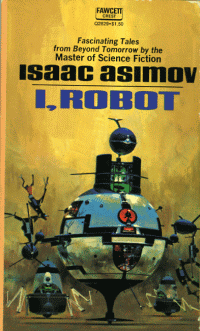
Are people superior to machines in our "programming"? Do we behave better or more "morally" than a robot would if we could program a robot to a human level of complexity? Isaac Asimov asked that question in one of his short stories in the I Robot collection called Evidence. At some future date, Attorney Stephen Byerley is running for the office of Mayor of New York. His opponent Francis Quinn levels a rather odd accusation against him. Quinn says that Byerley is a robot created in human form, with an outer shell of human flesh, much like a Terminator. Think about it.

Asimov's classic three laws of robots state:

  1. A robot may not injure a human being or, through inaction, allow a human being to come to harm.

  2. A robot must obey any orders given to it by human beings, except where such orders would conflict with the First Law.

  3. A robot must protect its own existence as long as such protection does not conflict with the First or Second Law.


If you tweak the wording of the laws just a little bit (and they have been so you don't have to reinvent the wheel), the three laws describe the behavior of a reasonably moral human being. If people were "programmed" with the three laws, how would our behavior be different? In Asimov's story, Byerley manages to prove he's a human being be punching a heckler during a speech, something a robot would not be able to do, but to the end of the story, it's always uncertain whether Byerley is really human or a cleverly disguised robot (Byerley could have arranged for the heckler to be another humanoid robot, enabling him to hit the heckler without breaking the first law).

I'm not suggesting that we program human beings as we would machines. That story too has been told in another Star Trek original series story What Are Little Girls Made Of?, written by Robert Bloch. Another, "free will humans are better than programmable humanoid android" story. Yet, what if we would choose to structure our lives around something like "the three laws"?

I seem to be focusing a lot of the works of Gene Roddenberry because one obvious example of a "machine who would be man" leading the way to more "human" behavior is Lt. Commander Data from the Star Trek the Next Generation series. More than once in STTNG episodes, Data refers to himself as having been programmed with the three laws and that his basic functioning depends on those laws.

Data is actually based on a failed TV pilot written by Roddenberry called The Questor Tapes (1974). Robert Foxworth plays the android Questor, designed and built by a brilliant scientist named Vaslovik. Vaslovik has disappeared, but a team of scientists, including Vaslovik's protégé Jerry Robinson (played by Mike Farrell, best known as B.J. Hunnicut on TV's M*A*S*H series), attempt to finish Vaslovik's work by programming Questor.

The Vaslovik programming tapes were damaged when project head Geoffrey Darrow (John Vernon) attempted to have them analyzed so when Questor eventually is activated (after everyone else has gone home for the night), he has all of his intellectual capacities but, like Data, has no emotional awareness. Like Data, Questor also has a compelling drive to understand the people and world around him and a need to help human beings. Although unstated, it's likely that Questor is "three-laws" compliant based on his actions.

Questor, Vaslovik, and a long series of androids before them, as the audience discovers during the film, were placed on Earth by an alien race to help guide humanity into maturity and prepare us to join the interstellar community of intelligent races. Vaslovik had to take himself out of service before activating Questor to replace him, due to exposure to contaminants produced by modern technology. Questor is to be the last in the series, with a "lifespan" of 200 years. Since he is without the emotions he was intended to possess, Robinson joins Questor as his "emotional mentor" on his mission to covertly guide selected people to become teachers and other leaders, gently shepherding human society into a more peaceful existence.

In real life, we probably can't depend on some wise alien species coming to Earth and either overtly or secretly giving us a hand and helping us not to be jerks on a planetary scale. However, our science fiction and fantasy stories do possess the hint of an answer to all of the problems people seem to create.

While people can't be programmed the way machines can, we have the ability to learn from our experiences and to make a few right decisions. If we don't know what those decisions should be, we could potentially point to the Asimov three laws as a foundation. Rather than saying that human beings are somehow better than our fictional robots, maybe we should let them be our guides, at least metaphorically. If we acted like the robotic guides in our fantasies, maybe reality and humanity would be a bit more livable.

The thing is, unlike a computer, or a person with plug-ins such as Neo in The Matrix, we can't depend on some outside force inserting a device into our heads and instantaneously giving us what we need to know, including the will to obey the instructions provided. We also can't depend on blindly obeying what others have taught us "robotic-like", but rather, must exceed our "programming". We have to think and decide for ourselves what do to and then have the courage to do it.

Epilogue: I got the last image from the typepad.com blog. Seemed a fitting description of how human beings act in real life.


Share/Bookmark


Tuesday, May 25, 2010

A Human Heart and Courage

A cyborg is a cybernetic organism (i.e. an organism that has both artificial and natural systems). The term was coined in 1960 when Manfred Clynes and Nathan Kline used it in an article about the advantages of self-regulating human-machine systems in outer space. -Wikipedia

Cyborgs, or people who have had some portion of their body replaced with an electronic or mechanical device, have long been the delegated to the realm of science fiction. When most of you think of such a thing, the image of Borgs from Star Trek probably is the first thing you consider. However, just a few days ago, I read the news story Man goes home with 'Total Artificial Heart'. I'm certainly not comparing 43-year-old Charles Okeke to Borgs by any means, but we seem to have come to the point where we can extend the life and abilities of human beings using cybernetic methods.

A quick run through of the history of Cyborgs in fiction reveals that the concept has been with us for a long time. Edward Page Mitchell's short story The Ablest Man in the World was published in 1879 and recounts the tale of a man who has a computer implanted into this head, turning him into a genius.

Prior to the Borgs, the most famous television cyborg was probably the polyester-wearing Six Million Dollar Man, a series launched in the early 1970s with Lee Majors in the starring role of a man with bionic limbs and an artifical eye (based on the somewhat more "realistic" novel Cyborg written by aeronautics and aviation expert Martin Caidin).

Cyborgs in science fiction novels are very plentiful and one of my favorite stories was written by Frederik Pohl in 1976 and called Man Plus. The story is about a man named Roger Torraway who, in order to be better enabled to explore Mars and prepare for human colonization, has his human body systematically replaced with with a completely artificial body. The novel is primarily an illustration of Torraway's struggle and journey from man to machine as he watches his "humanity" seem to disappear. What horror would a person go through as his living flesh is replaced by metal, wires, and circuits?

I've previously blogged about a couple of comic book cyborgs, namely the Doom Patrol's Robotman and the Teen Titan's Cyborg who both had major parts of their entire bodies replaced by machine parts, with, in Cliff Steele's case, only the human brain remaining (a la Donovan's Brain).

Lest we forget, the science fiction/horror film genre has produced four Terminator movies, thanks to environmentalist film maker James Cameron (now best known for the current hit movie Avatar). While the Arnold Schwarzenegger terminator is the most "bionic" of the cyborgs in the first three films, the character Marcus Wright in the fourth film Terminator Salvation (2009) is the only one who started out as a human being and was turned into a cyborg, with his human heart still intact, by Cyberdyne, programmed without his awareness to hunt down John Connor's father Kyle Reese while Reese was still in his teens. Although Wright was a convicted murder, executed for his crimes in 2003 (in fiction) just before Judgment Day, he develops a conscience and discovers his humanity at the same time he is struggling with the realization that he is a cyborg. Is he machine or is he still a person? The film's climax provides the answer.

That brings us back to the real world and the present time and how the field of prosthetics has entered into the world of bionics. A man, confined to a hospital bed for years, now goes home with an entirely synthetic heart. Reports from Popular Mechanics, ubergizmo and Wired.com (and many other print and online publications) detail artificial arms and hands that not only extend a person's strength and mobility, but tactile senses as well. Even beyond the replacement of damaged or missing limbs and organs, the military has actively pursued the development of a wearable exoskeleton to enhance the strength and mobility of soldiers in the field.

Are Cyborgs and Iron Man suits really that far out anymore?

What does this mean for our humanity? While no one will question that the person with an artificial limb or pacemaker is still completely human, will we ever reach a point in our cybernetic organism technology where a person will physically be more machine than living flesh and blood? Even if that becomes the case, is our humanity really at risk?

Having no personal experience with having prosthetic limbs, I can't speak with authority, but having a lot of experience being human, I have to say that a person is more than flesh, blood, and skin. What makes us human, for better or for worse, is that thing we can't really tie to our physicalness: personality, spirit, and dare I say it, "the soul". Sure, all that can potentially be tied into manifestations of the brain, we still can't escape the dilemna of the ghost in the machine; the sense of ourselves we can't directly tie into any function we can map in the human brain. That's the shadow realm where our humanity; our personhood resides.

When I was reading Charles Okeke's story, I imagined the fear I'd feel, walking out of the hospital and going home, trusting my life to a machine implanted in my chest that's powered by a device I'm wearing like a backpack. Yet I take my human heart for granted all the time and never worry about a sudden heart attack. If I had an artificial heart and two bionic legs, would I still feel human? Note, I didn't ask "would I still be human?" because I know in abstract, I would be.

How I'd feel, on the other hand, is what has been explored in fiction from Caidin's Steve Austin to Pohl's Roger Torraway. At the end of both novels, both men realize they are still men, and it's not their mechanical parts that defines them. Even the best of us tend to turn away or at least find it necessary to suppress the urge, when we see a person with a missing limb or some other form of disfigurement. Yet these people are...people, regardless if there is naked space where an arm used to be or a bionic replacement.

The people who should question their humanity aren't the ones with mechanical body parts but those of us who cringe or shudder, even subconsciously, when we see someone who has such replacements. I'm not nobel. I'm writing this because it's an issue I have, but at least I recognize it as a fault that is my own. If we can advance our technology to the level where we can return mobility and even life to people who have suffered catastrophic illnesses and accidents, we indeeed need to do so. Just because someone doesn't look like us, doesn't mean they're not the same as us. No more prejudice and bigotry, please.

One of my favorite quotes was written by the late Archie Goodwin in issue number 2 of the 1968 Iron Man comic book series titled "Enter the Demolisher". A rival industrialist named Cord, who was driven to bankruptcy by Stark, builds a robot called the Demolisher to defeat Stark's greatest creation: Iron Man. Cord wants to have the Demolisher defeat Iron Man, and bring him to Cord's factory, where Cord can then film how his own creation has defeated Stark's much vaunted super-armor.

While the robot does indeed bring a near-helpless Iron Man to it's programmed destination, Cord doesn't count on his daughter showing up, trying to convince her father to abandon his mad plan, or the fact that the robot, damaged in the fight, has gone out of Cord's control and is running on an internal program that includes killing Iron Man at all costs, even if it has to go through Cord's daughter to do it.

In the final moments of the fight, Tony shields the young girl's body with his own armored form as the robot fires a heat beam at her. Iron Man is helpless to fight back, since making any move will expose Cord's daughter to the deadly beam, killing her instantly. As the back of Tony's armor begins to melt, Cord himself, realizing that the only thing standing between his daughter and death is the man he had hoped to destroy, hits a vulnerable spot on the damaged Destroyer with a metal rod, distracting it just long enough for Iron Man to turn and strike back. Tony risks a fatal heart attack as his power levels continue to plummet, by attacking the robot with all his remaining strength, defeating his mechanical opponent, saving the life of Cord's daughter as well as his own.

Although he saves the girl's life, Cord himself is fatally injured. As he looks up at his daughter and the man in armor, his final words reflect his realization that no machine can replace or enhance Iron Man's essential powers; the abilities that count for more in this world than what any machine can produce:
..a human heart...and courage.

Thank you, Mr. Goodwin for the reminder that it's not the armor or the mechanics that matter most...it's our humanity.

Addendum: Oh crap! When I wrote this yesterday, I didn't think about the danger from software corruption and computer viruses to humans with advanced prosthetic devices. Mark Gasson, senior research fellow at the University of Reading's School of Systems Engineering has. Outlined in the article Scientist infects himself with computer virus. Hackers will someday soon literally be able to cripple and kill human beings with a computer virus.

Share/Bookmark