Showing posts with label DVD review. Show all posts

Sunday, June 15, 2014

DVD Review of Arrow the Pilot Episode

I've heard nothing but good about the television series Arrow (2012 - ) for quite some time, but I rarely watch shows while they are current, so I have been missing out. I was considering renting the DVDs of the first season when I saw a discounted box set of season one in the store yesterday. Throwing caution and my budget to the winds, I bought it. Last night I watched episode 1 of season 1: The Pilot.

Assuming Stephen Amell, who plays Oliver Queen/Arrow, does his own stunts, I'm impressed. The episode starts out like a shot with this mad figure scrambling quickly over rough terrain, running up seemingly impossible angles, and then shooting an arrow an incredible distance down to the beach of an island to explosively ignite a wood pyre, signaling his rescuers.

The mystery begins from the very start of the show. Who is this guy? How did he get on the island? What happened to him there?

The story of Oliver Queen of five years ago is told in flashbacks, with just enough information to tell the audience this is no simple "stranded" story. There are actually multiple mysteries. Who is Oliver's father and why, after their yacht exploded in the South China Sea, was he willing to do anything, including commit murder and then suicide, to insure Oliver's survival? Why does Robert Queen (Jamey Sheridan) tell Oliver the truth only at the end, and expect his son to right all of Queen's wrongs in Starling (not "Star") City? How did he know that Oliver would not only survive, but that his spoiled, playboy son would take on the mission set before him as well as acquire the drive and the skills to do so?

As Oliver's doctor told his mother Moira (Susana Thompson), he may not be the same son she knew five years before. That's something of an understatement.

The original comic book story was very simple fare by comparison. Millionaire playboy Oliver Queen is shipwrecked on an island for some years and, in order to survive, he taught himself archery. After he is rescued, for no particular reason, Oliver takes on a ward, Roy Harper, creates identities for them as Green Arrow and Speedy, and recreates all of Batman's gimmicks and gadgets (Arrow Cave, Arrow Car, Arrow branded everything) redone in an archery motif, and then fights crime with a bunch of tricked out arrows.

Of course, this was back in the day when comic books were written primarily for children. The 1970s saw Ollie evolve after losing his fortune (Roy grew up, moved away, and became a heroin addict) into an angry maverick with a hyper-developed drive to help the underdog and massive distrust of the establishment. But that was then.

Green Arrow, prior to this series, was most recently featured in a live action show in the landmark television series Smallville, but Justin Hartley's emerald archer was no where near as dark as how he is played by Amell. He was still darker than the world's ultimate boy scout Clark Kent (Tom Welling), but in order to keep Smallville at a certain level of "goodness," Hartley's version of "Arrow" could only fall so far.

Not so this Arrow who commits cold-blooded murder because "No one can know my secret." I only know this person from one episode of the show, but I would guess that his secret isn't just that he plans to fight crime while wearing a green hood and shooting arrows.

In fact, with few exceptions, Queen's arrows have no gimmicks and they do what arrows are supposed to do: put holes in things and people, including fatal holes.

Oliver's family is just as mysterious and troubled as he is. His mother was remarried (presumably they had Robert Queen declared legally dead since there was no definitive proof -- that is "a body" -- he was deceased) to Walter Steele (Colin Salmon, formerly "Charles" in the Pierce Brosnan "James Bond" films), his teenage sister Thea ("Speedy") is into drugs, and his best friend and "wingman" Tommy Merlyn (Colin Donnell) has been spending time in the sheets with his ex-girlfriend Laurel Dinah Lance (Katie Cassidy).

But while re-connecting to his former life is heavily on Oliver's mind, the greater weight in contained in a small notebook of names, the first one on the list (actually, it's in the middle of the list) is Adam Hunt (Brian Markinson).

Oliver isn't after the common thug in the street. He's pursuing men formerly associated with his father, men who all had a hand in the ruin of Starling City, men who Oliver will make (literally) pay, and he'll do anything to succeed...anything.

Oliver's baptism of fire is a kidnap attempt by a group of thugs wearing skull masks. They seem to know more about Oliver than the audience does. Did Tommy wake up in time to see his best friend take these guys out with ridiculous ease or was he telling the truth when he later said he was still too drugged to see more than a blurred movement?

Five years ago, Oliver was on the yacht having an affair with Sara Lance, Laurel's sister. Laurel isn't the only one who blames Oliver for her death. The detective in charge of investigating Oliver's and Tommy's kidnapping is their father Quentin Lance (Paul Blackthorne). Starling City must be a small town for people to cross-connect so closely.

Oliver came back from that island with not only enhanced survival skills, but the ability to speak Russian. Also, he's not only scarred and burned (which didn't happen in the yacht sinking) but tattooed front and back. He couldn't have tattooed his back by himself, so he wasn't alone on that island for those five years.

By threat and brute force, "Arrow" (his alter ego isn't given a name in the pilot) extorts $40 million from Hunt but leaves him alive. His brand of justice or revenge doesn't demand death but it does demand a lot of money, which is funneled into the bank accounts of (presumably) Hunt's victims.

After the kidnapping attempt, "Mommy Dearest" assigns a bodyguard to Oliver, an ex-military type named John Diggle (David Ramsey). How is Oliver going to sneak out at night with his own personal shadow tagging along? You can only grab and knock out a guy so many times before he starts to get suspicious.

The pilot episode is full of surprises, particularly how Oliver's mother was the one who arranged for him to be kidnapped in the first place.

Nothing is as simple as it seems. What was Robert Queen, Oliver, Sara, and four other people doing aboard a yacht in the South China Sea? Did the yacht sink because it was caught in a storm or did something more sinister happen? The last we see of Sara, she's falling into the water and disappears. Robert, Oliver, and one other person survive the initial sinking. Did Sara really die or will we see her again?

It almost seems as if Oliver's destiny to become "Arrow" and to avenge the wrongs done in Starling City was set in motion even before the yacht sank. Is there a master player or organization manipulating events behind the scenes?

Laurel Lance is named after the comic book character Black Canary. Does she have a future as a superhero? Oliver called his sister "Speedy" which is the comic book identity of Green Arrow's teenage sidekick. Would this show create a brother-sister crime fighting team? Who is Tommy? There are indications he's not just the happy-go-lucky pal he seems to be on the surface. What does his relationship with Laurel mean? Why would Sara betray her sister by sleeping with her sister's boyfriend?

The pilot episode of Arrow creates a good balance of mystery and action right from the beginning. It's as if Oliver, in trying to rediscover his life in Starling City is also rediscovering himself. We have seen only a tiny fraction of what happened after the yacht sank five years ago and Oliver was inexorably swept to the island which would become his home, prison, training ground, and I suspect so much more. What else will the series reveal about the secret of Oliver Queen and the person who will be known as "Arrow"? I'll post my impressions as I continue to review the first season of this series.

DVD Review: Non-Stop

The film was released to theatres last February and is now on DVD. I'm putting in plenty of spoilers so if you've not seen this film and you want to be surprised, don't read any further.

Liam Neeson must be basing his career on playing failed fathers who are law enforcement or ex-law enforcement officers. In the 2008 film Taken (which I didn't review here), he also played a "fallen cop" who was on the outs with his daughter but who, though the action of the film, managed to redeem himself. In Non Stop (2014), Neeson plays Bill Marks, an ex-NYPD officer fired after falling into despondency over the cancer death of his eight-year old daughter nearly ten years before. He's somehow managed to become a U.S. Air Marshall who's not doing so well as evidenced by his drinking and smoking habits.

Just another routine flight to London but of course, it doesn't stay that way.

Boarding the plane, he meets a little girl named Becca (Quinn McColgan) who is traveling alone to visit her father (no mention of her mother or other circumstances are given), which is the set up for Mark's redemption during the climax of the film.

The other most notable player is Jen Summers (Julianne Moore), the woman with a fetish for the window seat and who has something of a mysterious past.

Once airborne, Marks receives a text message from someone claiming to be one of the passengers. He (she?) wants $150 million transferred into an account or the texter will kill a person on board every twenty minutes.

Jack Hammond (Anson Mount), the other Air Marshall on the flight, thinks it's a hoax but Marks wants to notify the flight crew.

In an ironic twist, at the end of twenty minutes, Marks is the one who carries out the killing by defending himself when Hammond pulls a gun on Marks. That pushed credibility over the edge since the hijacker/terrorist had to have been able to manipulate both men with amazing precision. What if Marks had simply knocked Hammond unconscious? What if Hammond had shot Marks? No, the movie wouldn't continue with Hammond as the Marshall trying to stop the terrorist, Marks was the target all along. The account the money was supposed to be transferred into is in Marks' name.

Marks starts pulling together people he thinks he can trust (but can he?) in an effort to find who on board is texting him.

I wrote off the Arab/Muslim doctor early on as too obvious and discounted one of the terrorists (that's right, another twist, there's more than one) when Marks actually accused him of being in on the plot and taped his hands together (Marks carries a small roll of duct tape on him so he can cover the smoke detector in the plane's bathroom and have a quiet cigarette).

Next, the pilot dies by apparent poisoning leaving only the co-pilot to fly the aircraft (no engineer on board like in other "air disaster" movies).

In another twenty minutes, someone else is going to die and Marks' life and reputation unravels with each passing minute. Finally, no one trusts him except Jen, not his bosses at TSA, not the co-pilot, and not the passengers, who eventually see a news feed accusing Marks of hijacking the plane.

In the middle of all this, Marks discovers, thanks to the hijacker's texting, that Hammond was smuggling a large amount of cocaine in his brief case (Marshalls can just walk through security, no questions asked). He also finds a bomb. Apparently the hijackers never intended to leave the plane alive and it was never about the money...or so Marks believes.

Marks becomes (apparently) more unstable, announcing he's the Air Marshall on board, even after the co-pilot, under orders from TSA, takes Marks' badge and gun (Marks takes Hammond's credentials and gun shortly afterward), searching the passengers and reviewing their texts, including an off-duty NYPD officer. Unbeknownst to Marks, another passenger (not a hijacker) has been taking videos of Marks' actions and sending them back home, and they end up on the news, fueling the belief that Marks himself is hijacking the aircraft.

The co-pilot is ordered to make an emergency landing in Iceland and is escorted by two fighter jets. Marks is attacked and overcome by a number of the passengers who fear that Marks is going to kill them all by crashing the aircraft in a "9/11" type of terrorist attack.

By telling the passengers about the bomb and finally confessing his various failings as cop, father, and human being, he restores his credibility enough to regain some trust.

The video clips taken of him, once Marks finds out about them, give him the clues he needs to find out who one of the terrorists are but he neglects the other until it's too late.

Marks has placed the bomb at the rear of the aircraft and told the co-pilot to descend to 8000 feet to give the plane and passengers the maximum possibility of survival when it goes off (unlike other, similar films, no one on board can disarm the bomb). The fighter escort refuse to allow the descent into civilian airspace, but with only minutes left until the explosion, the co-pilot risks being shot out of the sky and sends the plane into a nose dive.

Speaking of 9/11 (major spoiler here), the two men who are hijacking the plane are ex-military who want to give America a lesson in how TSA anti-terrorist activities are a joke and there is no security. For one of them, it was also about surviving by parachuting (apparently, though I never saw any chutes) from the plane and collecting the money which was transferred into the designated account.

However the other terrorist is a martyr and plans for no survivors. For him, it was never about the money. It was about sending a message.

All hell breaks loose as the plane dives, the bomb explodes, and a gunfight takes place between Marks and the two hijackers.

Marks, of course, is the only one of the three who live through the shooting, but as the plane attempts to land, it starts falling apart in mid-air. A section next to Becca breaks off and Marks and Jen struggle to keep her from being pulled from the aircraft.

As expected they succeed in saving Becca from death, which redeems Marks since this is one little girl he can save. The plane lands more or less in one piece, the fighters never get the order to shoot the plane down (almost a moot point since it nearly crashes anyway), and Marks is publicly vindicated of hijacking and is announced to be the hero.

Nice action film with some interesting twists (I didn't specifically reveal the identities of the hijackers so you'll have to see the movie for that piece). I'm sure real pilots and Air Marshalls, as well as anyone familiar with networking, watching this film picked it apart over the various technical errors. However, if you put those to one side, it's a very watchable film. The ending is more or less predictable, but enough mystery, tension, and action is present to hold the audience's attention for the 106 minutes of running time.

The major plot hole I spotted was the level of information the two hijackers possessed on both Air Marshalls. I'm sure it wasn't hard to figure out Marks' past and his obvious alcohol abuse, but how the heck did they know about Hammond and his cocaine unless Hammond was in on it? That's the only explanation since the bomb was hidden in the cocaine, but Hammond was set up to be the first death on board. The film could have been about fifteen minutes longer so it could have the time to explain why any of this was happening and what would prompt Hammond and the two terrorist to commit such heinous crimes, fleshing out the characterization a bit more.

I don't think it was worth the amount of money I'd have had to spend to see this film in the theatre, but it was a good DVD selection.

Saturday, February 15, 2014

DVD Review: The Expendables 2

I wrote my original DVD Review of the first The Expendables (2010) film on the eve of the theatrical release of The Expendables 2 (2012). Obviously, the second film has been available on DVD for quite some time and The Expendables 3 won't be released in the theaters until next August. The opportunity to rent The Expendables 2 at my local public library presented itself and so I took advantage of it, hoping I wouldn't regret my decision.

Actually, I almost passed up this DVD. I've avoided similar opportunities in the past simply because I wasn't all that enthralled with the first film. I figured, like most sequels, that the second film would be a downgraded version of the first with lots of violence and gore, but little else, capitalizing on what its targeted fan-base loves most.

I wasn't wrong, but that's why I think this movie is better than its predecessor. It doesn't pretend to be something it's not.

The first film was trying to find a soul for itself, something beyond the sheer gratuitous violence that is characterized in most of its frames. It almost succeeded but that "almost" painfully accentuated that what was attempted had ultimately failed. In this sequel, Stallone stuck to what works for this franchise. Don't deal too much with the characters as human beings or try to examine their histories or motives. Just stick to the mission and watch the body count climb.

There's one exception of course, "Billy the Kid" (Liam Hemsworth) a young ex-Army sniper who joined the team because of the promise of quick and abundant cash which he needed to marry his French girlfriend. He was given a sympathetic back story and a likable personality because his brutal death at the hands of the main bad guy Jean Vilain (Jean-Claude Van Damme), is what motivates most of the action in the film.

If you've already seen this movie (and I'll tell you even if you haven't), you know after the opening sequence where the team rescues a Chinese millionaire as well as Barney Ross's (Sylvester Stallone) mercenary rival Trench Mauser (Arnold Schwarzennegger) in Nepal, CIA Agent Church (Bruce Willis) "convinces" Ross to undertake what was supposed to be a "milk run" mission in Albania to retrieve a piece of undescribed tech from an downed aircraft. Church sends along agent Maggie Chan (Yu Nan) as the expert who will retrieve the tech for return to the CIA.

Ross, as always, is unhappy with having a female involved, probably because of his history of getting all the women around him killed due to his violent occupation, but he acts more hurt than angry. It's always interesting watching Stallone attempt to act as if his characters have a "sensitive side." It's usually the part in his films where I want to scream, "Just kill somebody, already!"

One flight to Albania later, the tech is retrieved but Billy's captured by Vilain and his gang of mercs. The Expendables have no choice but to hand over the computer (more on that in a minute) to save Billy's life. Here, Vilain establishes himself as a villain by killing Billy anyway and then he and his gang of thugs quickly escape in a helicopter (too bad Trench wasn't there to yell, "To the choppah!"

Maggie belatedly reveals to Ross that the device Vilain has reveals the location of five tons of refined plutonium hidden by the former Soviet Union. The Expendables manage to follow the signal of the device but only get so far on their own.

Ambushed after spending the night in an abandoned Soviet military base across the border in Bulgaria, the third "special guest" after Schwarzenegger and Willis appears. Ross's mysterious friend Booker (Chuck Norris) appears out of nowhere to annihilate the gang attacking the Expendables, including their tank, in just a matter of seconds. Then, after a few cute quips, this "Lone Wolf" disappears again, but not before giving Ross and company the location of a village of allies to help them find and stop Vilain's gang known as "the Sangs."

The Sangs have been raiding the village to use all of the men and boys as slave labor to dig up the plutonium. The Expendables make quick and violent work of the Sangs who again raid the village for more slaves, and then find Vilain and the rest of his crew at the cave, just in time for the bad guys to all escape with the plutonium and to trap the Expendables and the former slaves in a cave-in triggered by explosions.

You find out a few things about Gunner Jensen and the actor who plays him, Dolph Lundgren. To quote Wikipedia:
Volatile member of the team, undone by years of combat stress and alcohol abuse. Lundgren's personal history (including his chemical engineering degree) were incorporated into the character's story by Stallone.
Jensen tries to make a bomb to free the Expendables but predictably, it's a dud. Fortunately, Trench and Church arrive with a digging machine at this point in the story, and the gang chase the Sangs to a local airport. Joined again by Booker, there's an all out battle where the Sangs are wiped out, Lee Christmas (Jason Statham) is given the honor of dispatching Hector (Scott Adkins), Vilain's right-hand man who you learn to hate almost as much as Vilain, and Ross goes up against Vilain himself mano-a-mano to get revenge for Billy's death (and who cares about stopping an international terrorist from getting out of the country with five tons of weapons-grade plutonium?).

The film is watchable, surprisingly so since it's also really predictable. It's fun because of the appearances by Schwarzenegger, Willis, and Norris, each mugging for the camera and saying each other's "tag lines" from their other movies. Besides the kick ass violence, it's why anyone would watch this film. It's like one long gag or series of punch lines. If you like a lot of blood, gunfire, and explosions, this is your kind of entertainment.

The Expendables franchise is also sort of a "good guy Stallone" project which I have to admire:
Sylvester Stallone explained that his casting was looking particularly for actors who had not experienced recent hits: "I like using people that had a moment and then maybe have fallen on some hard times and give them another shot. I like those kinds of guys. Someone did it for me and I like to see if I can do it for them." -from imdb.com
Ross tries to be the best "good guy" as leader of the Expendables, given the fact that the team is made up primarily of dysfunctional mercs who would never be able to live "normal lives" like most of their movie audience. Stallone is the mirror image in terms of being a "good guy" by opening opportunities to actors who otherwise might not have the ability to advance or even sustain their careers.

Don't look for too much reality in this movie or any others like it. Watching the huge battle at the airport, I caught myself wondering where airport security, the police, or even the Army were hiding. In real life, a major gun battle between a team of mercs and terrorists with a cargo of plutonium hanging in the balance would have gotten someone's attention. At least the passengers and other civilians in the terminal had the good sense to run rather than just stand there and get shot down.

Norris's character appears, disappears, and reappears like a ghost. He has no back story, there is no explanation for his presence, and his ability to take on and defeat impossible odds is very much in line with what has become known as Chuck Norris facts.

At the beginning of the film when the Expendables rescue Trench, it is presumed that Trench was there in a failed attempt to rescue the Chinese hostage. Trench even mentions that his own team were hanging back, but when the Expendables, Trench, and the hostage all escape in a rain of bombs and bullets, we see no evidence that any of Trench's force is around or ever had been.

At one point in the film, Maggie tries to get close to Ross, and this is Ross's cue to explain why he keeps women at a distance. It's an attempt to introduce some of Ross's humanity into the narrative (and I guess you can only blow up so much stuff in an 103 minute film) but the scene just fills space until the next battle begins. As I said, the movie works precisely because it has no soul or depth. It's just what you want and expect: action and gags.

Near the beginning of the film, Yin Yang (Jet Li) has to bail out of Ross's plane with the former hostage to return him to his home (Li had a scheduling conflict and could only be present for the filming of the opening sequence). At one point, he and Jensen trade barbs and Yang says that if Jensen misses him, he can find some other minority to torment. Apparently, this doesn't translate into Chinese women, because later in the movie, Jensen clumsily attempts to flirt with Maggie (unless you count that as torment, too).

At the climax of the film, Ross confronts Vilain to get his revenge for Billy's death. Vilain is unarmed except for the huge and ugly knife he previously took from Ross. Ross has firearms, but he lets Vilain's "fight like men or sheep" speech get to him. In real life, tossing your guns aside to fight a homicidal maniac hand to hand as a matter of pride is dumb. Even though this is good guy (anti-hero) vs. bad guy, there's no guarantee that you are going to win. If Ross wanted to humiliate Vilain as well as kill him, he could have just said "Bullshit" to the "men or sheep" business, and started out by blowing off both of Vilain's kneecaps. Then, until you run low on ammo, keep shooting this jerk in various non-lethal areas of the body to maximize pain and then, when done, put one between his eyes to make sure he'll never come back for the third film.

Sadly, in attacking the cave, Ross chooses to sacrifice his Grumman HU-16 Albatross. Such a beautiful and classic aircraft. It was probably the thing I liked the most in the first two films. To make up for being such a shmuck during most of the film, Church gives Ross a replacement: an Antonov An-2 biplane. Not as classic to be sure, but I'm interested to see how it'll figure into the third movie. Yeah, I'll probably watch it...but not until it comes out on DVD...cheap.

Friday, August 2, 2013

DVD Review: Marvel Knights, Astonishing X-Men

From Joss Whedon, the Mastermind Behind the Acclaimed TV Series Buffy The Vampire Slayer and Firefly, and Award-Winning Artist John Cassaday Comes the Ultimate Story of Mutant Survival!
 
When Dr. Kavita Rao develops a controversial mutant cure, Professor Charles Xavier's X-Men, the aggressive Wolverine, conflicted Beast and newly returned Kitty Pryde, led by Cyclops and Emma Frost, once again find themselves battling against science, prejudice and a mysterious new foe named Ord! Can the X-Men protect the mutants of the world against this powerful new alien menace and the concoction that threatens to rid them of their unique abilities?
 
With smart storytelling, incredible action, startling revelations and the reemergence of old friends, this Will Eisner Award winner for Best Continuing Series will have you on the edge of your seat like never before with truly astonishing animated motion co-directed by artist John Cassaday and the legendary Neal Adams himself! 
 
Editorial Review for Astonishing X-Men - Gifted (Marvel Knights) (2009)
 
Sometimes your local public library can have some interesting videos. Last week, I discovered mine had the Astonishing X-Men Gifted, Dangerous, and Torn motion comics (at least, that's what they're called. The videos are taken from the graphic novels of the same name. Having never read the graphic novels, I can only assume the story lines are the same or markedly similar.

However, I had to read up on the Marvel Knights imprint to find out that these stories were taking place in one of a collection of Marvel Universes (comic books are becoming way to complicated, in my opinion).

In brief, this trio of videos forms an entire, unbroken sequence of stories starting with Kitty Pryde's (Sprite, Shadowcat) return to Charles Xavier's school as an adult after an absence of some time. Although Cyclops (Scott Summers) is currently running the school and is the leader of the X-Men, the story is largely Kitty's story. She's the heroine on more than one occasion and the person who seems to be seeing with the clearest eyes.

Jean Grey (Marvel Girl, Phoenix, Dark Phoenix) is dead and the Professor is on a sabbatical at some initially unknown location. The other X-Men are Hank McCoy (the furry blue version of the Beast), Logan (the recently returned Wolverine), Emma Frost (the White Queen) and eventually Peter Rasputin (Colossus). Since the audience is thrust into the sequence of events mid-stream, we pick up details as the action moves along.

The videos seem geared to an older audience, as evidenced most clearly by the sexual scenes involving Scott and Emma. Nothing pornographic, but you see them in bed together in fairly little clothing and leaving almost nothing to the imagination. Also, at one point, Wolverine starts swearing. No, you don't hear the words, but you hear a lot of bleeping, during one sequence for about ten seconds solid, so you know he's unhappy.

The X-Men are apparently trying to recover as a team both in terms of public image and motivation at the beginning of the story. The school is like how Xavier's school is treated in the live action X-Men film series with the X-Men being the core team and the school's instructors but with a large number of young mutant students who play supporting roles in both the film series and this motion comic series.

The series ties directly into the larger world of Marvel characters with a cameo appearance by the Fantastic Four and an ongoing presence by SHIELD.

There are a number of subplots including the aftermath of a genocidal event which claimed the life of Kitty's father among millions of others, and which seems to have involved both the Sentinels and the X-Men. This is where the Professor has chosen to go, leaving the X-Men behind (he never rejoins them at the Mansion during the three-disc series.

The story arc that crosses all three discs is the prediction that one X-Man will be responsible for the destruction of an alien world. Someone from that world was sent to Earth to kill all the X-Men, since it's unsure which one will be "the destroyer of worlds." SHIELD is charged with stopping the alien but also finding the "guilty" X-Men, and it's unsure if one rogue agent and her team may not try to take the X-Men out themselves to prevent an interstellar war.

Within this context, other subplots occur, including the Danger Room becoming sentient and reforming itself as a feminized, humanized robot and trying to destroy the X-Men (and all of the students) by exploiting their weaknesses which "Danger" (the humanoid version of the Danger Room) knows all too well.

Emma Frost is something of an "X" factor within the team since she originally was a member of the Hellfire Club. It's revealed at the end of "Dangerous" that she is still in league with her former partners for some insidious purpose, but she's conflicted (of course) because she really does love Scott (even though she takes away his powers and reduces him to a drooling idiot in "Torn."

The stories are all reasonably compelling and the "acting" isn't bad. Each disc is made up of about six "chapters" running around fifteen minutes each (sometimes it seems that the opening and ending credits of each chapter go longer than the actual story). The animation seems choppy and especially in the opening sequence, the X-Men move more like robots than people, but I think that's an effect of this series being "motion comics" as opposed to straight up animation.

In addition to how the school and students are presented, other similarities to the films include a cure for mutation, the death of Jean Grey, and sinister Government forces threatening to destroy the X-Men. SHIELD even has a mole inside the school (I won't give the identity away and its only revealed late in "Torn".
 
Oh, one more similarity is that Scott is pretty much a stooge and an ineffectual jerk in both the films and the motion comic series. He's a tad more heroic in these videos, but not by much. Emma even confronts him about how Xavier only made Scott the leader because he felt sorry for Scott. Scott doesn't deny it.

Apparently Jean's death breaks him completely and he never emerges as the hero and leader he was (though still admittedly conflicted) in the original comic book incarnation.

The series is definitely watchable but if there is a back story that explains what's going on and what lead up to this sequence of events, I don't know about it (which is no surprise because I don't really keep up on the comic book universes...who has the time or the disposable income?). I was disappointed when I saw that "Torn" ends on a cliff hanger. We discover who the "destroyer" is and that destruction of the alien world is coming soon, but with the launch into space of a SHIELD spaceship trying to head off the disaster, that's all she wrote...literally.

Both the graphic novel set and the series of videos include only "Gifted," "Dangerous," and "Torn" without any subsequent products, so either the story was continued in some older series which was eventually collected as graphic novels, or (hopefully) the cliffhanger will be resolved at some future date.

The creation date for the videos runs 2009-2012, so they're recent. My interest and curiosity is piqued. I want to see what happens next. I think you will, too.

Saturday, June 8, 2013

DVD Review: Green Lantern (2011)

So I finally got around to seeing the 2011 film version of Green Lantern. The movie was generally panned by critics and audiences alike, but I felt that I owed it to myself to see if it was really that bad.

First, the stuff I liked.

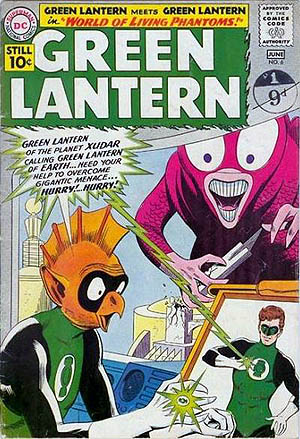
Taika Waititi as Tom Kalmaku was great. I was wondering how or if the film was going to include Hal's best friend "Pieface." OK, Tom was introduced in 1960 when (white) people didn't consider it racist to call the Inuit people "Eskimos" or to refer to an Inuit native as "Pieface." Pie, uh...Tom was originally Hal's aircraft mechanic at Ferris Aircraft and Hal's best friend (on earth) but he got an upgrade to best friend and engineer. In the silver age GL comics, Tom actually chronicled Hal's adventures (that book would be worth a lot of money) not unlike Dr. Watson's role relative to the adventures of Sherlock Holmes. Sometimes, the reader is treated to a GL adventure from Tom's POV.

In the film, Tom is a fun and smart engineer who can readily out think Hal but who still makes for a good "wingman" and reminder of just what an irresponsible jerk Hal can be sometimes.

Peter Sarsgaard in the role of Hector Hammond pre-transformation. He was brilliant, quirky, but likable and approachable. In spite of his intelligence, he was vulnerable and always living in the shadow of his powerful Senator father. If "Daddy Dearest" had just left him alone and kept him out of the investigation into Abin Sur and his spaceship, Hector would have gotten along just fine. It kind of ruinned it when the Parallax fear energy started infecting him, resulting in him murdering his own father (the guy was a douche, but not worth an execution by fire douche) and committing other heinous crimes including turning the earth over to a superpowerful alien (the aforementioned Parallex) for destruction.

Blake Lively as Carol Ferris. I thought she struck the right balance between corporate responsibility and human vulnerability, the heir apparent of the Ferris Aircraft "empire." She could be a little too "dippy" at times, especially for a woman who knows how to handle all of that responsibility, but in the end, she managed to keep her head long enough to save Hal from Parallex's clutches so he could retrieve his ring and save the day.

I was a little disappointed that the writers made her a test pilot and a corporate executive, not because I have anything against women being test pilots, but Carol was always the yang to Hal's yin, the level headed responsible person to Hal's irresponsible adventurer. Putting them both in high performance aircraft and literally making her Hal's wingman crossed the line and disrupted the balance between their characters. Carol and Hal shouldn't be on the same playing field.

I'm glad the movie maintained Hal's family including his brothers and nephew. The silver age GL comics always made a point to show Hal and his brothers together, each one having their own skill sets and all of them being highly competitive as brothers. It humanized Hal for the readers in a way the "only children" heroes of the 1960s (Superman, Batman, Flash, and so on) never did. In real life, most of us have some sort of family.

The scene between Hal and his young nephew Jason was one of the better ones in the film. Hal, the fun, favorite uncle, who screwed up and almost got himself killed, freaking out young Jason, not unlike how Hal felt the day he watched his father die as a test pilot in an experimental jet.

The portrayals of Sinestro (Mark Strong), Tomar-Re (Geoffrey Rush), and Kilowog (Michael Clarke Duncan) were great. Although the dedication and heroism of Sinestro was an especially strong presence in the film (foreshadowing Sinestro's fall from grace later on), Rush's Tomar-Re was my favorite among the "alien" GL's. As a kid, Tomar-Re was my favorite GL after Hal. He was Hal's best friend in the Corps in the silver age comics. Although the DC writers may not have intended it, the friendship between Hal Jordan and Tomar-Re showed that no matter how different, how alien two intelligent, compassionate beings can be, it's the desire to do good and to uphold justice that beings us together. Fitting that their relationship should have started during the early civil rights era.

In the film, Rush lends a calmness and warmth to Tomar-Re's voice. You can trust him. He's a little bemused at Hal pretty much all the time, but it's like a father relating to a young child who knows one day that child will grow to far surpass him. Tomar-Re is the kind of friend (and father figure) who would give a son just the right amount of encouragement and the time it takes for Hal to grow up.

What didn't I like. 

Everything else.

From the first few moments of the film and the opening narration, I could tell I was going to be disappointed. It was like reading a comic book and not a particularly well written one. The opening just screamed at me: "Don't take this film seriously." In relation to the Dark Knight Trilogy and the soon to be released film Man of Steel (the trailers look fabulous), Green Lantern was nothing to write home about.

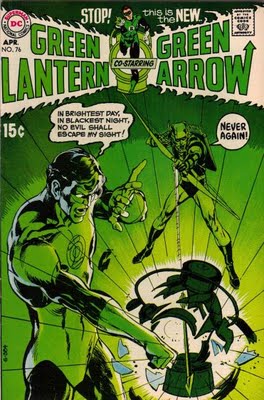
I think Ryan Reynolds was well cast to play the version of Hal Jordan the writers created, but he wasn't the Hal Jordan. In the original comic books, Hal already had the heart of a warrior and a hero. He had the personality of a policeman, albeit a somewhat rigid one. Right and wrong were polar opposites and in his heart, he always knew the difference, a fact that writer Dennis O'Neal used to good advantage when he and artist Neal Adams created the now legendary story No Evil Shall Escape My Sight (Green Lantern #76 - 1970).

Of course "perfect" heroes, such as DC tended to create in the 1950s and 60s don't make good movie characters because they have no room to grow. But having grown up loving the Hal Jordan Green Lantern and wishing for a really good film version of my favorite DC hero, I just didn't "feel it" watching Reynolds play Hal on the screen.

Frankly, I think the film's approach was all wrong. I'd never have introduced the "outer space" aspects of what it is to be a Green Lantern and certainly wouldn't have introduced the Corps and the Guardians so early in the game.

Hal had virtually no time to come to terms with the ring and the lantern before being whisked away to Oa, and even then, his training was about fifteen minutes long before Hal "quit," took the power ring, and with his tail tucked between his legs, scurried back to earth.

In the early silver age comics, Hal didn't know anything about the Corps. He periodically got "orders" from the lantern about specific "assignments" but he didn't know where they came from or what they meant beyond the immediate mission. I would have liked to have seen Hal trying to deal with the ring and the lantern more on his own first, discovering himself as a hero but only beginning to get a glimpse at the true implications of wielding that kind of power.

The writers could have even introduced a sort of "symbiotic" relationship between Hal and the ring, as if they both had something to give each other, the ring giving Hal power and Hal giving the ring the means to use it for good.

In spite of the fact that Hal was given a virtually overwhelming villain to defeat and the task of protecting the planet earth, I just didn't get any sort of personal angst or anguish...something to really overcome. Sure, Hector Hammond captured Carol and threatened to infect her with the Parallax energy, but I was really hoping Hal would have been able to face something even more personal (or maybe it was just the writing and the performances that didn't convey what I was looking for).

I recall in the issue 34 (1966) Green Lantern story "End of a Gladiator," Hal learned about the ring's "mortality fail safe." An emergency store of energy that's available, even when the ring's energy charge is exhausted, that can save a Green Lantern's life, even when the ring wielder is unconscious. During a battle between GL and one of his foes, Tom is mortally wounded. The villain tricked Green Lantern into thinking he had recently charged his ring, but in fact, it was an illusion and at the height of the battle, Hal's ring runs out of power. On the one hand, Hal is about to be shot. If he does nothing, the ring's emergency reserve will save his life. On the other hand, Tom is seconds from death. Hal does the impossible and orders the ring to use the emergency reserve to save Tom's life. Tom lives, but Hal is shot and presumed dead (a highly unusual set of circumstances results in his being revived).

It's that kind of conflict that would have made the climax of the film. The stakes didn't have to be a world, just the struggle for discovery of how heroic, how courageous, how honest Green Lantern member Hal Jordan could be.

In spite of all the special effects, the best efforts of the actors involved, and the decades of source material to be drawn from, Green Lantern the legendary hero of my childhood never materialized on the screen in 2011. It was just another movie.

With the potential for a DC Universe set of films culminating in one or more JLA movies in the future, I'm hoping for a Green Lantern reboot. Let's do it better next time.

Friday, June 7, 2013

Batman: Year One (2011) A DVD Review

Two men come to Gotham City: Bruce Wayne after years abroad feeding his lifelong obsession for justice and Jim Gordon after being too honest a cop with the wrong people elsewhere. After learning painful lessons about the city's corruption on its streets and police department respectively, this pair learn how to fight back their own way. With that, Gotham's evildoers from top to bottom are terrorized by the mysterious Batman and the equally heroic Gordon is assigned to catch him by comrades who both hate and fear him themselves. In the ensuing manhunt, both find much in common as the seeds of an unexpected friendship are laid with additional friends and rivals helping to start the legend.

-Written by Kenneth Chisholm

That a summary of the video Batman: Year One (2011) which I saw on DVD a couple of weeks ago. I saw and subsequently reviewed the 1989 Keaton/Nicholson Batman film on the same weekend, but I couldn't summon whatever I needed to write my "Year One" review at the same time.

Maybe that's because the video reminded me so much of the Batman: Year One graphic novel (2007 -- originally published February through May 1987 in the regular Batman comic book series) by Frank Miller and David Mazzucchelli. The graphic novel gained rave reviews if you can believe Amazon (and most people do), and I remember the work favorably as well. Why do I feel so "cold" about the video based off the graphic novel?

Maybe because it was so similar to its 136 page source. I mean, having read the graphic novel, why did I need to see the 64 minute video?

Don't we want films made from books to be true to their source? Well, yes and no. If I were talking about a text-only novel, there'd be no visual component except what was generated in my head as I was reading. With a graphic novel, you get words and pictures. With an animated video you get spoken words and moving pictures, but it (in this case) looks pretty much the same.

It was as if the makers of the animated film said, "Let's make the graphic novel story again but make it move." In other words, I didn't learn anything new or have much of a different experience than when I read the graphic novel a few years ago. Any film should be more than just a moving, talking version of its source. I want to have a different experience, related enough to the original to recognize it, but different enough to be worth my while.

If I had a choice, I'd probably just read the comic book version again because print typically includes more story detail that's cut for time in a film presentation.

This isn't to say that I didn't enjoy the animated film. It was watchable and entertaining. I could certainly see the portions that linked into Batman Begins (2005), such as Batman "calling for backup."

You see the less than honorable side of a relatively young Jim Gordon, cheating on his pregnant wife, struggling to rise above his failures, fighting criminals with almost the same darkness as Batman. You see a young Bruce Wayne donning the mantle of the Bat for the first time, making rookie mistakes that almost get him killed, nearly killing the legend along with him. You see a different "Catwoman" with a (apparently) lesbian twist (it's only hinted at, but you get that vibe).

If you've never read the graphic novel or the original series of comic books, you'll enjoy the film. If you've read the graphic novel, seeing the film will be like deja vu. It's that simple.

If I watch Batman animated films, I'll try to pick those that don't follow the print material so closely. I want to be surprised as the story unfolds in front of my eyes.

Monday, January 7, 2013

DVD Review: V for Vendetta

Last November, I reviewed the V for Vendetta graphic novel. I was generally impressed, but a lot of "dystopia" material came out of the latter half of the 20th century, so by the time I got around to reading Moore and Lloyd's work, I found it hard to be overly impressed. Also, the length of the story and the numerous elements introduced made it difficult to follow at times. That figures prominently into my review of the film V for Vendetta (2005).

First of all, who wouldn't be excited to watch a film starring Hugo Weaving (as "V"), Natalie Portman (as "Evey") and particularly John Hurt (as "Adam Sutler")? I was really looking forward to the experience but at the same time, worried because films almost never do justice to their original print or graphic novel source. This time, I'm not so sure the rule holds.

I mentioned before that I believe Moore was a bit too lengthy in his writing of the graphic novel. It made it difficult for me as the reader to be able to grasp and hold all of the various threads he introduced and have them all come together in a cohesive manner by the last page. As a film where everything had to be introduced, expressed, and resolved in 132 minutes (the film's running time), brevity and economy was forced upon the story, making the movie version of "V for Vendetta" quite a bit more efficient than the print version. Of course, part of the motivation behind cutting down the length was to accommodate modern audiences, both in how long they can tolerate sitting on their bum in a movie theatre, and in appealing to a wider population than might be attracted to Moore and Lloyd's production.

Any film or other creative work is not only a product of the artists involved but of the point in history in which it was made. The graphic novel was written over a period of years in the 1980s while the film version was released in 2005. While the span of two decades didn't overly affect the content of the film compared to the graphic novel (although the film "tightened things up" quite a bit, it was still pretty faithful to its source), the world in the film wasn't quite as dark and depressing as the graphic novel.

It made "V" somewhat less "scary" in the film and it allowed for the police, and particularly Chief Inspector Finch (played by Stephen Rea) to actually portray "good guys" rather than government stooges, wife beaters, and homicidal maniacs.

There were weak spots. I thought it was a little too convenient for Creedy to be able to deliver Adam Sutler, the dictator of the UK in the film, to "V" more or less on command. Someone like Sutler would have had multiple layers of protection and I can't believe someone as paranoid as Sutler would have allowed himself to be put in a position not only to be captured, but spirited away from his stronghold to an underground train station just to be shot in the head.

I understand that "aging" Evey was probably necessary, but in the graphic novel she was 15 years old. Making her an adult took away some of her vulnerability and the "transference" of her dependence to "V" as a father figure after the assassination of her parents (this dynamic is shifted into a "beauty and the beast" type of love story). Yes, I previously acknowledged Portman's star power and audience attraction, and comprehend why she would have been cast as Evey, but it made especially the scene where she had to dress up as a little girl to be used as bait to set up pedophile Bishop Lilliman a little ridiculous.

Not everyone is good at accents. When I first saw Bob Hoskins in the role of Private Detective Eddie Valiant in the film Who Framed Roger Rabbit? (1988), it never occurred to me that Hoskins wasn't an American. In fact, if someone had suggested to me back then that Hoskins was British, I would have bet any amount of money against the possibility...

...and I would have lost my shirt. The guy played the drunken, down-and-out, "cheap detective," brilliantly.

Which brings me back to Natalie Portman who is also a brilliant actress and an asset to this film...but her British accent was awful. First of all, even when she was able to maintain the accent for more than a minute or two, I just knew by listening to her that she wasn't British. Then too was her inability to maintain the accent consistently throughout the film. More often than not, she spoke her lines just like Natalie Portman would have spoken her lines in a dozen other films where she wasn't expected to pretend that she was a native of the UK. Frankly, if the accent was such a problem, Portman should have just ditched it. The story writers could have created a line or two of dialogue explaining her American accent or just ignored it completely and let the story tell itself. After all, who even cares about Arnold Schwarzenegger's accent, regardless of what role he's playing? For the purposes of this movie, Portman's usual speaking voice would have been fine.

I didn't like the ending, but I understood it was the sort of populist stuff the film makers thought the audience would want. In the end, "V" dies, but in the graphic novel, no one realizes this since Evey takes over his role, mask and all. At the end of the film, Evey never dons the mask and even partners up with Finch! At the end, all of the "rioting" citizens take off their masks, revealing ordinary human faces (even the people who had died in the film were in the crowd). I'm surprised that all of London didn't break out into a chorus of We Are the World.

No mass shootings. No atrocities at the film's climax (plenty of them during the film, however). The soldiers, lacking their dictator and his number one henchman to guide them (they're both dead, victims of "V" by this point in the movie), they stand down and just let the crowd sort of wash over them. We know from the much more tame Occupy Wall Street movement that when police and soldiers are confronted with an advancing mob of thousands or tens of thousands, all wearing Guy Fawkes masks, who have an uncertain intent, people end up getting gassed, beaten, arrested, detained, restrained, and shot. Something like that should have happened here, but it wouldn't have been the happy ending the audience wanted to see (or the happy ending the film makers thought the audience wanted to see).

And who was going to be the new leader?

I know what the film was trying to say. It was trying to say that "the people" would run their own lives. However, history shows us that in any revolution (from the American revolution in the U.S. to the Communist revolution in Cuba), the revolutionaries create a temporary state of anarchy when they overthrow the corrupt government, but then the revolutionaries form the basis of the new government. Even if that government is supposed to be by and for the people, eventually, it will take on a life of its own, establish its own priorities, and enforce its own existence.

At the end of the graphic novel, just as in the film, "V" realizes that he isn't the one to be part of rebuilding the nation. He is perfect for introducing anarchy, but rage, hate, and revenge aren't a good platform upon which to build the people's utopia. That's where Evey comes in. But in the novel, she dons the mask, the hat, and the cape and she becomes "V". No one knows the difference but she's a different "V", one who has the capacity for love, tenderness, and hope. Everyone was looking to "V" for the future once he ended the corruption of the past. If Evey doesn't fill the void, then who will?

Beyond the film and the graphic novel (and the Occupy movement for that matter), there is no sustainable "happy ending." After the ending credits roll, in real life, real people will still live on and people tend to form systems, from family systems to governmental systems. That might not make a good movie, but not addressing that reality made the "conclusions" of the stories for "V for Vendetta" ring hollow.


All that said, the film is a worthwhile watch. Given the events occurring in the world today, revolution is hard not to think about. "V for Vendetta" speaks to those thoughts and feelings, so I can understand the popularity of this film. It is well written and except for what I've already mentioned, well acted. I'm glad that I saw the film and read the graphic novel. I just don't believe it would have all ended so well.

Tuesday, December 25, 2012

DVD Review: Smallville Season 1, The Pilot

Somebody, save me. No, not really. I was in the public library the other day looking at the DVDs and saw that the Smallville season 1 collection was available. That's kind of unusual. Almost none of the Smallville DVDs are on the shelves for very long and in fact, season 1 was the only season of Smallville there. On a whim, and because I have only seen each season once, I decided to check out the first season of Smallville from the library. Figured it would be entertaining holiday fare, since I took a few days off for Christmas.

I remember the first time I saw the pilot episode. I had no idea what to expect. Well, scratch that. I had an idea of what to expect. I was just wrong. For one thing, I didn't expect a meteor shower of kryptonite. I didn't expect Lana's parents to be blown to bits. And who the heck is Aunt Nell?

I thought casting John Schneider and Annette O'Toole as Jonathan and Martha Kent was brilliant but unexpected (a young Ma and Pa Kent). I didn't realize just how much of a divergent trajectory Smallville would take from previous Superman canon. Actually, I wouldn't realize that for quite some time and eventually, it would get to be a real problem, but in the pilot episode, it worked out well.

Smallville has always been an uneven series. Some episodes just rocked while others were total dogs. So far, I'm about halfway through the first season and some of them are just ridiculous. It's amazing how kryptonite gives individual "meteor freaks" abilities that go so well with their personalities and personal problems (a fat girl who suddenly loses weight but has to eat a ton of fat to keep from starving?).

In the pilot, Clark already has powers but they're not fully developed. This was a real boon, since the audience can experience Clark's evolution toward becoming Superman along with him, which is the point of the series. He's fast, he's strong, he's durable, but that's about all he's got in the pilot. Oh, and he's very charming in a shy sort of way. Having achieved his abilities slowly and having been raised by parents who are caring and strong, Clark has been given the perfect platform for not abusing what he's got while at the same time, struggling to be popular in high school like any other 15 year old boy (I had some trouble picturing Welling and a number of the other "students" as that young, though).

Nobody knows what kryptonite is. They do know about meteor rock, but only Chloe suspects that the stuff has anything to do with the weirdness that's been happening in and around Smallville for the past twelve years or so. Meteor freaks would be the main catalyst in the first season, providing Clark with most of the foes he would battle. Most of them aren't bad people, just human beings whose bodies have been involuntarily changed and mutated by radiation exposure. The annoying thing about these freaks though is how they just disappear after Clark beats them. Sure, some die, but others are just (supposedly) taken away by the authorities. I think that's explained in subsequent seasons, but never entirely to my satisfaction.

These are super-powered metahumans, many who know that Clark is "special" himself. No one ever tells the cops, "Oh, by the way, the kid who stopped me has a punch like a crashing jet plane and can move about as fast?"

Lex Luthor.

More than any other character in the pilot and first season, he stands out as the somewhat dangerous but loyal big brother Clark never had. While driven by his own conflicts with his father Lionel (wonderfully played by John Glover), Lex is positively affected, not just by having Clark save his life, but by who Clark is. For most of Lex's life, he's been influenced by people who were primarily interested in power and manipulating others. Clark, super powers or no, is a truly transparent (except for his secrets), authentic human being (well, he looks human) who doesn't want anything from Lex except just to be friends.

Lex does everything he can do to help Clark and his family, though his methods definitely come from the "dark side" of being a Luthor, his intentions at this point are good. Lex's behavior shows us that he loves his friends (and as far as we know, Clark is his only friend) and hates his enemies. He's a great guy to have in your corner, but never, ever cross him or he'll find a way to get you.

Chloe Sullivan.

I hadn't realized just how annoying she was in the beginning. She's bitchy, and cranky, and sarcastic, and geez, would somebody shut her up. Quick to judge, slow to forgive, opinionated, and kind of full of herself. In some ways, she's like Lex in that she doesn't care who she hurts to get what she wants, which in her case, is the next "wall of weird" story. Unlike Lex, she's not calculating about it and in fact, she is rather careless, pursuing the goal without seeing the consequences. She matures as the show continues, but as I recall, by the series ending, she was still a little cold-hearted and goal driven.

In the beginning, she's a bright but unpopular person. Her hair always looks like a small explosion has scattered it at odd angles. She's the ugly duckling who is jealous of Clark's attention to Lana's beautiful swan. At one point in the first season, she calls the school paper her identity and in another episode, she refers to her laptop as her life. At age 15, Chloe is only as good and as interesting as what she writes about, which is probably why she goes after the unusual stories, rather than sticking to typical school activities. She's a proto-Lois Lane and is displaced by Lois in season four and afterward, which is why she has to develop other skill sets to stay interesting as a character. But in season 1, the writers of Smallville seemed to think Clark needed to play off of a Lois-type character from the very beginning.

Lana Lang.

Cute. Not as superficial as she seems for a cheerleader. Like most kids, she's trying to find out who she is and where she's going, which is another big point of the first season, since that's Clark's quest in spades. Having her parents die in the meteor shower when she was three mirrors Clark's own mystery, not having known his birth parents at all or even what planet they were from. Lana at least has Nell to fill in the blanks, along with pictures, diaries, and other documentation. Clark has a spaceship that, as of the middle of the first season, he's seen only once (as the series progresses, we get to see tons and tons of Kryptonian stuff and people and it finally gets rather oppressive how much we learn about a planet that blew up a long time ago). And of course, Lana has to wear that pesky little kryptonite necklace which disappears at odd times allowing her and Clark to actually have a conversation while standing closer than five feet apart. By the middle of season 1, Clark is weaning her from wearing it, which makes developing a friendship that includes more than phone calls and email easier to film.

Whitney Fordman.

He's not as big a pain as I remember him. Most of the time, he's actually a nice guy, for a jock with limited internal resources. He's authentically devoted to Lana, insecure enough to be jealous of Clark, worried about his future, and struggling with his father's heart disease (something Clark will have to deal with in his own Dad as time goes on). He's actually an OK guy and I can see why Lana likes him. On the other hand, Lana is smart enough to outgrow Whitney in a few years which is why it's a good thing he's eventually killed off. Oh, and that makes room for Clark to move in and hook up with her...until Lois shows up by season four.

Pete Ross.

Every guy needs a buddy and Pete is Clark's. Besides Lana and Clark's parents, Pete is one of the few people that comes from the silver age comic books. Of course, back in the 1960s, Pete is tall and blond and white...kind of like how Whitney looks. Of course, this is the early 21st century and in real life, even Smallville has a diverse population. I also didn't realize how well actor Sam Jones III was built. We expect the occasional beefcake shot of Clark in the boys locker room, but I noted Pete looking really buff himself.

Truth be told, Pete is really Chloe's buddy more than Clark's. In the pilot, Pete and Chloe bet whether or not Clark makes it to the bus stop in time to get his ride to school, and again whether or not Clark will stumble and act like a buffoon when he gets anywhere near Lana. Chloe and Pete are most often the two people you see actually working on stories for the Torch (Smallville High's school paper) and just as friends, they go to the homecoming dance together (neither being popular enough to score their own dates). Pete joins the football team to increase his popularity, which is natural, but you never get an impression that he's there to do much more than back up Clark and Chloe.

Relationships.

The whole "shipper" emphasis of Smallville wasn't in full swing in season 1 since the audience is still trying to figure out who people are supposed to be. We do see the beginnings, though. Whitney and Lana are dating, but Clark is totally pining for Lana. Somewhere inside, Lana realizes this but it doesn't come to fruition this early in the game. Lex, for his part, sees all this and repeatedly tries to set up situations where Clark and Lana are together. Chloe has a "thing" for Clark, but it's not so overpowering that she doesn't have interests in another guy (such as womanizing student Sean Kelvin, played by Michael Coristine in the episode Cool). Eventually, this will develop into a "shipper" issue of Clark/Lana vs. Clark/Chloe, but we aren't there yet.

And thankfully, that's all of the "shipper" drama we get to see in season 1. At this point, there's still a strong teenage angst thread running through the series, which I'm sure is present to satisfy the demands of its target audience, but for me, Smallville season 1 is mainly about watching Clark discover who he is as the future "Man of Steel."

Conclusion.

I particularly like the pilot episode of Smallville and a number of developments in Clark as a person and a "superhero" in season 1. It's "good clean fun," so to speak. I'm even thinking of getting season 2 after I'm done with this set of disks.

Saturday, November 17, 2012

DVD Review: The Amazing Spider-Man

I suppose it was OK. The odd thing about The Amazing Spider-Man (2012) is that I neither really liked it or disliked it.

OK, I liked it. The film was watchable and entertaining. I enjoyed it and would watch it again, but it wasn't "amazing" or "spectacular" or anything like that. It was just another superhero movie. It had its good points and its flaws.

Warning! Warning! Major spoilers ahead. If you're like me and waited for this film to come out in DVD before watching it (and you haven't watched it yet), I will give away a ton of secrets in my review. You have been warned.

I like that there was a mystery. So many superheroes get their powers by accident and I guess Peter did in this film too, but not quite by accident. In a way, his father created him.

When Peter Parker is four-years old, his parents suffer a home break-in. Someone specifically was looking for something in his Dad's office. Fortunately, Richard Parker hid the really secret stuff in a false bottom of his desk drawer (a trick older than Stan Lee, but the thieves still didn't tumble to it). Pawning little Peter off on his Uncle Ben and Aunt May, Richard and Mary Parker disappear into the night, never to be seen again. Later, Peter learns they died in a plane crash, but no one ever talks about it.

Richard Parker's work had something to do with cross-species genetics...and spiders.

It's interesting that teenage Peter Parker was interested in photography before becoming Spider-Man. In the original, silver age version, he started taking news photos as a way to support himself and Aunt May after his uncle's death. I found it particularly confusing though, when Peter webbed his camera to a wall to take shots of Spider-Man's battle with the Lizard, that the film had never established why he did it in the first place. In this movie, he is never shown to have a relationship with the Daily Bugle or making plans to sell his photos to them or anyone else.

But I'm getting ahead of myself.

Andrew Garfield did a very good job playing the geeky, socially awkward (to put it mildly) teenage Peter Parker. Of course, the audience has to get past the fact that all of the actors depicting high school students are really twenty-somethings, but we should be used to that by now. In fact, Garfield's Parker is so awkward, I found it amazing that the beautiful and quite articulate Gwen Stacy (Emma Stone) ever found him attractive in the first place. Sure, Peter had just heroically tried to save some kid from being bullied by "Flash" Thompson (Chris Zylka) and gotten pounded into the pavement for his troubles, but that should have just made him look like a loser to most high school girls.

In some ways, I was more interested in Garfield's Parker than in his Spider-Man. It was very easy to see how Peter, abandoned by his parents over a decade before, was an alienated, malcontented, loner sitting on a lot of rage. He wasn't the "nice kid" that Parker was originally created to be by Lee and Ditko 50 years ago. Yeah, Garfield's Parker will stand up for the underdog, but that's because he is the underdog, not because he's intrinsically a nice guy. After all, at various points in the film, he blows off both his aunt and uncle, humiliates Flash Thompson just because he can, and even ends up on the school principle's "bad boy" list (although performing community service isn't such a "bad boy").

So you take all of that and give it "spider powers." What happens?

Oh, but wait. The mystery.

A water leak in the Parker home's basement leads Peter to discover his father's old briefcase that had been left to gather dust in some forgotten corner. Infinitely curious and desperate to know more about what happened to his parents, he examines the filthy old thing and, perhaps remembering the false bottom of his Dad's desk drawer, discovers a hidden pocket with a "secret formula." He also discovers a photo of Curt Connors (Rhys Ifans), his Dad's former lab partner at Oscorp, and he aims himself in that direction to try and learn more.

By amazing coincidence, the day Peter goes to visit Connors at Oscorp, Connors is supposed to be lecturing new interns who are being taken on a tour of the place by (another amazing coincidence) head intern Gwen Stacy. Peter takes another kid's pass to get in (getting that kid subsequently thrown out) and gets his first look at Connors...and impressing Connors with his knowledge of cross-species genetics. It's the first time that the audience sees Peter has a brain built for science. It's never mentioned before this, and Peter might just have been another angry high school kid for the first thirty minutes of the film.

Speaking of amazing coincidences, Peter just happens to run into (literally) Norman Osborne's top henchman Rajit Ratha (Irrfan Khan) and sees that the folder Ratha is carrying contains the same "secret formula" symbols that Pete found in his Dad's briefcase.

Even though Peter has a stolen intern pass and has left the rest of the intern tour, no one seems to question him as he follows Ratha through the corridors of a private corporate building with lots of trade secrets and watches him manipulate a touch pad to open a door to some secret room. Two guys come out and go with Ratha but for whatever reason, Peter decides to stop following Ratha and to get into that room.

I must say that it was lousy security that let Peter gain access. No smartcard, retina scan, or voice recognition software was required to open the door, just a series of finger movements across the pad, which Peter saw briefly and remembered. And what was in that room? Just a bunch of spiders on webs inside some sort of machine. Naturally, Peter decides to touch and spiders fall all over him. He manages to get out of the room again without setting off any alarms but takes an eight-legged hitchhiker with him, which manages to "put the bite" on Peter's neck right before Gwen catches him and kicks him out of the building.

I should mention at this point that Connors later tells Peter that no animal subject of cross-species genetic experiments has survived, yet, once bitten, Peter seems to do OK. (Should I mention that Peter actually gives Connors the secret of his father's formula at their first one-on-one meeting, making the Lizard possible?) But then, Connors also tells Peter that it was his father's breakthrough with the spiders over ten years ago, that enabled the project to survive. Maybe that's why there was a special room with spiders. They were the only ones who could pass on their genetic traits to another species without killing that species. But why were Richard Parker's spiders (or more likely their descendants) still around at Oscorp and if they were such a breakthrough (even if Parker Sr. took all his research with him when he disappeared ... apart from one briefcase), why in over a decade, were no experiments done with those spiders that would have ultimately created another Spider-Man?

The spiders were there for Peter to get spider powers, then that was that. Bad writing.

The film spends a lot of time showing us how Peter develops his powers. He doesn't immediately decide to become a hero or an entertainer or anything else. The fact that he gained new abilities is cool and a terrific clue as to what his father and Connors were up to, but he didn't decide to do anything with them at all (except mercilessly tease Flash Thompson and shatter a basketball backboard) until his Uncle Ben is killed.

And yes, Peter could have stopped the killer and no he didn't and yes, it pisses him off.

But he doesn't become a hero yet, he just becomes a guy looking for revenge. Ironically, he never finds it. He busts a bunch of guys who kind of look like the murderer, but he never finds the actually guy. Maybe the shooter blows town after he blows away Uncle Ben, but we never find out.

In the process of refining his vigilante role, Peter first develops a crude mask and finally the entire costume. Smart as he is, he can't actually create a "spider web formula" as in the original comics, but he "borrows" some from Oscorp after becoming chummy with Curt Connors.

Which brings up the question of what happens when Peter runs out of his supply? The only place he can get more is Oscorp. Once Connors is put away at the end of the film, his only other way in is his girlfriend. Sure, he invents the shooters, but he has no ability to independently create more webbing.

It's little details like this that kind of bugged me (yeah, that's a bad pun).

Peter finally becomes a hero, not while fighting a bad guy, but by rescuing a bunch of people who the Lizard endangers by throwing their cars off a bridge. Peter's webbing is strong enough to suspend the cards from the bridge, but he only rescues one kid from one car. I have no idea how the kid got stuck in the car when his Dad made it out just fine. I have no idea why Peter didn't rescue anyone else from any of the other cars (and if they were all empty, why did he stop them from falling into the water in the first place?).

But in saving the little kid and seeing the father's gratitude, he gives himself a name and a more noble purpose.

Gwen's father Police Captain George Stacy (Denis Leary) was a jerk for most of the film but he was supposed to be. Peter's dinner with the Stacy family was a total disaster, but what teenage boy hasn't been humiliated by his girlfriend's father at one point or another. It was kind of cool to see the face of "Diego" (Ice Age films), though.

And how the heck doesn't Aunt May know Peter is Spider-Man? Her first clue is right after she and Peter watch Captain Stacy issue a warrant for Spider-Man's arrest during a TV press conference, Peter storms out of the house. May looks at him like, "what they heck is that all about." Later, when Peter comes home all banged up after his last battle with the Lizard, she looks at him, doesn't ask why he looks like he went ten rounds in the ring with Mike Tyson, and just hugs him. I tell you, that woman was smart enough to put it all together. She has to know.

By the way, I really liked Martin Sheen's Uncle Ben, especially when he's teasing Peter in front of Gwen and calls himself Peter's probation officer. Everyone needs an uncle like that. I was also pleased that Sally Field's Aunt May wasn't constantly at death's door. In the Lee/Ditko version (and later), May always has one foot in the grave and the other on ice-coated Teflon. At least this Aunt May is a fighter (although I get the impression she's a lousy cook).

Another thing I liked was that Flash wasn't just a two-dimensional bully. After Uncle Ben dies (and everyone at school knows), Flash tries to make amends. Sure, Peter picks him up and slams him against some lockers, but everyone, including Flash, understands why Peter's so angry and hurt. Just a nice little bit of realism.

Another nice bit of realism was Gwen confessing to Peter how afraid she was growing up, watching her Dad leave for work as a police officer each day, and wondering if he'd ever come home that night. How could she stand being with Peter if he insisted on being Spider-Man and going after the Lizard?

This is a nice echo (though the filmmakers probably didn't intend it as such) to Betty Brant, Peter's first girlfriend in the Lee/Ditko comics. They eventually break up because Peter's job as a freelance crime photographer (Betty never finds out Peter is Spider-Man) is so dangerous. Her brother was also some sort of thrill seeker and was ultimately killed because of it (actually, he was in deep with some thugs and couldn't pay them back the money he took and they killed him). Peter finally left Betty because he knew she'd leave him if she ever found out what he really did every night.

Why did Peter put "Property of Peter Parker" on his camera? Who does that? It was a lame way for the Lizard to find out Spider-Man's secret identity.

Connors survives the film, saves Peter's life in the end (after killing George Stacy) and goes to jail. I'd love to see his defense attorney's strategy. Technically, Connors was under the influence of a mind and body altering substance when he committed his crimes, so can the court really convict Curt Connors for what he did when he was the Lizard? Well, probably, since Connors injected himself with that stuff in an attempt to regain his lost arm. If a junkie shoots up and is high when he kills someone, he's still libel for the murder after he stops being high.

Promises you can't keep are the best kind. OK, it would have been a lousy promise to try and keep, and I don't really remember Peter agreeing to stay away from Gwen as her dying father's last request, but Peter just plain blew off the seriousness of a father's genuine love for his daughter and desire to protect her.

Lots of little interesting developments. Stuff for the future. Supposedly Ratha was pressuring Connors to begin human trails on cross-species genetics because Norman Osborne (owner of Oscorp and usually the Green Goblin) is dying...but we get no details on what's killing him and how the Connors experiments are supposed to help.

Does Peter ever go after the guy who killed his uncle again?

If Aunt May knows Peter is Spider-Man, what will she do about?

It's strongly implied that the plane crash that killed Peter's parents was no accident and that it was arranged because Richard Parker refused to start human trails on his formula. Connors is alive at the end of the film and has this knowledge, but will he ever tell Peter? If Peter finds out, what will he do, go after Norman Osborne? If Osborne wanted the secret of Parker's cross-species formula, why kill him? Why not kidnap his wife and son and hold them hostage (or some other equally evil plot) and force Parker to give up the formula?

And if Osborne wants human trials to begin now because he's dying, was he dying ten years ago when Parker also refused to perform human experiments, or was there another reason (like lots and lots of money)?

I understand that The Amazing Spider-Man 2 is in pre-production and scheduled for release sometime in 2014.

Maybe we'll find out some answers then, and get a look at Mary Jane Watson...and maybe Electro.